Showing posts with label Food. Show all posts

Saturday, March 07, 2020

One day in Wuhan (武汉)

Yellow Crane Tower, Wuhan
I've been struggling a bit with this post.  Just over a month after I had visited the city, news started emerging of a number of unusual pneumonia cases emerging.  Yes, I visited China and went to Wuhan in mid-November, as the start of my cruise through the magnificent Three Gorges of China.    And at end December, China would officially report the news that a new disease, what would become known as COVID-19, had struck the city.

In the end, I've decided to proceed.  I'm not trivialising the seriousness of the disease which has (to date) struck tens of thousands, and killed significant numbers as well, both in China and around the world.  But I think that others deserve to know that this is still a lovely city visit, particularly in November, and that the area has indeed so much to offer tourists. And so, I will proceed to recount my visit there.

Mine was not a long visit - just around a week.  After arriving late the previous night, we spent a full day in Wuhan, then took the train to Yichang the next morning where we boarded the Century Legend which took us down the Yangtze River, to Chongqing City. So, if you ever want a one-day leisurely itinerary for Wuhan, do read on.  But if you have a longer stay, you may want to read more here.

One aspect of life in China which we wanted to experience was its "cashless society", where all the hawkers had their own QR code for WeChat Pay or AliPay.  Just a few weeks before our departure, these two ubiquitous payment apps had extended their services to foreign tourists.  In the event, it was not possible to use WeChat Pay but fortunately the AliPay payment service was quite easy to figure out and we could use it to also pay taxi drivers, and to link up AliPay to DiDi (the Uber of China), so we could also hail and pay our taxi drivers via DiDi.

Re Gan Mian and Lotus Root Soup
We used DiDi for the first time when taking the taxi for our breakfast in Hubu Alley, the famed street food alley of Wuhan.  I have to admit though, that by the time we made it there, it was really more like our brunch.  We had a bowl each of Re Gan Mian (热干面), which literally translates into spicy dry noodle dish.  The sauce is served on top of the noodles, with a sprinkling of spring onions on top.  I also got some minced pork with mine.  We had this with lotus root and pork bone soup, and a serving of "Dou Pi" which came a little later.  Dou Pi is essentially rice wrapped in layers of egg, with diced beancurd and I think more minced pork within.  It was all quite tasty but the next day we walked around the corner from our hotel and found a number of little eating stalls and what we in Singapore would call coffee shops, all full of Wuhan residents eating their breakfast before going to work.  We had quite a quick, tasty meal of chee cheong fun, a prata-like dough pancake and some dumplings, washed down with soya milk.  Much better value for money and much more convenient.

The immortal and the crane over the tower
After our brunch, we made our way to the the Yellow Crane Tower (黄鹤楼), a very famous historical site here in Wuhan.   It's one of the "Four Famous Towers" of China, originally built for military use on the top of a hill where it has a commanding view of the region and the river running through the city.    The building is not the original tower; it has actually been rebuilt a few times but apparently a tower has been on this site ever since around 220AD. 

Entering the tower, we admired this large wall mural just inside.  It tells the story of how the tower originally came to be built.  Briefly, a wine merchant, Xin, gave shelter (and wine) to a visiting monk.  Some tales indicate that the monk was actually an immortal come to earth in disguise!  Anyway, the monk visited repeatedly and every time Xin gave him food and shelter.  To show his gratitude, the monk painted a crane on the merchant's wall.  The painting was animated to show the crane dancing, bringing lots of visitors to the shop.  So Xin grew rich, and as a sign in turn of his gratitude built the tower.  The tower is also immortalised in the classic poetry of China, with the poets Cui Hao and Li Bai both writing about it.  Indeed, Cui Hao's poem is probably particularly apt - it tells how the crane has departed, leaving a city bereft, and the poet left far from his homeland.  I reproduce it here.

The pond in the compound of the Yellow Crane Tower
昔人已乘黄鹤去,此地空余黄鹤楼。
黄鹤一去不复返,白云千载空悠悠。
晴川历历汉阳树,芳草萋萋鹦鹉洲。
日暮乡关何处是?烟波江上使人愁。

After climbing all the way to the top of the tower and admiring the view, we made our way through the compound to the peaceful, scenic Chinese Garden adjacent to it.  The centrepiece of the garden is a large pond, surrounded by weeping willows.   A few fountains gush quietly in the centre.  To one side, a low wall is covered with the carved forms of cranes - flying, walking, and doing all sorts of things.  Following the example of the famous Tang poets, there is also a poetry gallery here, featuring two poems by Chairman Mao, housed in their own pavilion!

A double-sided embroidery screen
We spent quite some time in the Yellow Crane Tower and its surrounding compound, but we had one more stop to make on our 24-hour stopover in Wuhan, in Tan Hua Lin. 

Tan Hua Lin is also part of old Wuhan, but of a much more recent date.  It's like the "western quarter", where all the Europeans stayed.  Here there are a few churches, including a former Canossian convent, and western houses where the various European merchants and traders stayed.

Today, it is full of souvenir shops, art galleries, and embroidery shops.  Wuhan is one of the well known "schools" of embroidery in China (another one is Suzhou, for example).  The embroidery shops show beautiful exemplars of Wuhan embroidery.  These include huge framed pieces - either to hang on the wall or the beautiful double-sided screen which I have shown in the photo on the left.  Each stitch is like a brush stroke, so delicate and precise.  You can also buy small little embroidered bags or table screens.  Embroidery equipment is also on sale - my friend bought herself an embroidery frame, which she dismantled and carried around on her shoulder.  Myself, I was just glad to see that this area also had a few cat cafes!  Sadly we did not have time to make a longer stay in one of them.

We ended the day off with dinner, close to the hotel.  The next day, we would spend travelling - by train to Yichang, where we would then take a coach to the cruise ship which would take us to the next part of our journey, down the Yangtze River, and through the heart of China.

My Three Gorges Flickr album is here.

Monday, May 20, 2019

Sayonara to Kyoto

Yasaka-no-to Pagoda - off Ninen-zaka 
Reflecting on this trip to Kyoto, it was indeed a peaceful and reasonably paced holiday, despite the uncertain beginning.  We experienced different aspects of Kyoto - both the city as well as the surroundings:
  • the old, historical and cultural heart of Kyoto - the Temples of Ginkakuji and Kinkakuji; Nijo Castle, and the meandering around Gion and the geisha district (including the Ninen-zaka and Sannen-zaka pedestrian streets); the Ukiyo-e Museum;
  • the vibrant beat of modern Japanese culture (albeit through the eyes of Yayoi Kusama and the manga artists and Writers)
  • the serenity of the Japanese countryside and village life in Miyama;
  • the charm of two different markets - Nishiki market and the Toji temple flea market.
As always, am ending off with a bit more information about our accommodation and foodie choices.  We stayed in Gion, near where I stayed on my last visit.  Really cosy little place, makes me feel so Japanese!  Let me say it again, I strongly recommend renting an apartment if you are staying any time in Japan.  It gives you much more room, allows you the comfort of having little meals in your own little living room, and there's a washing machine so you don't need to bring too many clothes.

Udon Sanshiki
As for food, my posts on my previous trips are here and here.  I've reached the stage where I'm going back to old favourites, like my favourite conveyor belt sushi at Kyoto station, Sushi no Musashi, and even the yudofu tofu place near Nanzen-ji, Goemon Chaya (again, I wanted to go to the famous restaurant but the wait list was just too long).  So this time round, I will just introduce three new places (plus one dessert surprise)

1.  Udon Sanshiki

This udon restaurant was near our apartment and we went there on the first day because (i) we like udon and (ii) there was a queue in front and like any normal Singaporean we associate queues with good food.  So we stood outside for maybe 10 minutes before they let us in.  We really enjoyed the chewy, smooth udon noodles!  Liked it so much we would come back for dinner on our last night in Kyoto.

2. Hanamakiya

The buckwheat mill in action
This was an unexpected find.  After visiting Kinkakuji we walked back to the main road in the
direction of the bus stop.  Looking down one side road, we saw yet another queue, and upon investigation realised that it was a group waiting for a restaurant to open.   We joined the queue and were thus one of the first few groups to enter, good thing too as it would fill up quickly behind us.  Hanamakiya is a small, unassuming restaurant which serves practically perfect soba (buckwheat noodles).  The soba is made on the premises (you can watch the buckwheat mill in operation).

I ate the Nishin soba, which is soba (buckwheat) noodles in soup with herring on top.  I understand that the herring is a Kyoto specialty and indeed I bought it in the Nishiki market a few days later.  I liked its nice flaky texture, and sweet and slightly smoky flavour.  It was served in a slightly sour soup of wild mountain vegetables.  All washed down with buckwheat tea (soba-cha).

3.  Maguro Factory

Maguro Factory's tasting tuna platter
Now if you know your Japanese you would know that "maguro" means tuna. And that tuna is like "the" fish for the Japanese (certainly not salmon).  So this is like a modern Japanese restaurant, serving tuna cooked all ways. We tried out this mini tuna tasting platter where the different cuts are nicely served on top of a little box (see photo).  You get to lightly sear the tuna pieces on a hot plate, dip them in a sauce and enjoy. 

We also ate tuna sashimi, tuna on top of rice and served with soup on the side (you pour the soup on the rice, for a tuna fish porridge, and top it with freshly grated wasabi).  The tofu squares were given as our appetiser and I believe I washed it all down with some beer. 

Souffle pancake at Hoshino Coffee
Dessert Surprise: Hoshino Coffee

And now for dessert!  We finished our meal at Sushi no Musashi and wanted to have something sweet to end.  So we found this nice coffee place near the sushi joint where they serve these hugely thick souffle pancakes, topped with chestnut puree. 

I got hooked on souffle pancakes after visiting Himeji Castle during my last visit to the Kansai area - we were tired after our visit, there was time before our return train and there was a convenient cafe.  There's no better time to eat one - or two, as the case may be.  Accompanied by a cup of mellow, smooth coffee.

So that's it for another year!  I must admit that I did not expect to visit Japan for so many years in a row and there is still so much to see and experience in this beautiful country.

Sayonara for now! 

Saturday, December 22, 2018

Paris : Shopping and Eating

Galerie Vivienne
I always like to leave a free day at the end of a holiday to do a little shopping and also so that there is time to squeeze in that one last activity.  Then we can go back home with no regrets... But before we get to that, let’s first do the round up for food and shopping in Paris.

I have, even before my Konmari stint, stopped buying souvenirs on holiday and started buying specialty food.  But even so, it is possibly to have lots of fun shopping for food or even just cruising the shops.  So here are my highly personal shopping “to-Dos” in Paris:

1.  Walk through their covered passages.  I wanted to be a “flaneur” and walk around the elegant
covered galleries of Paris.  I forgot (silly me) that the French shopkeepers don’t work on Sundays and the galleries were closed. I did manage to find one (Galerie Vivienne)  which was open to people who just wanted to walk through, and it was full of charming old-fashioned shops which made me wish I could go in and explore further.  So try going there on a weekday, to get away from chain stores and discover something unique to bring home from Paris.

The queue outside Louis Vuitton, Galeries Lafayette
2. Look at the Louis Vuitton Queue at Galeries Lafayette, which spills out into the corridor...  .... I just went to the Galeries branch of Angelina, where I enjoyed a glass of their famous chocolate (I got it cold, which is probably a crime but it was a warm afternoon).  I had a hot chocolate at Café de Flores on another day, which is another must-do.

3. Visit Shakespeare & Co.  I just said that I don't buy souvenirs but there is always the exception that proves the rule.  For me, it is that one book from Shakespeare & Co (see earlier post), so I can get it stamped with the bookshop logo.  

4. Gawk at Le Bon Marche - Le Grand Epicerie.  
I loved the huge food hall where there are so many exotic foodstuffs on offer, from all over the world.  I bought some biscuits and other edibles to take back to the office. There are also a few counters where you can sample the fresh seafood (cooked on the spot for you), or get a quick sandwich (we did this) and also an extensive boulangerie section.  .

5. Have it all at G. Detou - ah, the owner’s boast is true they do indeed have everything (j’ai de
J'ai de tout
tout) an aspiring baker could ask for, all packed within the two little shop units which make up this old-fashioned shop. As Clothilde from C&Z says, it’s magic!  Like her, I got pearl sugar, about 1 kg worth...  that's going to be a lot of choquettes.  But that's one item you can't get anywhere in Singapore.

There are many other kitchen equipment shops in the vicinity of Les Halles, as documented here.  In particular E. Dehillerin, which like G. Detou, is an old fashioned little shop with wooden shelves going up to the ceiling, all filled with amazing copper pots and pans.

6. Buy a baguette! The French buy a baguette every day.  You had better do it too.  There is a great boulangerie just below my sister's apartment, so that is where we got our daily bread.

7. Buy cheese at the airport!  ‘Cos then you can be assured that it is packed for air travel and won’t stink up your luggage.  I got a slab of Comte, and a little round of Camembert.

We had a nice time eating in little bistros and restaurants around Paris, including Breton buckwheat crepes at a creperie in the St Michel area, steak frites (steak with fries, another classic meal) and a simple salade Nicoise at a small cafe on the same road as G. Detou.

But I thought I would mention a few in particular, in case you are looking for a (moderately priced) place to go to after you've finished a morning's sight-seeing:

Whimsical decor at La Fourmi Ailee
1.  After a visit to Notre Dame, when visiting the Latin Quarter, try La Fourmi Ailee, at 8, rue du Fouarre, Saint Michel. It is a charming little place, where the walls are covered with paintings including one of a tortoise and a series of Chinese characters.

I had a yummy fresh pasta dish with tomatoes and black olives.  Warm, hearty fare at reasonable prices.  There were only a few diners when we got there but the place filled up swiftly thereafter.

Mona Lisa as painted
by the computer
2.  Near the Louvre, you can find the Cafe de la Regence, 167 rue St Honore.  It is an elegant brasserie, with bookshelves and paintings lining the walls.  It was a little strange however to see a pixelated Mona Lisa on the wall just beside our table.

When in France, embrace French food.  So I ordered a duck confit (duck cooked in its own fat) and a bowl of French onion soup topped with a crust of bread and cheese - it's as traditional and French as you can get.  The duck drumstick was tender and tasty, and it was accompanied by the most marvellous tiny new potatoes!    The onion soup is such a French classic but it is so filling that it could be a whole meal in itself.  I was glad that we shared it.

Beef bourguignon
3. After visiting the Sacre Couer, or when wandering around Montmartre: Try L’Anvers du Decor, 32bis Rue D’Orsel.  This is definitely not in the super-crowded area just next to Sacre Coeur, so the serving staff had time to go through the menu with us.  

It is supposed to be famous for its beef dishes so I had the beef bourguignon with French beans on the side - lovely and tender meat, hearty, rich stock.  And of course this is another French classic meal.  My sister had a pot of mussels though.

Les Nympheas
Moving outside Paris, we had a lovely outdoor lunch in Les Nympheas in Giverny, just outside Monet's house.  The name translates to "water lilies" in English and is obviously a reference to Monet's iconic work.  The little restaurant is surrounded by a veritable sea of flowers and so we were happy to sit outdoors for once, where we were able to enjoy the sunshine and the beautiful blooms around us.  Go early, to beat the crowds and visit the garden after lunch.

I had a quiche for lunch but my mother and brother-in-law tackled the rabbit dish.  It looked rather yummy but the quiche was really very good so I have no regrets.

Quiche at 3 Rue Pichet
In Chartres, we had lunch at 3 Rue Pichet.  This is another small unpretentious, charming restaurant where the waitress brings the menu for the day on a little chalkboard.   I ordered a salmon and potato dish - well cooked and tasty but it was a little light, even for me.

My mother took the quiche and my sister the duck served in a broth with carrots, potatoes and bacon (!) with a crust of bread on the side.

So we had lots of tasty meals but I have to give praise where it is due, so  lots of kudos go to our favourite Chef, my dear Brother-in-law who would whip up something yummy most evenings so we could have home-cooked, value-for-money food rather than go out to eat.  He did a great steak frites, prepared a salad of buffalo mozzarella and after a day of sightseeing we got back to a dinner of asparagus, his famous roast potatoes, savoury sausages and a baked vegetable dish (I can't remember what vegetable exactly). And that was really eating like the French :-)

Dinner en famille
More photos will be put on Flickr, when I get round to it.

Last but not least... we did go for that one last activity in Paris ... a totally touristy activity, a boat cruise down the River Seine!  And so I end off this series of posts on Paris with a photo of the Eiffel Tower:

Au Revoir Paris!


Sunday, January 28, 2018

Tokyo Neighbourhoods: Shibuya, Harajuku and Ometesando

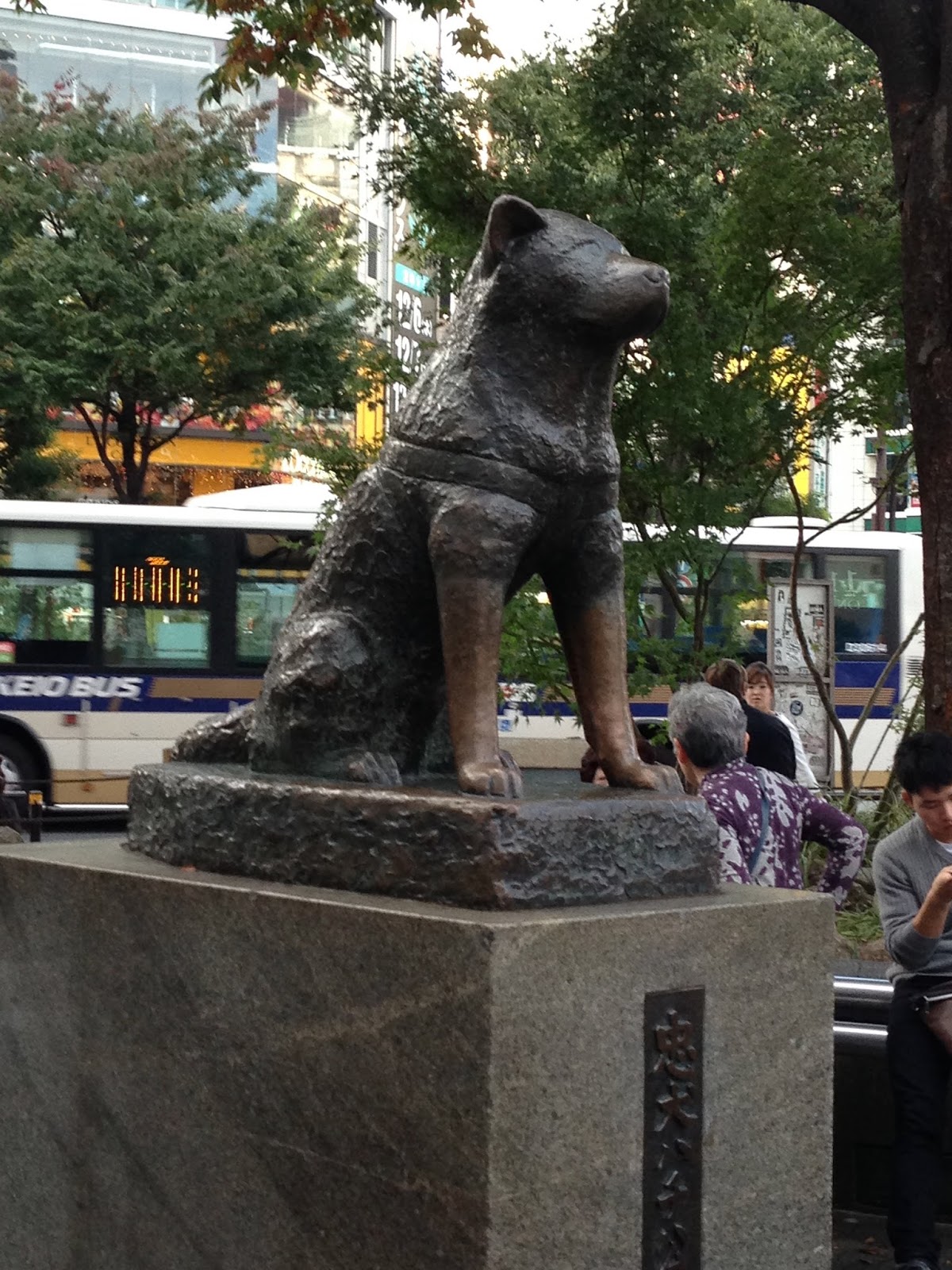
Hachiko the Faithful Dog
It is said that each Japanese shopping district has its own distinct clientele and its own vibe.  Where Shinjuku is the province of the salaryman, or the government official going to the staid Isetan and Takashimaya departmental stores, Shibuya is where the fashionable youth congregate and Harajuku the quirky kawaii side of Japan.  Then there is upmarket Ometesando, with its expensive boutiques (and Apple store).

Well, I am pleased to say that we spent an appreciable time in all.  I wrote about Shinjuku in this earlier post so I’ll talk about the rest here.  Shibuya is of course known for the most famous traffic junction in Tokyo, Shibuya Crossing.  This is a “scramble crossing”, in other words, the traffic stops completely and pedestrians take over, crossing to the exact side of the road which they want to go to. It is apparently one of the busiest traffic junctions in the world!  We emerged at the “Hachiko” exit of Shibuya station - as everyone knows, Hachiko is the loyal dog who waited for its owner to come back at the station exit every day before they walked home together.  Alas, one day, his owner had a heart attack and died before coming home.  But the loyal pooch continued to wait for him, just the same until he too passed away.  His statue now stands in the spot where he used to wait.

Incidentally, another famous icon of Japan is just by the Hachiko statue - Hello Kitty is the decor theme of the Tokyo Tourist Info Bus!

Scramble Crossing, from the L'Occitane Cafe
Many guidebooks mention also the Starbucks at one junction, as the place to watch people scrambling across the road.  But of course we didn’t go there - we went instead to L’Occitane which was on another corner and has a rather nice cafe on the second floor, with a good view of the crossing too.  (Of course the main L’Occitane store with all its products is on the first floor.). Unfortunately the tables by the window were taken but we still managed to get quite a good view of the crossing.  The cafe itself is a little pricy but I think I would rather have sat here and eaten our dessert medley with a taster of four desserts altogether and a cup of tea each, than gone and queued up at the Starbucks for a pricey cup of coffee.

After tea, we went shopping - there’s a lot of shops catering to a younger crowd here, but we didn’t go to them.  Instead, we went to Tokyu Hands and Loft.  My favourite stationery shops in Japan and maybe the whole world!!!  Topped up my collection of washi tape, and bought some accessories for my handphone.  I still have not used up all the post-its I bought the last time.

Our beef on a grill
We ended the day with dinner at Aburi Shibuya Honten, a little grill restaurant on the fourth floor of one of the little buildings, just near Tokyu Hands.  Not easy to spot, but we were glad we did!  The restaurant has maybe six tables, and we got the second last one (the last one was filled up whilst we were there).  Service is fast, the meat is very tender, succulent and flavourful.  Just goes to show that in Japan you don't need to go to the much reviewed places - just try something a little unexpected and you'll find that it's pretty good!

On Takeshita-Dori
The next day being Sunday, we went to church at Roppongi (St Francis, English masses!) and then went down to Harajuku.  We were looking for kawaii gals and punk guys, but we just got loads and loads of tourists :-(  Tokyo Cheap gives a great list of things to do in Harajuku and indeed I did make it to places like the Meiji Shrine, and Yoyogi Park (which I will talk about in a future post).  But for the youth scene, the place to go to is apparently Takeshita-Dori, so that's where we went.  Indeed, the shops are most interesting - check out the exciting costumes sold at Takenoko - you also get shops selling high platform shoes, lingerie, fairy clothing etc.  But not that many people actually going the whole hog.  But maybe it's all just gotten too cliched to go down the street dressed Harajuku-style.  There is also a big Daiso - and that's where we spent a little time.  100 Yen is less than S$2 after all!  And of course, lots of sweet things - cotton candy, and crepes galore!  We went to Marion Crepes where we had savoury crepes (it was lunch time, after all).

From Takeshita Dori, we walked to the Ometesando area.  Just before that, we found Laforet, the departmental store for Lolita wannabes... we went in trying to find some Lolitas but again, not much luck. But it is still worth paying a visit, just to look at all the merchandise.

The Ometesando area is where all the more high-end shops are - again we didn’t really go to these.  But there are also children’s shops, and small quaint little boutiques of all shapes and sizes. Just off the main road is Cat Street, which I initially had high expectations of but sadly, it was really just the street name.  It is a small pedestrianised road which (again) has lots of charming, quaint little boutiques selling Knick-knacks and the like.  Expensive ones, of course.

What with all this walking, it was time for a cup of tea.  We had read on-line about  Q-Pot, which actually makes jewellery items (pendants, rings, earrings etc) which look like chocolates, biscuits and sweet things generally.  So Q-Pot cafe is where they serve the desserts looking like jewellery.  If you want a kawaii cafe, look no further! The table decor comprises towers of macaroons and where the lamps are jugs hanging upside down from the ceiling. The "necklace" plates display a lady wearing a Victorian/Edwardian era dress and the piece of cake is displayed like a necklace hanging around her neck.

Food itself was generally ok - I liked my "Russian Apricot Tea", served with apricot jam instead of sugar.  I had the BisQuit Tiramisu on my necklace plate which was enjoyable, but not exceptional.  You go for the experience, if you want to see the kawaii side of Tokyo.

I have to confess that after taking tea we were a little tired with all the walking and went back to the apartment.  But the next day, we did come back to this area because we wanted to try out the sushi at Heiroku Sushi, which we had walked past on our search for Q-pot Cafe.  Heiroku is supposed to be one of those well-known sushi bars where all the tourists go to, etc.  And yes, we did have to queue, but fortunately it was not peak period so the wait was relatively short (and in any case it was good to take a little rest from all our walking).  I have to say that it did not “wow” me as much as I would have expected and the plates coming out were all the high-end, expensive stuff.  So you have to order the cheaper items! (I thought that it should be a better mix).  But I suppose if you come to this area to shop, you would go for more high-end stuff :-)


More photos of everything on Flickr, here.  In brief, if you want to go shopping, these shopping districts of Tokyo can satisfy all your needs and then some.  But even for non-shoppers, these are interesting places to visit to do a bit of people-watching and just feel the vibe of this modern, exciting metropolis. 

Monday, December 25, 2017

Ueno: Visiting Museums


Ueno Park - the Shinobazu Pond
We spent a day at Ueno!  Ueno is the cultural hub of Tokyo, with numerous attractions within the park itself.  There are numerous museums, the famous Ueno Zoo, and various temples and shrines such as the Bentendo temple in the middle of the Shinobazu Pond (see picture).  Of the many museums, we visited two - the Shitamachi Museum, a small, intimate little museum which aims to preserve a neighbourhood of old Edo; and the Tokyo National Museum, which showcases the history of Japanese art.  There is also the natural history museum, art museums etc.

Ueno park itself is a spacious, yet bustling park.  Likely because of its fame, as well as the numerous things to do within the park.  The two museums we visited were at either end of the park, so I can say we walked through the entire length of the park, from the Shitamachi, past the old Kiyomizu Kannodo temple in the middle, to the Tokyo National Museum on the other end.

Our guide at the Shitamachi Museum
“Shitamachi” means “downtown” and this museum aims to preserve a "slice of life" in old Tokyo.   It is just a small museum, but really that is part of its charm.   The ground floor presents a street scene, preserving the front room of a merchant’s shop and two other smaller dwellings, one owned by a sweet shop owner and another by a metal worker.  We were brought around by an English speaking guide, Mr Fuji, who talked to us about how people lived in days gone by, and shared his own experiences in those days.   The second floor features the entrance area of the Japanese communal bath and a more modern kitchen (from the 1970s).   Also children's toys (including ones Mr Fuji played with in his youth).  It was a very pleasant visit - especially with our own personal guide.

We went next to the Tokyo National Museum. It’s totally unlike the Shitamachi, being a huge three-building complex around a central square.  And of course, being a national museum, it has a far broader scope than just old Tokyo.  The advice was if you have only a few hours, visit the Japanese gallery so that’s what we did.  We didn't have a friendly Mr Fuji to show us around.  But the exhibition guide is pretty good and the exhibits themselves clearly labelled.

The main exhibition in the Japanese Gallery presents the “Highlights of Japanese Art” and indeed it was a well curated journey through the history of Japanese art, across different items from the traditional pottery ware, paintings and wood block prints, to kimonos, samurai armour and even a fire-fighters’ jacket.  There were also horse armour, and a room full of wonderful Japanese painted screens.  It was a truly educational visit, probably my first extensive experience of this aspect of Japanese arts and culture (as opposed to appreciating cherry blossoms or autumn leaves).  The only slight disappointment was that I was hoping very much to see some original woodblock prints of Mt Fuji, namely Hokusai’s famous “The Big Wave” taken from his “Thirty-six views of Mt Fuji”  but apparently it’s not on display.   I am however pleased to say that thanks to Youtube, it is possible to look at all thirty-six views online.  

Japanese painted screen

In between the two museums, we went for lunch at the nearby Ameyoko Market, situated under the train tracks.  We found this nice unagi (eel) restaurant, Unatoto, which sells nice little unagi based set lunches with a little bit of salad, pickles and soup on the side.

For dinner, we went to a supposedly healthy restaurant, Midori no Kitchen, in Ueno Station (the sort which prints the number of calories per meal) which was recommended by Tsunagu Japan.  Not really "authentic" Japanese, but in a way it was nice to have a change!  Thus ended our cultural day in Tokyo!

Food photos below, for more photos on Ueno and the two museums, check out my Flickr page here.


Unatoto

Midori no Kitchen

Saturday, December 16, 2017

Asakusa: Visiting Senso-Ji

One of the joys of travel is that sometimes I serendipitously discover all these links between the various destinations one visits.  So for example, the day after our visit to Ieyasu Tokugawa’s grave in Nikko, we go visit Senso-Ji in Tokyo and discover that Ieyasu Tokugawa also made this temple (then already around 1000 years old as it was first opened in 645AD!) one of “his” two temples in Edo.  Asakusa was then a small humble village, Edo, then a small town.  Over the years, of course the temple has grown into one of the oldest and most visited Temples in all of Japan.  And Edo has metamorphosed into Tokyo, one of the great global cities in the world.  Ieyasu would be proud.

More on the history of Senso-Ji and on its grounds can be found on other sites, like this one and this one, so I will not go into it again here.  I didn’t in any case feel compelled to go and look at every single thing listed on these sites - we were happy to just wander around the temple and its grounds, and in the process, discover its secrets (such as the free green tea).  

The crowds at the Kaminarimon Gate
So we arrived at the Kaminarimon Gate, which marks the beginning of the entryway to Senso-Ji.  The huge red lantern hanging in the gate is a symbol of Senso-Ji, Asakusa and Tokyo itself.  It is of course the prime photo opp spot in the whole of these temple complex!  Behind the gate is Nakamise Street, the shopping street in front of the temple - selling souvenirs, food, religious items etc.

Now as we were passing through the gate, we noticed this rather enthusiastic tourist.  Often we see tourists all dressed up in Japanese kimono, the ladies all prettily decked out in floral kimono with their hair all done nicely, and the men in their duller outfits.  But this particular chap was dressed as a Ninja, and doing his best to act like one - posing in “ninja” poses, hiding behind the lantern etc etc.  Unfortunately I didn’t get a photo (too many people always in the way) but it was quite hilarious to see this ninja prancing around looking as conspicuous as possible (when one considers that the ninja is supposed to be blending into the shadows, disappearing into the night etc as they go about doing their secret work).   In fact he was happy to pose for photos, including with the kimono-clad tourists who wanted to get a little extra out of their time in costume.

The second gate - the Hozomon Gate
Anyway, we walked through the second gate (the Hozomon Gate) and approached the main temple where the golden “Kannon” statue was supposed to reside.  Unfortunately, I didn’t get to see it - apparently it is not in the public areas.   There is another large lantern just at the main doorway, above an offering box  where visitors offer donations and bow.

Next, we visited this little garden next to the main hall, a quiet spot after the bustle of the temple.  There were many little shrines here (actually there are a number of shrines throughout the complex) each with its own little friendly statue awaiting visitors, some looking very weathered as their markings had faded over the years.  This, more than anything, gives you the sense that indeed this is a very, very old temple...

For those interested, more photos of Senso-ji here.

After the temple visit, it was time for lunch.  Apparently the area around the temple is famous for its
Soba at Owariya Honten
soba, so we had soba for lunch.  We ended up in Owariya Honten, a short walk from the temple.  According to Tsunagu Japan this shop has been in existence for over a hundred years - a positive youngster compared to the ancient temple nearby but still pretty respetable for a soba restaurant!  We had the house special, a bowl of soba noodles in a tangy soup (flavoured with yuzu juice and zest) with two large, delectable tempura prawns. A satisfying meal!

After lunch we made our way to Asakusa-bashi, the nearby “crafting district” of Tokyo.  Here is where craft lovers  - knitters, beaders, embroidery fans etc - find their Mecca, with numerous little shops all over the place.  We were here to learn how to make tsumami flowers, which is the technique used to make these little flowers from Japanese crepe fabric (not a huge destructive tidal wave!).  The flowers are assembled in various intricate beautiful ensembles to make up the elaborate headdresses (Kanzashi) of maikos and geishas.  I had of course seen these when we were in Kyoto previously at the Gion Corner (as seen in these photos), and was instantly captivated.

The workshop is run by a Tsumami craft shop, Tsumamido, in a basement workshop next to the shop itself.  We were the only two in our class where we made the petals and leaves and assembled it to form a flowery brooch.  Not bad, for a first time?  But nothing compared to those in Gion Corner or indeed those on this site.

My handiwork

We went back to Shinjuku after this - walked around the shops, visited Isetan's food hall to buy some breakfast, etc etc.  A slower pace compared to the long day trip to Nikko, but it enabled us to rest and recharge for the next day's activities!

Sunday, December 03, 2017

Tokyo Neighbourhoods: Shinjuku

So the thing about Tokyo is its many different neighbourhoods, each with its own character and street vibe.  And since we are staying here, I thought that this is where I would begin: with Shinjuku.

Shinjuku - where the Tokyo city government sits side by side with the many department stores, and the small alleyways of izakayas, drinking spots alongside the beautiful Shinjuku Gyoen park. Where the busiest subway station in Tokyo bewilders the visitor with the multiple subway lines and train lines all up and down the station.

I have to say that we didn't go to some of the more "famous" areas such as Kabukicho or the Golden Gai (somehow tramping through red light districts didn't really appeal) but we did spend time in  Isetan, Keio and other department stores in the area.  And we ate around the area quite a bit (so yes, there will be foodie reviews here).  We also spent an entire morning in Shinjuku Gyoen, just 10 minutes walk from our apartment.  In this quieter corner of Shinjuku, we found convenient little minimarts, little family restaurants, etc.  And we managed to escape the madness of Shinjuku station by going to Shinjuku-Sanchome or Shinjuku-Gyoenmae instead.  This is the part of the city I like - not too far from the city centre to make it inconvenient to get anywhere but at the same time not right in the hustle, bustle and crowds.

Shinjuku Gyoen - Traditional Japanese Garden

We had wanted to spend the afternoon in the Shinjuku Gyoen park on our first day in Japan but the heavy rain put paid to that.  So we had to postpone the expedition to another morning.  Shinjuku Gyoen park is considered one of the top parks in Tokyo and is made up of three large gardens - the Japanese Traditional Garden, the English Garden and the French Garden. There's also a greenhouse full of tropical plants - we did not see the need to go in. Of course, the Japanese Garden is the largest of all!  It is a pleasant strolling garden - with numerous ponds, winding paths, flower beds, and a view of the NTT Docomo Tower from practically anywhere in the garden!

That's one big chrysanthemum
The Japanese adore their flowers and at this time of year, the chrysanthemums are in bloom.  So there are little pavilions set up at intervals throughout the garden, each with their own display of beautiful blossoms.  Huge flowers bigger than my fist; long-petalled spidery flowers; small, spiky-petalled flowers - how could such different flowers all be part of the chrysanthemum family!   

Children "fishing"
Just so the chrysanthemums had some competition, we visited the rose garden in the French garden area.  It was quite a formal arrangement, different from the "natural" feel of the Japanese garden.  But there were shady sycamore avenues on either side; a pleasant place on a summery day.  Indeed, the park was full of families and children, sitting on the lawns and under the trees.  It so happened that we went on a public holiday, so it's likely that parents were free to take their children to the park.  But it all combined to create a warm, happy atmosphere in the park - children running, laughing, blowing bubbles; people lying on the lawn watching the clouds overhead, or sitting and contemplating the reflections in the water at the Japanese garden.  It wasn't as exquisite as the Japanese gardens in Nara or in the Kyoto temples but for a big and crowded city, it is a peaceful and restful place to spend a morning.

For more photos of Shinjuku Gyoen, ck out my Flickr.

By contrast, the rest of Shinjuku is lively and bustling.  We would go around the Shinjuku quite a bit - to shop, have meals or to get to our tour pick up points.  So we had many meals around the area (including a bento box dinner which we picked up from Isetan's food hall - a gourmet experience in itself).  Here are my three favourites:

    Tsukiji Sushi
  • Tsukiji Sushiko - quick, courteous service and lovely fresh fish!  I had a chirashi don, and I have to say that it did its namesake market proud. It is also a pleasure sitting at the counter watching the sushi chef at work - the quick, deft slices of his knife and the precision with which he places each piece of fish just so.  Not a big restaurant, just a small branch of a bigger chain but worth looking out for on a future visit to Tokyo.
    Zen
  • Zen - a quiet okonomiyaki restaurant in a quiet street just minutes away from our apartment.  Somehow okonomiyaki is a real Japanese comfort food, at least in my book.  Here the okonomiyaki is nice and thick - but perfectly cooked throughout.  We had ours accompanied by sake, edamame beans and grilled oysters.  Again the oysters were cooked just right - moist, and fully of briny flavour.  Service was friendly - the proprietor came by to show us his coin collection (we contributed a 20 cent Singapore coin) and spoke to us via his Google Translator.  Again, worth a return visit.  Neither Tsukiji Sushiko or Zen are in the heart of Shinjuku, and are closer to Shinjuku-Sanchome station.
    Shinjuku Izakaya
Small little izakaya somewhere around in the Shinjuku-Sanchome area.  We were walking around looking for somewhere to have dinner when we saw the English menu in the window.  The chef standing at the grill took pity on these poor lost tourists and came out to hand us the menu to scrutinise more closely.  Small, crowded, full of the office workers stopping by before going on their way home.  We ordered tonnes of little dishes, far more than the office workers on either side who had only a light snack with their mug of beer.  We, on the other hand, were imbibing a fruity alcoholic soda.
Of course, one of the best things about dining in Shinjuku was the knowledge that we had only a short walk back to our cosy apartment after....

Saturday, February 04, 2017

Osaka: Bright Lights, Big City

Glico Running Man!
Osaka!  Our last stop this visit.  We took the train down from Nara and were delighted to find that it stopped literally at our subway stop.  We spent a fun evening walking through Dotonburi, took our obligatory photo of the Glico Running Man, and ate some takoyaki.  The next day, we made our way to Himeji Castle.  We were so tired out after our day trip (and indeed, the last day of a holiday is a sort of anticlimactic day) that we decided to pursue a very minimalist agenda.  Food and shopping!

We went first to Kuramon market, which was literally down the street (our apartment was really very conveniently located).  We moved from shop to shop, sampling the wares and had a yummy seafood breakfast of uni (sea urchin), grilled scallop, oysters, sashimi.  We had a great time eating away, and taking in the atmosphere.  

Kuramon Market
We went next to Doguyasuji which is where all the restaurants and chefs around Osaka get their cooking equipment.  It was incredible!  If you ever wanted any Japanese cooking equipment, this is definitely the place to get it.  But since I have promised myself that I'm not buying anything new till I have Kondo'ed my kitchen, I was quite restrained.  The only thing I bought was some plastic food fridge magnets.  Yes, you can get the plastic food displayed in the window of Japanese restaurants here!  It is quiet an experience

Our big breakfast at Kuramon market did not stop us from having a crab kaiseki lunch at Kani Douraku.  There are actually a few branches of this very popular crab restaurant in Dotonburi, characterised by the gigantic crab right in front.  But it is very popular, so much so that even after 2pm there was no table available for those without a reservation.  We decided, nonetheless to wait and after about 20mins we were ushered to a table upstairs. 

Truly, no one does crab like the Japanese.  The best thing about their crab is it comes with the crab
The unmistakable signboard of Kani Dourake
legs and claws cut beautifully in half so that extracting the meat is truly effortless!  We had numerous dishes, including crab sashimi, boiled cold crab (my personal favourite) served with a delicate lightly vinegared dipping sauce, grilled crab, crab gratin, crab chawanmushi, crab sushi (another of my faves), crab hotpot (house specialty) and others.  Dessert was a scoop of ice cream floating in matcha.  Ummm..... It was one of those truly enjoyable meals.

After this heavy meal, we did some shopping to walk off the food.  Specifically we found our way to the duty-free cosmetic shops.  Now, Japan has a great tax refund system for tourists.  They figured out that there's a limit to how much duty-free the ordinary shopper can buy at the airport and even in 1-2 duty-free shops in the city centre.  And that it's definitely inefficient for hundreds of passengers to clog up a small tax refund counter at the airport.  So they allow selected shops here in the city centre to administer the tax refund programme (you can tell them by the big sign which they display prominently at the front of the shop).  You buy your goodies, they pack it in one of those transparent plastic duty-free bags and charge you the amount payable before tax only.  There's a little receipt stapled in your passport and that's it.  When we got to the airport, all we had to do was hand in the receipt (the customs officer didn't even bother looking at it).  Wonderful!

Anyway, we had a great time at the cosmetics shop.  We had done all the research beforehand (actually we had spent quite some time the last two nights reading through product reviews and recommended sites such as this one) and so we were all prepared to make our purchases.  In my case, I bought some Hadalobo products, plus the AHA cleaner by Cleansing Research and Lululun masks, amongst other things.  Plus my favourite Aqualabel Moisturiser by Shishedo.  We were so burdened with all our purchases that we had to go back to our apartment to deposit them (and have a little break) before making our way out again.  We had to buy some presents for family/friends, which we got at the 300 Yen shop in Shinsaibashi.  We ended off with an okonomiyaki (an Osaka specialty) meal before going back to the apartment to pack.

As a result of all this shopping and research (both for this and earlier trips), I'm now in a good position to recommend what gifts to buy for family and friends:
  1. Kit Kat and Glico products.  There are so many different interesting flavours for both Kit Kat and Glico Pocky.  Fun to try!  There are also regional specialties to enjoy, such as Takoyaki and Okonomiyaki-flavoured snacks.  It's great to bring back to the office (and is very popular!).
  2. Cosmetics and make-up.  Even if you can't buy enough to make up the 5,000 Yen required for the tax refund, the prices are still better than in Singapore.  Check out the link above (and there are many others) for shopping inspiration.  Great for female relatives and friends.
  3.  Stationery. I'm talking about fun, novelty and useful items such as erasable pens ("Frixion", no-staple staplers, cute post-its, etc.  Plus the best range of washi tape ever.  I've recently discovered washi tape and its great to find new designs at prices lower than in Daiso Singapore.  Go to places such as Loft, Tokyu Hands, and Ito-ya for the great range of stationery.
  4. Clothing, accessories, bags.  I have not done much clothes shopping in Japan.  But I do recommend looking for the tabi socks  in shops such as 3 Coins (it is a 300 Yen shop).  I also managed to find an Anello bag, one of the latest "It" bags - again very competitively priced compared to buying it in Singapore.  I really love my little blue backpack.
  5. Cooking items. Lots of novelty items. If in doubt, just buy the plastic food fridge magnets or keychains.  Brings a smile to my face every time.   
Ah, just writing all these posts really makes me feel like going to Japan again!  Glad we are planning another trip this year.  😊

Goodbye Osaka.
As always, more photos here.


Sunday, December 25, 2016

Dining and Shopping in Kyoto: Beef and Sushi and Needles

Izuju Sushi - Mackeral Sushi and the "Mosaic" sushi
One of the best things about Japan is that the standard of the restaurants here are generally good.  We didn't really have any major "dining ambitions" here in Kyoto, beyond eating a good variety of the different Japanese meals, but most of the time, we just chose our restaurant based on what took our fancy.  Many a time, our picks surprised us!

As in my last trip, thought it is easier to summarise our foodie experience all together (with a little extra on a special shopping excursion at the end).  This time though, I've taken pains to try and identify/locate the restaurants, especially the better and more memorable meals:

Sushi, sushi

Izuju Sushi
Amazingly, during this short visit with a limited number of meals we went to two top sushi restaurants in Japan, at least according to Tsunagu Japan!  They are two very different sushi restaurants, one very traditional, and one totally modern.

I did not know previously that there is such a thing as Kyoto style sushi and that one of the best exemplars of this type of sushi is Izuju Sushi.  This was one of the few restaurants we went searching for based on its reputation.  Izuju is just across from the Yasuka Shrine, and is a small little restaurant with only a few tables.  Go early, or you'll have to queue!  Choices are limited - the restaurant is known for its mackerel sushi and inari and also this interesting "mosaic" type sushi.  Little ingredients (like pickles) are packed into the rice so the sushi itself is a complete meal.  There was also a seasonal special, on horse mackeral sushi.  The restaurant requests courteously to try their food without soy sauce, to better enjoy the flavour of the rice.  Indeed, I did not need soy sauce, as the flavours of the rice and fish are so fresh that any addition would diminish the overall experience.  There is a far more detailed blog post about Izuju here, so I won't go into more detail on the food, ambience, and the history of this well-known restaurant.

"Ikan Bilis"
The second restaurant, Sushi no Musashi, is in Kyoto station and we actually came by here the last time we were in Kyoto!  We rather enjoyed ourselves and so we came back here again.  This is a totally modern conveyor-belt, Tokyo-style sushi restaurant, with one of the largest selections of sushi toppings I've ever had - lots of different shellfish, sashimi and it's all really fresh and good.  Prices are reasonable, and no surprise, you will have to queue for this one too.  What I like is that they actually name the seafood that you're selecting - having said that I am not sure what the name of this particular fish is.  I just mentally called it "ikan bilis".

Where's the Beef

Blow-torching the beef
A few doors down from Izuju is a beef restaurant, "Kappo Bar Gyugyu Gion Honten".  It sells Kobe Beef but as prices are like 9,000 yen for a steak we had the "normal" Wagyu instead.  We got a seat downstairs, on the bar surrounding the kitchen so we had a good view of our food being cooked on the grill.  One of the more exciting dishes was this version of beef carpaccio.  The beef (sliced super thin) is lightly cooked with a blow torch and served with a lump of sushi rice, radishes, and some soy sauce.  It is literally two mouthfuls of food, but really yummy mouthfuls.  

Kameoka beef
Obviously, we had not eaten enough beef because the very next day, we found ourselves in another beef restaurant called Gyuraku in Kameoka (we were looking for a nice restaurant for lunch after our ride on the Sagano Romantic Train)  Here there is no mention of Kobe beef.  Rather, the restaurant proudly proclaims that it is using only the famous "black cattle" of Kameoka.  The beef itself is also available in the butcher's next door. It appears that Kyoto prefecture  is trying to promote its own beef products internationally and Kameoka is one of the leaders in this!

Anyway, we had a steak served on a hot plate and next to a hot stone.  So we can cook it further to the degree of done-ness we want.  The steak itself was good - moist and flavourful.  It gave us the strength and energy to make our dripping way back through the rain to Arashiyama.


Traditional Kyoto Cuisine - Kyo-ryori, and Yudofu 
Kyo-Ryori Manshige

Another unexpected or rather unplanned meal was our first in Kyoto, at Kyoto station.  We were really looking for the conveyor belt sushi but got lost in the massive station and found Manshige instead.  We were attracted by the promise of traditional Kyoto food (termed Kyo-ryori) and indeed, it was a charming meal full of dainty little dishes - including the tiniest, sweetest little new potatoes I've ever seen, and three of the tofu "lollies" which I remember from my last trip here.  In addition, there was a delicately flavoured soup made from seafood and which comes with a squeeze of lime (Thai influence?).  It was such a lovely meal, that it is no wonder that I subsequently found it on someone else's "best restaurant in Kyoto station" list.  And apparently it is a branch of a more famous restaurant somewhere else in Kyoto!

Yudofu Set Meal
We also took the opportunity to eat Yudofu, another Kyoto delicacy especially in the Nanzenji temple area - apparently all the vegetarian monks swear by it.  And the purity of the water here in the area makes for the most pure Yudofu ever.  Now Yudofu is really not the most exciting food in the world.  It is a few pieces of tofu in a stock flavoured with one piece of kelp. It is served in a claypot.  You put the cooked tofu in a dipping sauce, add radish, seafood and bonito flakes and that's it.  Fortunately, the dish comes with some side dishes as well - vegetable tempura, and other small side dishes such as pickled seaweed and some tuba tofu (Yuba is made by skimming off the the film off the top of soya bean when it is being cooked).

We didn't go to a famous restaurant for this one either. We tried to but it involved a 1 hour wait so we went to the less famous (and much cheaper) establishment called Goemon Chaya down the road.

Ramen

Black Ramen
Regular Ramen
Another "must have" when in Japan is the ramen.  We were walking home from Hanamikoji when we passed by Musoshin ramen restaurant and decided that a hot bowl of noodles was just the thing for dinner.  Musoshin prides itself on its tasty stock made from vegetables and chicken and indeed the rich, thick broth was very tasty.  It is so thick, it coats the noodles completely so each mouthful is full of flavour.  They also have a special "Gion Black Ramen" dish which features a black ramen stock, sprinkled over with black sesame seeds and served with some black seaweed on the side.... you get the picture.

Little did we realise that it is rated so highly - ranked 29th out of all the restaurants in Kyoto! Maybe it is the result of the very active calls to review it positively on Tripadvisor

Nishiki market 

Beef Pao
No visit to Kyoto is complete without a visit to Nishiki Market.  I had visited the market on my last visit to Kyoto but it's still worth a repeated trip.  We made our way there but it would appear that the sashimi stalls are not open on a Monday morning :-( Anyway, we had breakfast here, if conger eel tempura, a beef pao (courtesy of Kyoto foodie tip), takoyaki and matcha flavoured soy milk ice cream can be considered breakfast.  The conger eel tempura was not wonderful - it had been sitting a while and so was not that fresh any more.  At least they reheated it for me.  But the beef pao - hot, steamy, full of succulent meat - was something different and definitely worth a repeat visit during future repeat visits to Nishiki (yes I think another visit to Kyoto is a definite possibility).

At Misuyabari
After visiting Nishiki market we went looking for Misuyabari needle shop.  My friend had tipped us off to this shop - because she wanted us to buy her some decorative pins and the famously sharp needles the shop is famous for.  It was not easy to find - it is actually in an offshoot of the Teramaki Shopping Arcade - but behind the row of shops.  We had to go through a little alleyway, which opened into a courtyard garden and the shop was on the far side.  If interested, the directions are here.

The shop itself is tiny, and sells primarily needles, the decorative pins (ordinary pins but with little pinheads of dogs, cats, and many other little items).  It has a 360+ year history and apparently used to sell needles to the Imperial Palace!  The shopkeeper doesn't speak much English but somehow we managed to get by.

Tea for Two

Apple Tea
Somewhere along the way, we started having tea.  It started with a rainy visit to Arashiyama and a warm cosy English tea served in a traditional looking Japanese house.  Who would have expected to see scones and Earl Grey?  Although it turned out that the house specialty is actually an apple tea, complete with chunks of freshly cut apple.  It's a seasonal specialty so not always available.  Anna Maria is on the main street, on the way from the railway station to Tenryu-Ji temple.  It's a welcoming place and I certainly would recommend it to anyone who wants a little break from all the walking around (rainy day or not).We also decided to treat ourselves to a nice tea 


after tracking down the Misuyabari needle shop and making our purchases.  Our reward for effort, so to speak.  Lipton Tea House was started up apparently in 1930 as the British wanted to interest the Japanese in drinking Lipton rather than green tea. And to have a nice piece of cake with it.  I had a nice cheesecake.  But honestly it was just a nice break after all the walking (and BTW we had not had lunch, just all the snacking at Nishiki market).

We were amused to see two of the other patrons of the needle shop having tea here, too.

Well, I've come to the end of a long long post all about my Kyoto food experiences.  Or at least the more significant ones.  Glad that we had some new food experiences and also the chance to revisit a few old favourites.  Looking forward to my next visit to Kyoto (whenever it is)!


Starting the Day Right...

Related Posts Plugin for WordPress, Blogger...