Showing posts with label Paris. Show all posts

Saturday, December 22, 2018

Paris : Shopping and Eating

Galerie Vivienne
I always like to leave a free day at the end of a holiday to do a little shopping and also so that there is time to squeeze in that one last activity.  Then we can go back home with no regrets... But before we get to that, let’s first do the round up for food and shopping in Paris.

I have, even before my Konmari stint, stopped buying souvenirs on holiday and started buying specialty food.  But even so, it is possibly to have lots of fun shopping for food or even just cruising the shops.  So here are my highly personal shopping “to-Dos” in Paris:

1.  Walk through their covered passages.  I wanted to be a “flaneur” and walk around the elegant
covered galleries of Paris.  I forgot (silly me) that the French shopkeepers don’t work on Sundays and the galleries were closed. I did manage to find one (Galerie Vivienne)  which was open to people who just wanted to walk through, and it was full of charming old-fashioned shops which made me wish I could go in and explore further.  So try going there on a weekday, to get away from chain stores and discover something unique to bring home from Paris.

The queue outside Louis Vuitton, Galeries Lafayette
2. Look at the Louis Vuitton Queue at Galeries Lafayette, which spills out into the corridor...  .... I just went to the Galeries branch of Angelina, where I enjoyed a glass of their famous chocolate (I got it cold, which is probably a crime but it was a warm afternoon).  I had a hot chocolate at Café de Flores on another day, which is another must-do.

3. Visit Shakespeare & Co.  I just said that I don't buy souvenirs but there is always the exception that proves the rule.  For me, it is that one book from Shakespeare & Co (see earlier post), so I can get it stamped with the bookshop logo.  

4. Gawk at Le Bon Marche - Le Grand Epicerie.  
I loved the huge food hall where there are so many exotic foodstuffs on offer, from all over the world.  I bought some biscuits and other edibles to take back to the office. There are also a few counters where you can sample the fresh seafood (cooked on the spot for you), or get a quick sandwich (we did this) and also an extensive boulangerie section.  .

5. Have it all at G. Detou - ah, the owner’s boast is true they do indeed have everything (j’ai de
J'ai de tout
tout) an aspiring baker could ask for, all packed within the two little shop units which make up this old-fashioned shop. As Clothilde from C&Z says, it’s magic!  Like her, I got pearl sugar, about 1 kg worth...  that's going to be a lot of choquettes.  But that's one item you can't get anywhere in Singapore.

There are many other kitchen equipment shops in the vicinity of Les Halles, as documented here.  In particular E. Dehillerin, which like G. Detou, is an old fashioned little shop with wooden shelves going up to the ceiling, all filled with amazing copper pots and pans.

6. Buy a baguette! The French buy a baguette every day.  You had better do it too.  There is a great boulangerie just below my sister's apartment, so that is where we got our daily bread.

7. Buy cheese at the airport!  ‘Cos then you can be assured that it is packed for air travel and won’t stink up your luggage.  I got a slab of Comte, and a little round of Camembert.

We had a nice time eating in little bistros and restaurants around Paris, including Breton buckwheat crepes at a creperie in the St Michel area, steak frites (steak with fries, another classic meal) and a simple salade Nicoise at a small cafe on the same road as G. Detou.

But I thought I would mention a few in particular, in case you are looking for a (moderately priced) place to go to after you've finished a morning's sight-seeing:

Whimsical decor at La Fourmi Ailee
1.  After a visit to Notre Dame, when visiting the Latin Quarter, try La Fourmi Ailee, at 8, rue du Fouarre, Saint Michel. It is a charming little place, where the walls are covered with paintings including one of a tortoise and a series of Chinese characters.

I had a yummy fresh pasta dish with tomatoes and black olives.  Warm, hearty fare at reasonable prices.  There were only a few diners when we got there but the place filled up swiftly thereafter.

Mona Lisa as painted
by the computer
2.  Near the Louvre, you can find the Cafe de la Regence, 167 rue St Honore.  It is an elegant brasserie, with bookshelves and paintings lining the walls.  It was a little strange however to see a pixelated Mona Lisa on the wall just beside our table.

When in France, embrace French food.  So I ordered a duck confit (duck cooked in its own fat) and a bowl of French onion soup topped with a crust of bread and cheese - it's as traditional and French as you can get.  The duck drumstick was tender and tasty, and it was accompanied by the most marvellous tiny new potatoes!    The onion soup is such a French classic but it is so filling that it could be a whole meal in itself.  I was glad that we shared it.

Beef bourguignon
3. After visiting the Sacre Couer, or when wandering around Montmartre: Try L’Anvers du Decor, 32bis Rue D’Orsel.  This is definitely not in the super-crowded area just next to Sacre Coeur, so the serving staff had time to go through the menu with us.  

It is supposed to be famous for its beef dishes so I had the beef bourguignon with French beans on the side - lovely and tender meat, hearty, rich stock.  And of course this is another French classic meal.  My sister had a pot of mussels though.

Les Nympheas
Moving outside Paris, we had a lovely outdoor lunch in Les Nympheas in Giverny, just outside Monet's house.  The name translates to "water lilies" in English and is obviously a reference to Monet's iconic work.  The little restaurant is surrounded by a veritable sea of flowers and so we were happy to sit outdoors for once, where we were able to enjoy the sunshine and the beautiful blooms around us.  Go early, to beat the crowds and visit the garden after lunch.

I had a quiche for lunch but my mother and brother-in-law tackled the rabbit dish.  It looked rather yummy but the quiche was really very good so I have no regrets.

Quiche at 3 Rue Pichet
In Chartres, we had lunch at 3 Rue Pichet.  This is another small unpretentious, charming restaurant where the waitress brings the menu for the day on a little chalkboard.   I ordered a salmon and potato dish - well cooked and tasty but it was a little light, even for me.

My mother took the quiche and my sister the duck served in a broth with carrots, potatoes and bacon (!) with a crust of bread on the side.

So we had lots of tasty meals but I have to give praise where it is due, so  lots of kudos go to our favourite Chef, my dear Brother-in-law who would whip up something yummy most evenings so we could have home-cooked, value-for-money food rather than go out to eat.  He did a great steak frites, prepared a salad of buffalo mozzarella and after a day of sightseeing we got back to a dinner of asparagus, his famous roast potatoes, savoury sausages and a baked vegetable dish (I can't remember what vegetable exactly). And that was really eating like the French :-)

Dinner en famille
More photos will be put on Flickr, when I get round to it.

Last but not least... we did go for that one last activity in Paris ... a totally touristy activity, a boat cruise down the River Seine!  And so I end off this series of posts on Paris with a photo of the Eiffel Tower:

Au Revoir Paris!


Saturday, December 01, 2018

A Day in Montmartre


The Basilica du Sacre-Coeur de Montmartre
Aside from our mini-pilgrimage to the Catholic sites in Paris and its environs, the other "theme" of this holiday is probably getting a glimpse into the lives of the Impressionists.  Not so much their paintings (been there done that), but where they lived and worked.  Today, our visit to Montmartre covered both areas, starting with our visit to the Sacre Coeur and then, after lunch, around the Musée de Montmartre.

Montmartre is the "hill of martyrs", so named after the first Bishop of Paris, St Denis, who was decapitated here.  A most appropriate place to site this beautiful basilica!  The building itself is rather new - construction started in 1875 and was completed in 1914, a mere 39 years after!  It is truly a pilgrimage, having to walk up the hill to get to the basilica (and braving the touts along the way) but of course it was one we willingly made :-)  We were rewarded of course by a spectacular view over Paris.

We got here in time for morning mass (it is our routine now) and we celebrated the feast day of that most French of saints, Joan of Arc.  Maybe it is because we are visiting so many French Churches this visit, but I find they do love their French saints - St Joan, St Ursula, St Vincent de Paul, St Louis IX, St Therese of Lisieux etc - whose images appear in the stained glass windows and whose statues pop up in the various little shrines. Whilst mass was in French, the choir was a small group of nuns and their pure, sweet voices needed no translation to be appreciated.  They continued to sing even after mass had ended, which added to the atmosphere of faith and joy which I felt during my time here.

St Joan, as peasant girl
and warrior maid
After mass, we explored the huge church in greater depth. It was not my first time here (I think more like my third?) but it has been sufficiently long ago for memories of previous visits to have dimmed (although I do remember coming for Sunday mass here, the entire building packed despite its size).  We admired the humongous mosaic above the altar (apparently the largest in France), and wandered around the little chapels, many of which were dedicated to the French saints.  But there are two conspicuously non-French saints featured.  First, there is a chapel for St Ignatius of Loyola (also called the Chapel of the Jesuits, it was certainly funded by them), who apparently came with his companions to the nearby Church of St Pierre (of course there was no chapel in those days) and it was here that they started the "Society of Jesus", or the Jesuits.  Another chapel has a sign to commemorate the visit by St John Paul II to the basilica in 1980.

I did not know that the Basilica is the venue for perpetual adoration of the Eucharist, something which started way back on 1 August, 1885!  Pilgrims come here to spend the night in the guesthouses here and take their turn to pray before the Eucharist.  Maybe it is an idea for another time.

For more photos, look here.

Life is Art
We had lunch at a little bistro somewhere down the hill. Due to our unfamiliarity with the area, we did not realise that we would have to make our way back again to get to the Musée de Montmartre, where we intended to spend the afternoon!  Ah well, the exercise was probably good for us.  It was also quite pleasant to wander around the narrow, steep streets of the area.  Montmartre formed no part of Baron Haussmann's plans for Paris and so it has no gracious boulevards or majestic squares.  It is full of staircases, twists, and turns, with a little bit of graffiti in the corners.  And when you turn around the corner there is indeed a little square, but full of shops and street artists plying their trade.  And all of a sudden, you feel that you have indeed walked back into a picture which Renoir could have painted, of people just enjoying the sunshine and each other's company.
12 Rue Cortot

The Musee de Montmartre is described as the "most charming museum in Paris" and indeed it is full of atmosphere.  We could almost see Renoir sketching in the garden, with Toulouse-Lautrec wandering in for a visit before going off to one of the nearby caberets (maybe the Caberet du Lapin Agile, or "Agile Rabbit", or the Theatre du Chat Noir, or the "Black Cat", or the Cabaret du Moulin Rouge, named after one of the windmills, many of which were once found here ).  Above the gardens, Suzanne Valadon would sit in her studio painting away at her easel.

Suzanne Valadon's atelier-apartment
The visit starts off with a short video on the history of Montmartre, before leading us through the gardens and to 12, Rue Cortot, where some artists (including Renoir) had their studio.  It is here that the collections of the museum can be found, with paintings of Montmartre over the years, and also featuring works by Toulouse-Lautrec, Suzanne Valadon, her son Maurice Utrillo and others.   We ended up with a visit to Suzanne's studio apartment right on top of the building.  Of course I am an utter dunce when it comes to art and aside from the big names (Monet, Renoir) I tend not to be so familiar with the others, including Suzanne.  But she had an interesting life - starting off as a model/muse for Renoir, Toulouse-Lautrec and Degas, and then going on to be an artist in her own right.  She was completely self-taught, except for what she picked up by observing and talking to the artists she was modelling for.  Got to respect a woman like that.

It was indeed a day of contrasts, from the sacred to the secular, from the serene beauty of the Basilica to the more tumultuous, vibrant life of the Bohemians.  But together, both Sacre Coeur and the Musee de Montmartre bring together and tell the story of this little corner of Paris.


Sunday, November 18, 2018

Saints Extraordinaire


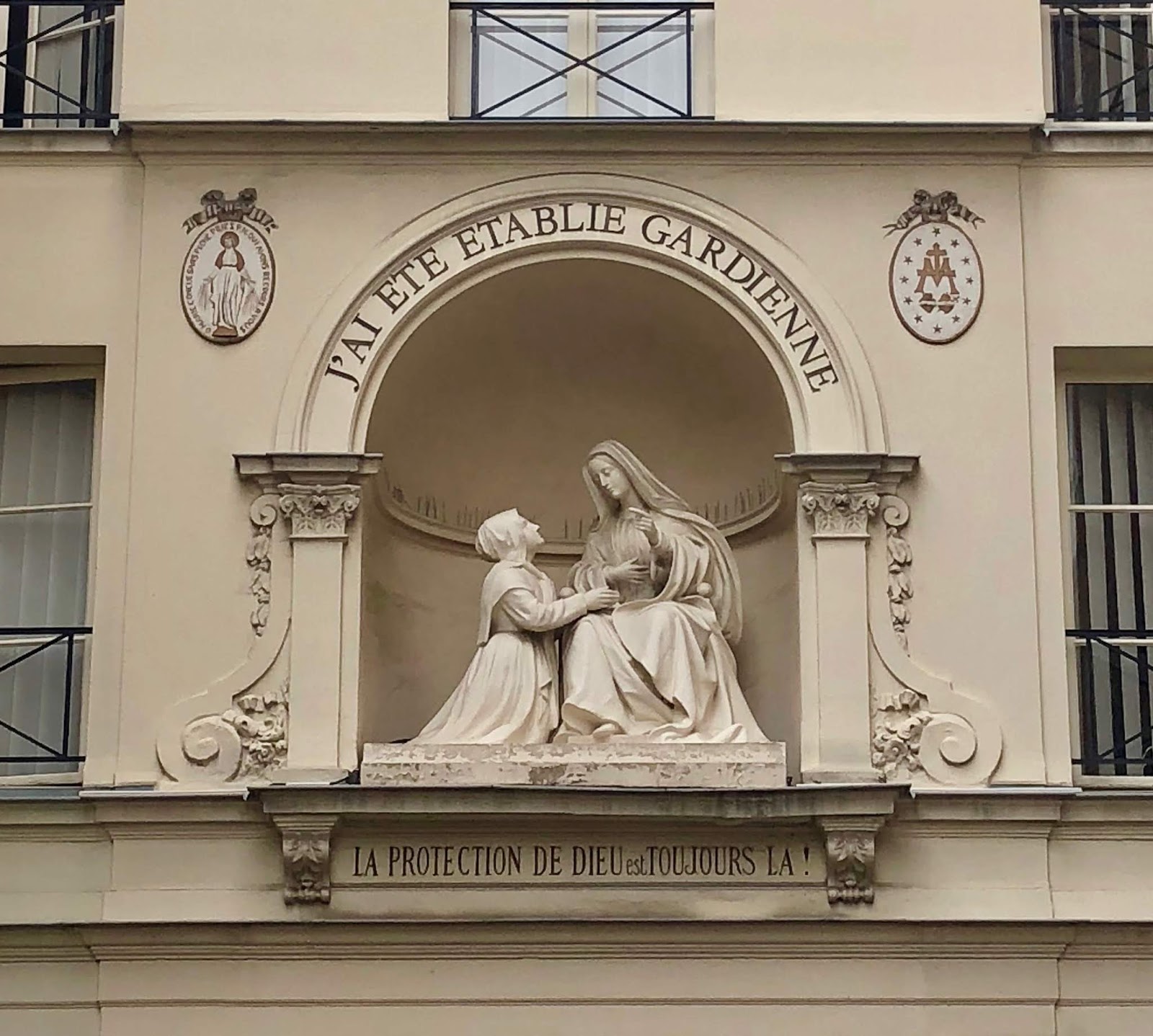
St Catherine praying at the feet of Mary
In a little corner of the left bank of Paris, just behind the trendy St Germain area, is "Religious Orders HQ".  We came here to visit the Chapel of the Miraculous Medal, but found also the motherhouse of the Mission Etrangers de Paris (MEP), and the Espace Nicholas Barre of the "Souers de L'Enfant Jesus"!  Without them, my life would indeed not have been the same!

The visit to the Chapel was one of the more significant stops on our mini-pilgrimage.  Hidden behind an insignificant little entrance way on the Rue du Bac, this is the original quarters of the Sisters of Charity (also called the Daughters of Charity), co-founded by St Vincent de Paul and St Louise Marillac.  It was here that the Virgin Mary appeared to St Catherine Laboure, then merely a novice of the order.  A detailed account of Catherine's story is here, but I shall give a short summary: Catherine had a vision of Mary, seated on a chair.  Mary asked her to have a medal made, with the image of Mary with beams of lights emitting from her hands on one side, and with the Sacred Hearts of Mary and Jesus on the other.  Around the person of Mary, the words, "O Mary, conceived without sin, pray for us who have recourse to thee". Thus, the medal is more properly known as the "Medal of the Immaculate Conception", and confers graces and blessings on the wearer.  Catherine had the medal made but her identity and role in its making was kept secret for most of her life.  She was subsequently canonised as a saint.

The Chapel at Rue de Bac
The Chapel of the Miraculous Medal itself is a shrine containing the perfectly preserved bodies of St Catherine Laboure and St Louise Marillac.  It also holds a reliquary containing the undecayed heart of St Vincent de Paul, which had been removed earlier from his then undecayed body.  Unfortunately, the body of this great saint subsequently decayed after being affected by a flood.   We visited his shrine later on, just around the corner.

Anyway, we had timed our visit to the chapel in good time to attend the morning mass, but it was quite crowded what with all the groups of pilgrims coming from all over and seats were in short supply.  So we had to split up. But we were fortunate, for others could not even get a seat! I took some time to admire the chapel - it is truly a little jewel, with lovely mosaics covering the arch above the altar, and on the side chapels.  On the left of the altar is St Joseph, bearing the Christ child, and on the right, Mary holds a globe in her hands.

It was a powerful experience being there for mass and even after, as the pilgrims stayed back for quite some time after mass ended, to venerate the saints and to pray at the foot of the altar.  Thereafter, we went to the little shop and bought lots of medals and got them blessed by one of the priests who said mass.

We went next to the Shrine of St Vincent de Paul, just around the corner. It was behind yet another nondescript door but what splendour awaited us on the other side!
.
Magnificent shrine of St Vincent de Paul
The shrine is richly decorated, with an ornate ceiling and pillars along the sides.  The bones of St Vincent, covered in wax to create a wax model, are in a transparent case above the altar, and apparently you can get nearer if you go up a staircase behind the altar.  Well, we did not know it at the time and so did not go up...

Two other, lesser known saints lie along the side aisles of the church - St Jean-Gabriel Perboyre and St Francois-Regis Clet, both martyred in China.  More of their background is told in this article.  These two martyrs are priests of the order of the Congregation of the Mission (CM), which is a missionary order set up by St Vincent de Paul (again).  They are also called Vincentians, or Lazarists.  The main church is this shrine of St Vincent de Paul and hence this is where the other two saints were laid to rest.  Interestingly, the one society St Vincent did not found is the Society of St Vincent de Paul!  It was in fact set up as a lay society by a French lawyer, Blessed Frederic Ozanam, who was inspired by St Vincent to do this work for the poor.

After the visit to the shrine, we went back to Rue du Bac to have lunch at La Grande Epicerie de Paris, the food section of Le Bon Marche, Paris' oldest department store.  We had a simple sandwich there and thereafter made some purchases (mostly goodies for the office) before making our way onward.

The "Meridian Line"
After lunch, we went on to our next stop, the Church of St Sulpice. St Sulpice was born in 570AD (!) and died in 647.  He was the Bishop of Bourges and was greatly concerned with the poor and the sick.  The current church replaced an older one on the same site and was built by the then Parish Priest, Jean-Jacques Olier (1608-1657).  It is the second largest church in Paris, smaller only than the Notre Dame and includes a seminary as well.  There are a number of interesting features about this church, such as its impressive pipe organ, and more unusually, its "gnomon", which is an astronomical device meant to help determine the dates of important church feasts.  The gnomon was featured in the Dan Brown book, "The Da Vinci Code", and called a "Meridian Line".  It was meant to act as a red herring to confuse those who sought the grail... ... but the use, and description of the line in the book were in fact erroneous.  Even so, due to the book's popularity, the number of visitors to the church increased, all looking for this device.  So much so that there was apparently a small notice indicating that a lot of the details about the gnomon in the book were in fact wrong.  I didn't see the notice, but then again I never even realised that the obelisk had anything to do with the Da Vinci code ...

After this visit, we had certainly seen enough churches for the day, so we went to the Cafe de Flores for hot chocolat and tarte au citron.  Then back home to rest.

More photos of the Miraculous Medal here, of the Shrine of St Vincent here and of St Sulpice (from both this and a previous trip) here.

Sunday, September 02, 2018

Notre Dame, St Chapelle and Latin Quarter

St Chapelle by Candlelight
Four Seasons
Undoubtedly, the highlight of this second day in Paris was our concert at Sainte-Chapelle. Vivaldi's Four Seasons sung through the chapel.

Sainte Chapelle was built by King Louis IX (later St Louis) to house the Crown of Thorns (at least what was thought to be the crown of thorns).  Completed in 1248 (!), it is a beautiful medieval chapel with tall windows of magnificent stained glass. Whilst there has been some destruction over the years (for example during the French Revolution), apparently two-thirds of the stained glass is original, and the chapel underwent an extensive restoration fairly recently.   It is one of the most difficult attractions to get into in Paris, due to the small size and the length of the queues outside.  So I thought that the best way was to combine the visit with this classical music concert.

Indeed it was a very special experience.  The queues were long, it is true, but needed in any case to get through security and into the chapel.  As the sun was still shining (days are lengthening at the end of May) we still got to see the stained glass lit by the light of the evening sun outside.  The strains of "Air on a G String", followed by the "Four Seasons" filled the chapel as the light slowly faded outside.  But then the exquisite screen, just behind the musicians then took prominence.  It was really an unforgettable evening!
Chapel of the Crown of Thorns

After the concert, we were surprised when the rain started    pouring down when we left.  The day had been so bright and sunny that we were not expecting such strong, gusty winds nor the torrential rain.  It was as though we were experiencing Singapore's own two seasons (tropical heat and thunderstorms) in this one day!

But back to how we spent the day.  We started off at Cathedral of Notre Dame at the Ile de Cite, which I have been to twice during previous visits to Paris. But as always, you find new things to see.  This time, I particularly noticed the chapel devoted to the Crown of Thorns relic (moved over from Sainte-Chapelle during the French Revolution).  I am always rather sceptical as to the authenticity of these relics but one can and should remember the symbolism of the crown of thorns, and the suffering of Christ which he endured on our behalf.

Restored - the Visit of the Magi


The Cathedral itself is undergoing its own slow process of restoration.  The exterior has been largely completed and within, various areas have already been restored.  The screen around the high altar is in progress, so half of it looks a little grubby whilst in the other half, the expressions and features figures in the key biblical scenes have emerged from centuries of dust and grime.

Within Shakespeare & Co
After our visit to Notre Dame, we had lunch across the Seine in the Latin Quarter and from there we last visit to Paris.  This little bookshop is so popular with tourists that it has even managed to start up its own little eatery on the side.  But I like it for the quirky little upper room, with its beautiful view of the towers of Notre Dame, and the resident cat (I didn't spot the cat but I did see the cat bed!).

I bought a book (of course) - David Leibovitz's The Sweet Life in Paris which I had borrowed previously from the library.  I like his irreverent style, his self-deprecating humour, and the yummy recipes sprinkled throughout.  My sister read the book prior to moving to Paris and apparently can relate to the tussles with the French bureaucracy both within government and with the service standards and processes in even the commercial retail establishments.  My mother too ended up reading the book during the rest of our stay.

Christ child meets John the Baptist
We continued to stroll around the Latin Quarter, visiting the church of Saint Severin, famous for its gargoyles, stained glass, and magnificent architecture.  It has also got a majestic pipe organ, so the church is also famous for its sacred music performances.  We were lucky that someone was rehearsing whilst we were there  - click here for my video.  The stained glass is huge - so you can actually see every single detail clearly!  There were more small churches in close proximity to St Severin, but we didn't go visiting them (two in one day is quite enough).

We also walked on the banks of the Seine, itself a UNESCO World Heritage Site.   On Pont Neuf we took in the views over the Seine including the impressive  Conciergerie, a palace turned prison turned Department of Justice.  We ended the day with dinner, and of course the concert at Sainte-Chapelle.

A long but enjoyable day!  More photos here.

The classic view of the Conciergerie  with the tourist boat sailing past

Sunday, August 19, 2018

Living the Expat life in Paris

It has been about ten years since I last went to Paris on holiday!  Some people find it odd that I don't mind revisiting places that I've been to.  I don't find it odd at all!  Big cities have so many things to see and do that you can't see them all on one trip; places change and I and my interests change too.

Anyway, this time round it was very different as my mother and I were visiting my sister and her husband, who are currently working in Paris.  It was an opportunity to experience the life of the expat in Paris.

The Arc de La Defense, from Neuilly-sur-Seine
So first of all, we were not staying in the central Paris area; the Paris planned by Baron Haussman.  We were staying in the prosperous suburb of Neuilly-sur-Seine, in a small one bedroom apartment within 5 minutes' walk from my sister's apartment (rented off AirBnB).

It's also a straight metro ride to the centre of Paris, and to my sister's office in the La Defense area - Paris' business district.  We paid a visit to La Defense, sat beneath the arc, visited the local Decathlon and walked around the towering, modern office blocks in the area.  It's a totally different Paris! There's also residential blocks in this area, but we were glad that my sister had chosen to stay in the quieter, more traditional Neuilly area.

Trompe L'Oeil wall, Neuilly-sur-Seine
Here, the houses are the traditional 6 to 7 floors high.  What was once an old house has now been divided up into apartments (about two per floor) typically with a caretaker staying on the ground floor.  There are typically shops on the ground floor too - a florist, or baker, or butcher.  You enter through a large front door, big enough to drive a car through. As in the old days this would be a carriage, just beyond the entrance there is a smaller yard area where you can find another building which would be the stables.  My sister's apartment is on the sixth floor, with lovely views over the area.  Our apartment was over the stables, with a view of the yard.  But very quiet, with no traffic noises.

We spent our first day in Paris mostly walking around La Defense and here in Neuilly-sur-Seine.  Whilst there are quite a few restaurants in the vicinity, we typically had nice home cooked dinners most nights.  The local supermarkets are just nearby and there's also this frozen food paradise called Picard (the ultimate in quality and convenience).  We bought our bread from the bakery, our other breakfast items and fruit from the either the supermarket or the little shop at the corner, which was open all hours (run by migrants of course).

Eglise de St Pierre
There are also a number of churches in the area - St Peter's, St John the Baptist.  Handy to get to for Sunday mass.  But we didn't go to either!  Instead we went to the English language church in Paris, St Joseph's (apologies, I forgot to take photos here). It is a smaller, intimate and more modern little church with a very diverse and cosmopolitan congregation.  Including of course all the Singaporeans!  So it was that when we went over for Sunday mass, my mum met two people she knew from our parish back in Singapore.  They too had moved over to France...

For the rest of this trip, we would be visiting many, many more churches.  My mother had decided on a "DIY Pilgrimage" and so we had listed down all the major Catholic sites to see in Paris, plus a few others to visit on day trips.  I'll be slowly covering our visit in my next few posts.

In the meantime, check out this France album for all my shots this trip.


Monday, May 26, 2008

Le Chat Noir

Le Chat Noir
Originally uploaded by Taking5
So the pooch of the day today is a cat!

Well, it was the first cat I saw in France. So it deserves a special mention.

As you can see, I only managed to catch a glimpse before he disappeared behind the fencing.

From Paris to Avignon

Today, we left Paris for Avignon. We had spent much of the previous night packing up. So, we spent the morning taking our last look at Paris.


First, coffee in a small specialist coffee shop and then we walked to the Pompidou area and then to Les Halles. It was all very ordinary and then I had two firsts! First, I saw my first McDonald’s in France. It was near Les Halles and aside from a small unobtrusive sign above the entrance, the Golden Arches were not in sight. Guess McDonald’s has finally learnt about French subtlety. Then, I walked a little further and spotted my first cat! However, it swiftly dashed away from me into a fenced area where I could not follow. We wandered around till it was time to go to the train station.

We were taking the TGV from Gare de Lyon to Avignon Central. It was a fairly smooth journey and I was able to update my journal, look at my photos and do the accounts along the way. We picked up a taxi at Avignon Central and he took us to our B&B, La Banesterie. The taxi driver drove rather rapidly around the walls of Avignon till he reached the entrance gate nearest our B&B (near the Palais des Papes, or Palace of the Popes). Then he made his way through a maze of little streets before stopping in front of an ancient building with a statue of Mary above the door. I was delighted.

We were holding up traffic (this was a narrow, cobblestoned street which allows only one car through at a time) so we quickly disembarked and entered the house. The first thing which I noticed was the smell of chocolate, lingering in the air. Our host was a tall Frenchman with a curly mop of hair. He took us to our room and then sat down with us and a map of Avignon to mark his recommended restaurants on our map.

Wandering around the B&B only confirmed our impressions. It is a really charming old place with low timbered ceilings, uneven floors, small narrow staircases (of course our room is on the third floor, thank goodness the ceilings are low), lovely old furniture etc etc. There are also signature chains of “glowing roses” in each room. Our room also had a little plate of chocolates and a lavendar pouch on the bed. Details, details.

We took a walk out to see the sights that evening and wandered around Avignon. The Palais des Papes, the Place de l’Horloge, the Rue de la Republique where the high street shops were and the small little boutiques in the pedestrianised area and along Rue Joseph Vernet. We found many closed (many shops close on Mondays and typically close on weekdays at 7pm) so there was a certain amount of window shopping. Finally, however, it was 8pm when restaurants started to open (here they keep Paris time!) and we went to La Compagnie des Comptoirs for dinner. It was a new trendy restaurant in an old convent with the swankiest toilet I saw in France. (I did not realize until I checked out the weblink that it was originally opened by a pair of celebrated Michelin-starred chefs who were identical twins - Jacques and Laurent Pourcel). It was serving fusion-ish food. I had sashimi with a sort of cream cheese layer on it for starters. Then, a huge serving of this pork dish which was like kong bak with lots of honey involved – yummy, but I had a problem here because I don’t really want to eat all the fat but of course that is the nice part of the dish, so ended up removing the fat on two out of the three huge pieces of kong bak and eating only the last one in its entirety. That piece was truly delectable. The dessert was a spiced poached pear with chocolate and ice cream. It was nice but the table next to us was celebrating a birthday and the birthday cake featured not a candle but a sparkler! I just hoped that the rest of our stay in Avignon would sparkle too. The weather report is not good.

Photos here.

Sunday, May 25, 2008

Paris Pooch of the Day (6)

Ok, I admit it. For some reason, I forgot about taking dog photos in my mad dash from place to place during the day.

So that's a dog from yesterday, taken at the restaurant we went to. He was really a friendly little thing who got on very well with the people at the only other occupied table.

Spirit and Structure

Today was our last full day in Paris – how time has flown.

We went for mass in Notre Dame – we’d checked out the mass times when we were there previously. It was an interesting mass. The previous day, the cathedral had hosted “La ceremonie d’adoubement des nouveaux Chevalier et d’investiture des ecclesiastiques et dames de l’Ordre equestre du Saint-Sepulcre de Jerusalem”, which I presume means the investiture of the new knights and dames of the Equestrian Order of the Holy Sepulchre of Jerusalem. I looked the name of the order up subsequently; at the time I read the notice I thought it was the “Order of Saint Sepulchre” and was thinking how strange it was to have a saint with such a name… pardon my (lack of) French indeed. Anyway, the mass appeared to be a celebratory mass for the new knights and dames, who filed in procession down the aisle to their reserved seats in the front of the church. The celebrant was Cardinal John Patrick Foley (a US Cardinal), the Grand Master of the Order.

The other unique feature of the mass was that it was sung in Gregorian chant, so the Gloria, Kyrie, Agnus Dei etc were in Latin. I remember thinking how pleased my dear mother would be – she’d know all the words and probably could sing along quite comfortably.

After mass, I had wanted to see St Chapelle – but was confronted by a fairly long queue. So we had lunch instead at a café on the Left Bank, opposite the Notre Dame. It was a pleasant little seat, with a good view of the river, and the buildings on the Ile de la Cité so although the restaurant was pretty pricey for the rather average food we got, we were nonetheless fairly happy.
I realized from scrutinizing my guidebook that we were only a block or two away from the Shakespeare and Co bookshop. So as soon as I’d downed my “Belle Epoque” crepe (bananas, chocolates, almonds, and four huge globs of Chantilly cream) I popped off to see the bookshop whilst my friend went off to another flea market. I’d read about the bookshop in my guidebooks and I must say I wasn’t disappointed. First, it was open - in Paris on a Sunday - and pretty crowded too! There was a quiet buzz about the place, people standing about the door looking at the Seine and the Notre Dame - a pleasant place to be.


Shakespeare & Co is an antiquarian bookshop, and indeed it reminded me of the old second hand bookshops down Charing Cross Road in London. But there are new books too, and a good section just inside which features books about France (all in English of course). The very thing I was looking for! So I bought a book (mentioned in an earlier post; now you know that I did edit my posts before putting them up) entitled “Sixty Million Frenchmen can’t be Wrong” by Jean-Benoit Nadeau and Julie Barlow, an attempt to explain “what makes the French so French”. We all know the French Paradox – they drink lots of wine, cheese and other fatty foods and yet have low obesity and few heart problems. Likewise, although the French seem to have high taxes, restrictive labour laws, large public sector etc etc – the economy still seems to be doing pretty well (in relative terms), with high labour productivity. The authors’ theory is that the reason why France works is the harmony between the “spirit” of the French and the structures they have given themselves, and the book spells this out in greater detail. I could have bought more books if I’d wanted to, but time was short and the weight of my baggage a weighty issue indeed. I was rather pleased, though that the book bears a “Shakespeare and Co” stamp on it.

The rest of the day was spent museum visiting, to maximize my museum pass (especially since I couldn’t go into Ste-Chapelle). Started off at the Louvre, where I’d decided to look more at the French paintings and early European paintings. There was another contemporary art exhibition going on at the time by Jan Fabre and the exhibits were scattered throughout the Louvre – so when I went into this huge room of old European paintings to see a coffin with a peacock head and tail sticking out.


I was running late after rushing through the French painters, but I could not resist and just before I left, went to take a peek at the Leonardo paintings – the Madonna of the Rocks, Virgin & St Anne and the one and only Mona Lisa. There were some “da Vinci Code” moments, I must admit. I checked out the weight of the Madonna on the Rocks and speculated whether it would be indeed possible for an elderly man with a bullet wound to insert a secret message behind it. As for the Mona Lisa, the best picture I got was of the crowd around her. (Note: After coming back to Singapore I discovered that the Louvre actually has a thematic trail on the “Da Vinci Code” which includes their comments on the factual elements in the book.)
I had planned to meet my friend at the Rodin Museum and so I rushed there. By this time, I was pretty exhausted, having rushed from place to place and wandering around the Louvre without many opportunities to take the weight off my feet. The Rodin Museum, like the Picasso museum, is in a huge old mansion. But the difference is that this was not being renovated and there was a great difference indeed. It was a pleasure to walk through the beautiful rose garden to the statue of The Thinker in the middle. The museum was closing soon so I had only a few minutes to rush through the rooms (it said that it was closing at 5.45pm but in reality they chased us out with about 10 minutes to spare).

We went that night for dinner at Restaurant 404, recommended by Eric as one of the best North African restaurants in Paris. It had a great atmosphere indeed and we were fortunate to get in there by 8.05pm. We were seated together with a couple who had not made a reservation (I have not sat with another group at a restaurant since my student days in London). But it was easy to see why they did that – the place had many reserved seats and it filled up pretty fast. By seating us together it was more likely that we would be served and leave at the same time, so there would be a whole table of 4 released, giving them more flexibility. I enjoyed the dinner – had a tagine of duck and apple which I rather enjoyed. We had dessert and also some mint tea, which I’ve not drunk since I was in Dubai (really must remember to do it here in Singapore, especially as I have a pot of fresh mint just outside the door!).

But we could not stay and soak up the atmosphere. Back to the apartment to pack!

Incidentally, for the whole of our stay in Paris, I never did manage to get online. Most of these posts were written off notes done during our stay there and then posted once we got back to Singapore.

P.S. Ok, I admit it! I also had to see the spot where the big inverted glass pyramid and the small little pyramid almost touched. Here it is.

p.p.s. I am also not unaware that the "Grand Master" phrase has Da Vinci Code echoes.

Saturday, May 24, 2008

Paris Pooch of the Day (5)

A storekeeper's dog, in the flea market. He was a friendly little thing. Ran around, and then lifted his leg by a floor sign.


Before coming to France, my friend warned me about dog poo in Paris. I did keep an eye out and whilst the danger of stepping on a piece of dog poo is there, it was not as bad as he made it out to be.


Maybe he had an unfortunate accident?

Flotsam and Jetsam

Today, we spent the morning at the flea market, Marché aux Puces de St-Ouen. When we talk about a flea market in this context, we are actually talking about several different buildings, each packed with stalls selling slightly different items. Some sell antiques, but most really sell second-hand stuff, or really new items which are reproductions of the old stuff. These buildings are then surrounded by a lot of little shops selling cheap clothes, leather products, etc on the fringes.

My favourite market was the Marché Jules Vallès. This particular market sold old pieces of furniture, books, what have you. It was like an extended attic full of the flotsam and jetsam of many people’s lives. You could find anything in these markets, from an old keyboard, to clocks, to old porcelain statues missing a hand or a foot, to a kitchen stove and even an old Jaguar (yes, as in the car).


I would find it so difficult to work out what was a potential collectable which just needed a little restoration work, from what was really a piece of junk. For example, there was an old violin, probably three-quarter size. I was reminded of my sister’s old violin, which she used as a child. It was originally in my grandfather’s house and missed its strings, was covered in dirt and (if I’m correct) also missed its neck rest. When we got it cleaned up, it was actually quite a good violin. My sister used it until she grew out of it and got her very own, full-sized violin. But it was her violin teacher who made the call that it was usable, not me.

Actually, the flea market reminded me a little of my grandfather’s garage – which is probably the reason why I liked it so much. It even had the same, dusty smell.

We had a quick lunch and then I went off on my own to the Tuileries Gardens. I got off at the Louvre metro stop, then walked down the length of the gardens to reach the Musée de l’Orangerie. Now the Tuileries Gardens have at either end these large fountains, surrounded by sandy pathways… I realized just how sandy when I saw the sand blow in the wind. So I got off the main paths to walk down a quiet tree-lined avenue where there were fewer people and hence less disturbance of the sand. Nonetheless, my shoes were covered in dust.

Now, I’d bought the 2-day Paris Museum Pass the previous day from FNAC (the French Virgin Megastore counterpart which sells books, DVDs, CDs, electronic equipment etc). The virtue of the Museum Pass is that you don’t need to queue to get in. Or at least, you get your own separate queue. So I waltzed past all these people who presumably had queued for a while and walked to the head of separate queue. So it saves time (it also saves money if you go to enough museums, especially the more pricey ones) which can be better spent looking at exhibits.

The L’Orangerie is famed for the huge paintings of water lilies by Monet, which were a gift from him to the French State. The oval shape of the rooms were determined by him and he then worked his paintings (partially completed at the time the location was decided upon) to fit the space. There are a total of 8 paintings, 4 in each room. They depict water lilies at different times of the day. According to the AV show, Monet loved the subject of water lilies because the combination of the flowers, water, and the sky and clouds reflected in the water was like the combination of the earth, sea and sky – a limitless, boundary-less world, without any fixed focal point so the eye looks everywhere at once. The rooms, two ovals connected to each other, symbolize infinity. I sat in front of each painting, to soak this serene world in.


The L’Orangerie is actually a very manageable museum. Aside from the water lilies, there is a small very select collection of paintings. The original collector was a Paris art dealer, Paul Guillaume, who bought many of the paintings. After his death, his wife continued his collection and then gave them to the state. There are Renoirs, Cezannes and Matisses.

Now the plan was that I would meet my friend at the Picasso Museum in the Marais area later that evening. So I thought I would take a look around the shops and buildings in the Marais area. The word “Marais” means “marsh” and so the buildings in this area were built on reclaimed marshland. Many were built by the rich and wealthy, in particular the beautiful Place de Vosges, famous for its symmetrical layout. Cardinal Richelieu stayed here in 1615. Maison de Victor Hugo (I didn’t go in though) is in one corner. Hugo stayed here for many years and wrote Les Miserables here. Indeed, the Marais is a charming area, with beautiful old houses and buildings. I wandered around these narrow old streets (quite different from other parts of Paris) and made my way to the Musee Picasso.


I thought I would be able to spend some time here. But the Musee Picasso appeared to be undergoing some renovation. There was scaffolding outside (this is why there is no photo) and inside, everything seemed a little less permanent in nature with what appeared to be temporary signs and I could not seem to find the more famous paintings as listed in my guidebook (I forgot to pick up the museum guide, a hazard of getting the museum pass). I did find a rather nice little AV theatrette showing a film of the master at work – he’s painting on glass, the camera is on the other side so you can see what he paints. I also quite liked the exhibition of photos of Picasso by many famous photographers – Man Ray, Cecil Beaton, amongst others. Anyway, somehow I finished it in double-quick time. Then it started to rain… of course that day I did not bring my umbrella… so I was stuck in the shop for some time. The rain died, I ventured out and since it was still rather early (I’d planned for a two hour visit to the museum but lasted only an hour there) I was very fortunate to bump into my friend in the street! We happily went back home to take a rest before dinner.

Dinner that evening was in the little neighbourhood restaurant around the corner from our apartment. We walked there around 7.20pm and found that it would not open till 8pm (that was when we found out that restaurants open about 8pm in France). On previous evenings, we must have reached the restaurants just after 8pm. So we wandered around and returned to the restaurant. We were the first customers in and spent some time deciphering the menu. The next group of customers (all 3 of them) walked in and ordered the beef fondue. So when we tried to order it, we were told that there was no beef left! Amazing. Did she have a huge lunch crowd? So we had to have fish instead (that was the only other item available on the menu). At least, we got to eat escargot. Ok, but not great. Well, we are talking about snails here. The owner’s cute little dog was running around in the restaurant – where are the environmental inspectors in France! Parisians indeed do love their dogs!

Thursday, May 22, 2008

Paris Pooch of the Day (3)


Take me somewhere fun
Originally uploaded by Taking5

Would I forget? This little fella was in one of the shops we visited in the market. No, he wasn't supposed to be there. But he was.


Plus de Repression


Plus de Repression
Originally uploaded by Taking5

When we met Eric at the metro station earlier in the day, he told us that there was supposed to be a strike that day (actually I had heard about this whilst in Singapore, but forgot about it). He was concerned that his students would have difficulties getting to the assigned meeting spot as a result. But it looked as though the transport workers, at any rate, were working.

Later that evening, however, we went to Galeries Lafayette and found that the streets were unnaturally empty and some even barricaded. Then, we saw, a procession approaching. It turned out that the French public sector unions were striking over the increase in the number of years they had to work before qualifying for a full pension. The retirement age before getting their pension is 60 years, but they have to work for 40 years (now being raised to 41 years) before getting the full pension.

The protests were taking place in Central Paris, and this photo was taken just outside Galeries Lafayette. It shows the start of the procession - when we left the building some 1.5 hours later, there were stil a few stragglers passing by.

I'd bought a book - "Sixty Million Frenchmen can't be Wrong", by Jean-Benoit Nadeau and Julie Barlow. This book attempts to deconstruct the French psyche, to help us understand them better. The authors lived in Paris for 2 years and describe in their book how they would check the newspapers for the "forecast" on which roads would be closed due to protests taking place. According to the authors, these forecasts were generally very reliable. To quote a short extract from the book,


"What the French really excel at is protesting. Protests, marches and demonstrations are an essential element of the French social fabric. Rich or poor, bourgeois or working class, the French have no inhibitions when it comes to taking their views to the street, grabbing a sign, chanting slogans, forming human chains around towns, or cracking fireworks in front of bored riot squads. Protest, to the French, is not a mere expression of frustration. It is an important rite of public life"


According to the authors, the French culture and tolerance of protest has its roots in the French Revolution, when the people took to the streets. The French people take these protests in their stride, with probably only tourists bothering to photograph the strikers.

Just to complete the events of the day - after our busy morning at the cooking class, we walked up some 9 flights of stairs (20 stairs each) to the Sacre-Coeur. The place was thronged with tourists. The Sacre-Coeur does not allow any photos to be taken. This in a sense helped preserve the sense of tranquility and holiness in the church.


After our visit to Sacre Coeur, we wandered around Montmarte, did a little shopping and found ourselves in a little church, St Jean l'Evangeliste de Montmarte. It was a simple red brick building but had really beautiful stained glass windows within. It was after our visit to the church that we went to Galeries Lafayette.


Given that we'd had a big lunch that day, we had bread and soup for dinner. Thanks to the lack of serving spoons, we had to drink our soup with teaspoons. If ever you want to make your food go a longer way, that's one way to do it.

Photos here!

Cook'n with Class

Today we went for our French cooking class (including market visit, 3 course meal) at the cooking school "Cook'n with Class". Our chef teacher, Eric Fradeau, speaks excellent English – indeed, he was in New York for 7 years working for a hotel chain which got him to set up restaurants in their hotels. But he decided he wanted to try something on his own and Voila! Back in Paris, in his cooking school.


We were a class of 7 altogether: the two of us, a mother and 2 daughters from Canada, and this couple who happened to stay in the same neighbourhood as Eric did when in New York. We discussed menus on the way to the shops – decided upon mussels at the beginning, saw what was available in the shops for the starter, and so on (the French typically eat what's in season). For dessert, we decided upon the chocolate lava cake. Yum!


Market visit was not to a market per se but rather to a little series of shops on the street near the metro stop (Rue du Poteau). Our first stop was a horse shop. Now Eric prounounces horse “ors” so one of the Canadian ladies thought he was saying “ox”. But the horse heads on the sign gives it away. Eric says that the French are losing the taste for horse meat. There are now fewer horse meat shops in Paris than there used to be, and it is eaten largely by the old. Of course, the French do not eat the whole horse. Just three parts – the rump, tenderloin (and I forget the third). For hygiene reasons horse meat must be sold on its own and not with the other meats, hence these stand alone shops.


We next visited the cheese shop or fromagerie. I rather liked the shop, with the huge variety of cheese available to look at – from France and other regions in Europe (Italy, Switzerland and Holland). We got some cheeses here. Then, the butcher shop (boucherie) – again, incredible variety - with rabbit, chicken, duck, lamb, pork etc. Some with the "AOC" tag to show that it is meat of the highest standards. There was a “no dogs” sign in the shop but dogs were still pottering in and out. Need a proper leashing area for the dogs outside, since it would be impossible to think that the French would leave their dogs at home.


Next to the fishmongers (le poissonnerie), where we were going to get our mussels plus two large sea bream. The fishmonger de-scaled, de-boned and filleted the fish on the spot for us. Finally, the vegetable shop where we were shown around all the varieties of beautiful tomatoes, potatoes and so on – and where we also picked up bunches of white asparagus for our appetizer, in addition to loads of veggie and salad items - macha leaves or “lamb lettuce”, oranges, a tomato, potatoes, celeriac (celery root tuber – now I know what that looks like) plus lots of herbs - flat leaf parsley, tarragon, and a bouquet garni of thyme and bay leaves, and some strawberries and raspberries to accompany our dessert. And just before our arrival at our cooking school, we picked up some bread from an artisan boulanger, i.e. the baker bakes from scratch including milling his own cereal. No short cuts on food for the French.


What was really charming was that these little stand alone shops have not been completely replaced by supermarkets. The variety and high quality of goods available in each shop indeed is better than anything I've seen in Singapore.

We then proceeded for class, which was very nearby. Eric's chosen his spot well. This was quite enjoyable even though I wish we were more active in the cooking – Eric passed us vegetables/food and told us to chop this and that, as opposed to giving us a recipe which we then had to work through. I do appreciate he has to work with a large range of ability and kitchen experience, so I guess this is what he has found works. Also interesting to note that practically everything we ate was boiled as opposed to fried. Hmmmm… French food is healthier than I thought.

Finally, it was time to eat. The white asparagus was beautiful…. it was soft and melted in the mouth. I really loved its delicate flavour. It was accompanied by a green salad of mache or lamb lettuce, with chopped tomatoes and orange segments and a dressing of honey, balsamic vinegar, and olive oil. Incidentally, I must say that I know now the amount of waste that must be generated in the French restaurants. A good quarter to one-third of the asparagus is not eaten because it is too fibrous; this is gauged by bending the asparagus and seeing where it breaks. The Canadian lady asked Eric whether he composts; he confessed he did not as he would have to travel to the suburbs to do this and he only had a little motor car...

The fish was alright, and I now definitely know what is meant by French food being all about the sauce. But the mussels were beautiful – tasted so fresh and cooked just right so that they were soft, succulent and juicy. They were accompanied by a mash of the celeriac and potato, and by little pearled vegetables. Incidentally, pearling the veggies also results in a lot of waste being generated, especially when done by unskilled hands who scoop out the little spheres at quite some distance from each other. I of course tried to maximise the number of pearls I got out of each courgette or turnip or carrot.

The chocolate cake was fun! It was also so simple to make, that I am really encouraged to do this at home. Essentially the cake doesn’t cook all the way through – so the molten centre is really the original cake mix (egg, sugar, chocolate, butter and flour). Eric also told us the secret of really sweet strawberries – forget about what the outside looks like – what is important is whether the core of the strawberry is pink – that’s the sign of a sweet strawberry. The inner cores of the strawberries we get in Singapore are all white, so that’s the reason why they just are not so sweet.


Ah yes, a really satisfying and filling meal indeed. After all that, it was difficult to put down the other things we did that day. In fact they are just jottings, so I will end this post here. (And the photolink is here).


P.S. The website for Cook'n with Class (note! there's a large section with recipes): http://www.cooknwithclass.com/index.html. And Eric is a warm and friendly chap, who makes everyone feel comfortable (aside from explaining things very well).

Starting the Day Right...

Related Posts Plugin for WordPress, Blogger...