Showing posts with label Rome. Show all posts

Sunday, November 03, 2019

Papa Francesco and St Peter's Square at Night

I'm this close to Pope Francis!
This is a short post; mainly to keep track of the key events in my life which took place in 2019. I was privileged to be a participant in the Caritas Internationalis General Assembly held in May this year.  The GA opened with a Papal Mass celebrated by Pope Francis.  Definitely one of my Bucket List items! 

It was a wonderful experience, sitting there in the Basilica with Catholics from all over the world around me.  The Universal Church!

After mass, there was a reception and dinner.  We had the pleasure of walking back to our bus through St Peter's Square.  What a serene atmosphere it was, in the still and peace of the night.

A few days later, we had the additional honour of a Papal Audience.  Truly a moment to remember.


St Peter's Square at Night

Sunday, October 20, 2019

Rome and the Romantic Poets

I visited Rome in May this year, for the first time since my pilgrimage 10 years ago.   Unfortunately, I didn't have much time for sight-seeing as the main purpose of my visit was to attend the one-in-four-years assembly which my Catholic charity has in Rome.

Temple of Aesculapius, Gardens of Villa Borghese
But I did get there one day earlier and managed to visit a few places I've not been to before - the grounds of the Villa Borghese, and the Keats-Shelley Museum.  They are quite near each other, and make quite a pleasant day's sightseeing.

The Villa Borghese was originally owned by Cardinal Scipione Borghese, nephew of Pope Paul V, hence the name.  The Villa holds one of the top art collections in Rome - unfortunately I didn't realise I had to book well in advance to enter (something to note for future reference).  So I could only visit the Borghese Gardens, the park surrounding the Villa and itself one of the largest public parks in Rome.  The park is also the site of a  famous horse show arena, the Piazza di Siena, hence the statues of horses I saw there.  I didn't realise it but there was a famous horse show going on at the time - so the grounds were full of caravans and the like.

The Church of Trinita dei Monti
From the park, I took a slow walk to the Spanish steps.  The Spanish Steps are so named because the square they lead down to (Piazza di Spagna, or the Spanish Square) houses the Spanish Embassy to the Holy See which is still here today. It's one of the most famous squares/stairs in Rome, made famous by the movie, Roman Holiday starring none other than Audrey Hepburn.

But, the steps are really called Scalinata di Trinità dei Monti in Italian as they lead up to the Church of Trinità dei Monti.  The Italians have recently stopped visitors from sitting on these famous stairs but when I was there, the restrictions were not in place and it was a rather nice, happy atmosphere, of people sitting and chatting and taking in the atmosphere.

T he other strange little irony about this area is that this Spanish Square is practically the "English Quarter" of Rome!  The English loved Italy, attracted by the warm weather (so different from the rainy weather back home) and good food.  Many came here for the opportunity to study classical Rome and others to admire the architecture and art, and to be inspired by the glorious scenery.  So around this area are cafes such as  Cafe Grecco, the oldest coffee house in Rome where luminaries such as Byron and Goethe used to hang out.  Another English favourite was Babington's, an English tea room just on the left of the Spanish stairs (as you ascend the stairs).  It's been around since 1893!

John Keat's room
On the right of the Spanish steps is where John Keats stayed, and died.  This building is now the Keats-Shelley Museum, dedicated to the memory of Keats, Shelley and Byron (who lived across the square at No. 66). Since I occasionally fancy myself a poet I decided that this was where I would spend my precious afternoon in Rome.

Indeed, the tragedy of Keats' short life is preserved here in this little museum.  There are just a few rooms in this little museum - a main living area, and two bedrooms.  Keats' room holds his bed, a chest of drawers and his death mask beside his bed.

He was just 25 years old when he passed away of tuberculosis, convinced that he had not achieved anything in life.  His published works were few, and due to his ill-health, he could not marry the lady he loved, Fanny Brawne.  He was buried in the Protestant Cemetery in Rome.  As per his instruction, his name is not on the tombstone and it only states that "Here one lies whose name was writ on water", ie a name which doesn't leave a mark but is washed away as the water flows...

English Romantic Poets in Rome
Despite his own modest assessment of his worth, Keats today is regarded as one of the geniuses of English literature with his famous odes, such as Ode to a Nightingale, Ode to a Grecian Urn, and my favourite (which I have referred to already once on this blog), Ode to Autumn.

Sadly, the three Romantic poets all died young.  Percy Bysshe Shelley, Keats' good friend, drowned after the boat he was in floundered in a heavy storm.   He was just 29 years old.  Shelley's widow, Mary, is of course very famous in her own right thanks to her novel, Frankenstein.  In fact her creation is probably more famous than she is!

The last of the three, Lord Byron, or George Gordon Byron, died at the age of 36 years, from a disease caught whilst he was fighting for the Greeks in the Greek War of Independence.  For that he was considered a hero amongst the Greeks, a true Romantic who died for his ideals but whose memory lives amongst them still.

I came away reflecting about the transience of life.  To everything there is a season.  But truth, beauty, love of nature, freedom of expression, life and liberty, the importance of being true to oneself - these were indeed the externals which the Romantics stood for and whilst they passed away, their poetry lives on and their message with them.

Thursday, June 04, 2009

Martyrs, Icons, Romans, Fountains


Rome is an amazing city. Here, you can visit Ancient Rome, Christian Rome, Italian Art/Culture/Fashion. Rome has so much to see and we are only here three days!!!
We started off today with a visit to the Basilica of St Maria Maggiore – the last of the four papal basilicas. It is also called the basilica of Our Lady of Snows, because Our Lady appeared to the Pope one August night and directed him to build a church where the snow lay... and indeed the next day the snow covered the ground on the hill.

What makes this church so special however is that it is apparently the only one which has not been rebuilt. St John Lateran has been destroyed by the barbarians, fire and an earthquake; St Paul's partially destroyed by fire; St Peter's completely re-built. But St Maria Maggiore is the original structure – there have been additions and renovations but it is essentially the same building first constructed in the 4th Century, which means that the building is 1600 years old!!!! There are two side chapels (newer ones), the Pauline and Sistine chapels, where Popes Paul V/Clement VIII and Sixtus V are buried respectively (now I realise that Sistine is after Sixtus...). So not all popes are buried in the Vatican Crypt.
The highlight of the church however is the relic it contains - little bits of the manger in which Jesus was laid. One is of course a little curious why St Helena was so convinced it was the one...

Maybe its age and air of antiquity is why I find this basilica so much more engaging than the others. I am not so enamoured of huge basilicas which are certainly very grand and imposing. They invite admiration but less so, prayer. I like little churches with inviting little shrines which encourage you to stay a while and pray. This ancient church, with its beautiful old mosaics, really had a deep prayerful atmosphere.

The next port of call was the Basilica of S Prassede. SS Prassede and Prudencia were the daughters of Pudens, who was a pupil of St Peter. The two ladies were martyred and their bones were brought to be entombed in this basilica together with those of other martyrs.
Oh, and there is also another relic – the pillar of the Flagellation. Brought by by St Helen (again), to Rome. Good thing for her that as mother of the Emperor, she had the authority to do whatever she wanted to do. By contrast, for today's pilgrims – it's not something we could have brought backin our check-in luggage.

We had mass in St Alphonsus which features the original icon of Our Lady of Perpetual Succour. As there are a number of OLPS parishioners in the group, they must have really appreciated it. Apparently, the icon was painted in Crete and brought to Rome by a merchant, on a ship. The ship got into trouble, but was saved when the sailors prayed in front of the icon for help. Hence the name of the icon. Here, it was nice to see that (unlike the large basilicas) they still provide the old fashioned candle which you actually light. The big churches tend to have these sensor activated candles - you drop your coin in the offertory box beneath and the candle lights up.

After lunch, we visited the Colosseum – for a brief photo stop. Thereafter, we went to the Pantheon – ah yes, the Pantheon. I remembered it well from my last visit here. I still find it incredible that this Roman temple has been able to stand for almost 1,800 years. Of course, this was because it was converted into a church which meant that no one would tear it down. Apparently, when Michelangelo built the dome of St Peter's, he deliberately made it just a little smaller than the Pantheon's dome. Besides the artist Raphael, the first king of a united Italy, Vittorio Emmanuel, is buried here.
Finally, we made our way to the Trevi Fountain. Of course, we had to throw the coin in. I threw a coin here in the fountain many years ago and indeed here I am back in Rome. According to Roberta, however, if you throw 2 coins you meet someone new and if you throw in 3 coins you breakup. Hmmm..... we saw a bridal couple by the fountain and figured that they should just throw one coin in! We were given a little free time at the fountain before rejoining the bus. I had my first and only gelato in Rome here. That's what happens when one goes for a pilgrimage....

Street Vendors, Rome


Unlike my recollection of Florence, Rome has surprisingly few street vendors. But they all are the same – not too many wares out on the street, just enough that they can gather them up quickly at the first sign of the police...

Wednesday, June 03, 2009

Upon this Rock

This morning, we went to visit the catacombs of Rome – Santa Domitillla's. I was fascinated by the whole prospect of visiting the catacombs. The guide however dashed some of my illusions/ preconceptions about the catacombs. I thought it was this early Christian hideaway but he told us that no, the early Christians certainly did not live there.

First, the Romans knew exactly where the catacombs were so it could not be regarded as a sanctuary. Second, the catacombs themselves did not support life – smell of rotting bodies would have been a real turn-off. There was not enough oxygen, they were very dark (and apparently an oil lamp only lasts 20 minutes due to the lack of oxygen). They were left strictly for the burial of the dead and some prayers would be said there but not a proper mass.
On the walls, though, were the signs of the early Christians – the fish (the greek word for “fish” is an acronym for Jesus Christ Son of God and Saviour), the good shepherd, fish and anchor, the chi-rho and the alpha and omega on the walls of the catacombs. We could not take pictures inside so this photo was taken outside.

The guide also took us around a small portion of the catacombs. The corridors were narrow and ceilings were low, and there were little niches in the walls where the bodies were put. The individual chambers were also decorated depending on the wealth of the family concerned.

We had our mass in the catacombs, in a small chamber. It was a little crowded for our group but it added to the atmosphere of the mass, that just like the early Christians, we were just together in a small room to pray and worship our Lord. Here in Rome, what I find most moving is that we reconnect to the beginning of the church, to the early Christian fathers and the early days of our Faith, creating a true sense of continuity within the church.
After lunch (another Chinese restaurant) we went off to the Vatican City. We started first with the Vatican museum but sadly we did not have the time to go through it in detail. We walked through a few beautiful rooms but the highlight was the spectacular Sistine Chapel, featuring the frescos of Michelangelo. I had seen them many years ago, prior to their being cleaned and frankly it was hard to retain an impression of this dark and dingy wall and ceiling. But cleaned of the grime and smoke of centuries, the fresh and powerful colours of Michelangelo's original painting shone brightly again. We were not allowed to take photos, but I saw quite a few people sneaking shots.

Leaving the museum, we came across this water fountain. Rome has a number of water fountains, and the water is all drinkable. I seem to remember this from my earlier visit here. There are a number of such fountains around Rome, our guide also showed us one little one which looks like just some drainpipe on the street.

Our next stop was the crypt, including the shrine above St Peter's grave, which was also near the grave of Pope John Paul II (JPII). For many the highlight was being near JPII's grave but I thought of Peter, leaving Rome to flee to safety, only to meet a stranger on the way who, in response to the question, “Quo Vadis”, indicated that he was going to Rome to die again (or Eo Romam iterum crucifigi). Peter, realising it was Jesus, turned back to Rome to face his martyrdom. No photos allowed in the crypt and we were not allowed to linger by JPII's grave.
We then spent some time in the great Basilica of St Peter's. The church is magnificent and I was immediately struck by the rays of light coming in through the windows in the dome (by Michelangelo), as shown in the photo here. We saw the beautiful Pieta, also by Michelangelo - my mother whispered critically in my ear, “the proportions are all wrong”. Well, yes. There is no way a small little woman (the way I envisage Our Lady) could carry the body of the Christ over her knees in that way. But hey, Michelangelo gets to break the rules. We walked around the huge church, found the statue of Peter with his shiny and worn foot, and then admired the huge dome. I had wanted to climb up the dome of the church but there was insufficient time. That's the problem with tours -sometimes you can't do the things you would like to do. We did however spend some time in quiet prayer, in a corner of the largest Catholic church in the world before leaving for dinner.

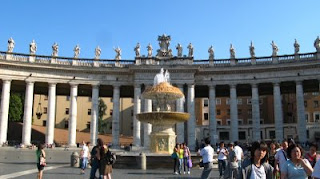
Again, the best place for links is probably this site: http://www.sacred-destinations.com/italy/rome. And my photos are here: http://www.flickr.com/photos/taking5/sets/72157619689628758/ . But let's end off with a picture of Bernini's famous colonnade; there are four rows of columns but when you stand on this particular spot you only see the front row:

Any lot will do


In Rome, the cars are largely quite small. Little Fiats, Renaults, the Swatch/Mercedes “Smart” car, even a little Toyota. In this crowded city, parking space is at a premium and small cars definitely have an edge. You don't even need to use a regular parking lot.


Tuesday, June 02, 2009

Passing by


I wanted to have a little daily post on my blog similar to the “Pooch of the Day” posts during last year's France trip. Since it was Italy, my initial thought was “Italian Hunk of the Day”, but it is not so easy to take shots of complete strangers (and the Swiss Guards were not very cooperative, shooing us away). So I thought I would focus on non-religious scenes instead.

This first shot is a bit of a cheat. After all, it is the restaurant where we had lunch on our first day in Rome. Chinese Italian food is not exactly what you'd get in the typically Cantonese restaurant here in Singapore and frankly most Zhi Cha food is a lot better. My guess is that they have huge problems getting ingredients, particularly fresh green leafy veggies. Think that was some fried lettuce we had for lunch today! Every other dish is cooked with capsicum, typically green. We are going to really miss our Kai Lan and Kangkong by the end of this trip. I was thinking at the end of the meal, if this is how Italians experience Chinese food, they are definitely not going to give up their pasta and pizza.

Pilgrimage 2009 - Rome, Rotondo, Lourdes

(Note: These posts were largely written on the road, but edited and posted upon return to Singapore. I'm backdating them so that they describe the events of the day.)

I had been meaning to take my mother on a pilgrimage for a few years – so this year we finally got round to signing up for a 13 day Rome-Rotondo-Lourdes pilgrimage.


Our group is some 27 people, excluding our tour leader and our spiritual director. Mostly retirees, but about 6 younger people (including me). In true Singapore style, I find one ex-colleague, one colleague of a cousin and the parents and aunts of my primary school classmate. As we always say, Singapore is a small place.


Our first day was meant to be an “easy” day, but I must admit I was truly exhausted at the end. Probably because I didn't sleep on the plane, beyond dozing off for a few minutes here and there.

We started off at the Basilica of St Paul outside the Walls, or Basilica di San Paolo fuori le Mura (there is another St Paul within the walls of Rome but it is an Episcopalian aka Anglican church), which was erected over St Paul's grave. Here, we met our guide, Roberta, who displays a truly impressive knowledge of church history, the popes, and Roman history. I am amazed that she can remember whether a building was built under Pious V or Pious VI or Sixtus V or Sixtus VI. Roberta herself is an elegant Italian woman – unlike the stereotypical fast-talking Italian, she pronounces each word deliberately, accompanied by graceful hand gestures. She has to speak softly in a little radio transmitter; we get headsets to listen to her. With the large number of tourist groups around each church or site, I can imagine the cacophony which would have resulted if all the guides attempted to communicate to their groups over each others' noise. So each day we wait for the aptly named “Whisper” man to arrive to bring our headsets in.

St Paul's is one of the four papal basilicas in Rome, where the high altar can be used only by the Pope or his nominee saying a mass in his place. It is full on columns on each side, with a glorious ceiling and the portraits of the popes lining the walls.


We then went to Tre Fontana – where Paul was decapitated by the sword. The place is so called because tradition has it that when Paul was beheaded, his head bounced on the ground three times and where his head hit the ground, a fountain emerged, according to church tradition. Today the springs seemed a little sluggish with the water moving only slightly. I thought of Paul at the end of his life, proclaiming “I have fought the good fight; I have won the race.”


After lunch, we went to Santa Croce – the church of the Holy Cross, which had within the relics of the True Cross, brought back to Rome by St Helen, the mother of the Roman Emperor Constantine, sometime around the 3rd Century AD. Apparently the church was built or originally converted from the house of Helen, after her death. Sorry no photos, the relics were in a very low light environment and they just didn't come out well.


Along the way, we passed the Circus Maximus, where many of the early Christians were killed by the Romans. It was next to the Palatine, the home of the Emperors (so they didn't need to go far for the executions). Today it is a green grassy plain with a raised hump in the centre. Rome is drenched in the blood of the martyrs; apparently half a million Christians were executed by the Romans, principally by the Emperor Nero.


Thereafter, we went to Sancta Scala (the Holy Stairs) and the Basilica of St John Lateran, just next to each other. At Sancta Scala, it was incredible to see all the pilgrims going up the stairs on their knees. Don't know whether it is truly the steps leading to Pontius Pilate's rooms but the deeper beauty and truth of this place is the faith and contrition displayed by all the pilgrims who are taking this painful journey to repent of their sins. Alas, where I was concerned, the spirit was willing (well sort of willing) but my knees are weak. I would be prepared to give it a go on the last day but wasn't willing to hobble for the rest of the pilgrimage.

Our next stop was the basilica of St John Lateran, or more accurately, the Archbasilica of the Most Holy Saviour, St. John the Baptist and the Evangelist at the Lateran. The name came about because the hill the Basilica was built on and surrounding lands were originally owned by the powerful Lateran family of ancient Rome. Constantine took over the lands to build the church, the first official church in Rome. Thus Christianity was institutionalised within the Roman Empire. This is why the church of St John Lateran has also the title of "ecumenical mother church" (mother church of the whole inhabited world). It is also the cathedral of the Pope as Bishop of Rome. So from the blood of the martyrs, rose the early church.

The popes stayed here at the Lateran basilica until 1309 when the papal court moved to Avignon; it would only return 68 years later in 1377 (see my post on the Pope's Palace here). But it was felt that the palace was in too poor condition and not fit for habitation (especially if one compares it to the papal palace at Avignon ). So they moved over to St Peter's where the pope has stayed every since.

St John Lateran has been re-built a few times over the years. It has an imposing nave with gigantic statues of the apostles on each side, each with their iconic symbol (eg two keys for St Peter; coins for Matthew). The floor is beautiful with multi-coloured marble in geometric patterns. Here, we had our first mass together as a group. Father looked at the sorry, exhausted state of his flock and kept his sermon short.


We went for dinner, checked in at the hotel and went to bed quickly.

I've not put in the links for many of these references, but more information on many of these places can be found here. My photos can be found here.
Starting the Day Right...

Related Posts Plugin for WordPress, Blogger...