Showing posts with label museums. Show all posts

Sunday, March 31, 2019

A Trio of Museums

I am embarrassed to admit that I have been to Kyoto on two other previous occasions but did not step into even one museum.  Gardens, cherry blossoms, autumn leaves, ponds and streams (and one cat cafe), but no museum.  This time round, it would be different.  We started off with one museum on our planned itinerary but ended up seeing two more, partly because there was quite a bit of rain on our last two days in Kyoto so we moved our activities indoors.

The Great Wave - taken off the museum poster,
not the original print
The museum we had put on our agenda was the Kyoto Ukiyo-e Museum.  After looking so hard and failing to see Hokusai's "The Great Wave off Kanagawa" in the Tokyo National Museum last year, I was so happy to find out that the Kyoto Ukiyo-E Museum had a special exhibition on Hokusai's work.  To recap, ukiyo-e are Japanese wood cut prints.  The word, "ukiyo-e" literally means "sadness of life", but the prints typically depicted scenes of every day life, and of nature.  Because it also commonly was used to make posters advertising performances of Japanese kabuki performers, geisha and teahouses, or the places and scenes of the “floating world”, ukiyo-e also came to describe life’s impermanence.  Nothing however could be less impermanent than these prints.  The ukiyo-e artist first draws out the print on paper, and it is then transferred to a wooden block.  In fact, depending on how detailed and how colourful each picture is, it could be transferred to many wooden blocks, each translating to a different layer of colour.  The wooden blocks are then covered with pigment, and carefully stamped on a piece of paper, layer by layer making the prints.  In this way, numerous prints could be made. It was art for the ordinary man.

At the same time, it was also highly influential.  Ukiyo-e and the Japanese sensibility towards nature and art inspired western artists - in particular the  Impressionists. Monet, for example, had a roomful of ukiyo-e which I saw when I visited his home in Giverny earlier in 2018.

Hokusai is one of the great ukiyo-e artists and he is famous, in particular for his "Thirty-six views of Mt Fuji" of which "The Great Wave" is one.  Unfortunately the museum was very small - it is literally one room and a shop so it is not really worth the 1000Y I paid.  If it was not for the special exhibition, I would have been rather disappointed.  But I managed to see not only the "Great Wave" but “Black Fuji” and “Red Fuji”.  Whilst these three prints were enclosed and behind glass, I could also see most of the other prints up close.  Sadly we were not able to take photos but it was really so impressive to see how the wood carver must have delicately carved each line, each curve of the outline.

Today, ukiyo-e continues to influence artists from all over the world.  I watched a video on the flight back to Singapore, on how this US artist started drawing a series of prints, entitled "Ukiyo Heroes", which was subsequently transferred on to the woodblocks by a craftsman based in Japan.

Yayoi Kusama
Our second museum was the Forever Museum of Contemporary Art's Yayoi Kusama : “Pumpkin Forever” exhibition.  The "Forever Museum" is in Gion Corner, beside the theatre where I watched the annual Spring Dances or Miyako-Odori in Kyoto.  Now, Kusama had held an exhibition in Singapore, at our National Gallery, but at that point in time I didn’t have the time to make a visit.  So it was destined that I view her art here back in her home country.

Again, we were only able to take photos of selected exhibits. Yayoi is quite a controversial character and artist; she left her native Japan to go to the US in the 1950s where she tried to break into the art world, a difficult feat for a Japanese woman.  In the liberal air, love and sunshine of the 1960s, she became a performance artist, in addition to her work as a painter and in creating soft sculptures (they look like sea anemones to me, although they are apparently soft phalluses).  She returned to Japan, but the stresses of life got to her and she admitted herself into a mental institution.  There she continued to paint.   Today, her fame and popularity has spread across the world and her work is exhibited in many countries.

Infinity Room
There is a Yayoi Kusama Museum newly opened in Tokyo.  Here in Kyoto, the exhibition is held across a few rooms in the Forever Museum.  She is famous for her polka dots and pumpkins, infinity rooms and mirrors and the combination of all three.  So of course the exhibition includes an infinity room of a mirrored pumpkin with polka dots and a wall with mirrored polka dots.  There are rooms full of polka-dotted flowers, of polka-dotted pumpkins (apparently no two are alike) of varying dimensions and colours.  I have to admit that there's a certain compelling quality to her art.  Sadly photography is not allowed of most of her works.

(Postscript: Apparently the Forever Museum of Contemporary Art closed in Feb 2019.  Sadly it was more ephemeral than the name suggests.  Anyway, for more info, click here.)

The third and last museum we visited was Kyoto International Manga Museum.  Totally something I never expected I would go to!  But it was a rainy day and googling "things to do in Kyoto on a rainy day" resulted in the manga museum coming up multiple times, on multiple lists.  So I decided to give it a go!  My brave attempt to understand the Japanese youth culture.
Inside the Manga Museum

This was indeed a very educational visit for me, especially as I have never opened a manga comic in my life (till now).  The museum is sited in a former school building and this history is apparent in the wide staircases leading up to each floor, the steps low and broad to accommodate the little legs of the younger children, the regular rooms where the classes must have been held. The museum traces the history of manga, and how it evolved over the years. Here I learnt too about the different types of manga - violent tales of the samurai warriors, stories of ghosts and spirits living side by side humans in the modern world, some really more fantasies and others of school days (cos they are targeting at a youth audience, obviously). Anyone can take down a manga and read!  Of course much of it is in Japanese, but there is a foreign language section, including an English section so I actually browsed through a few volumes worth of popular manga, “Natsume’s Book of Friends”. But even the English manga are printed Japanese-style, in other words you start reading from the back of the book, and it goes right to left not left to right.  Takes a little getting used to.

So that's it - a trio of museums, each portraying aspects of Japanese culture, ranging from traditional ukiyo-e to the modern manga and the polka-dotted world of Yayoi Kusama.

More photos will be put up when ready.


Saturday, December 01, 2018

A Day in Montmartre


The Basilica du Sacre-Coeur de Montmartre
Aside from our mini-pilgrimage to the Catholic sites in Paris and its environs, the other "theme" of this holiday is probably getting a glimpse into the lives of the Impressionists.  Not so much their paintings (been there done that), but where they lived and worked.  Today, our visit to Montmartre covered both areas, starting with our visit to the Sacre Coeur and then, after lunch, around the Musée de Montmartre.

Montmartre is the "hill of martyrs", so named after the first Bishop of Paris, St Denis, who was decapitated here.  A most appropriate place to site this beautiful basilica!  The building itself is rather new - construction started in 1875 and was completed in 1914, a mere 39 years after!  It is truly a pilgrimage, having to walk up the hill to get to the basilica (and braving the touts along the way) but of course it was one we willingly made :-)  We were rewarded of course by a spectacular view over Paris.

We got here in time for morning mass (it is our routine now) and we celebrated the feast day of that most French of saints, Joan of Arc.  Maybe it is because we are visiting so many French Churches this visit, but I find they do love their French saints - St Joan, St Ursula, St Vincent de Paul, St Louis IX, St Therese of Lisieux etc - whose images appear in the stained glass windows and whose statues pop up in the various little shrines. Whilst mass was in French, the choir was a small group of nuns and their pure, sweet voices needed no translation to be appreciated.  They continued to sing even after mass had ended, which added to the atmosphere of faith and joy which I felt during my time here.

St Joan, as peasant girl
and warrior maid
After mass, we explored the huge church in greater depth. It was not my first time here (I think more like my third?) but it has been sufficiently long ago for memories of previous visits to have dimmed (although I do remember coming for Sunday mass here, the entire building packed despite its size).  We admired the humongous mosaic above the altar (apparently the largest in France), and wandered around the little chapels, many of which were dedicated to the French saints.  But there are two conspicuously non-French saints featured.  First, there is a chapel for St Ignatius of Loyola (also called the Chapel of the Jesuits, it was certainly funded by them), who apparently came with his companions to the nearby Church of St Pierre (of course there was no chapel in those days) and it was here that they started the "Society of Jesus", or the Jesuits.  Another chapel has a sign to commemorate the visit by St John Paul II to the basilica in 1980.

I did not know that the Basilica is the venue for perpetual adoration of the Eucharist, something which started way back on 1 August, 1885!  Pilgrims come here to spend the night in the guesthouses here and take their turn to pray before the Eucharist.  Maybe it is an idea for another time.

For more photos, look here.

Life is Art
We had lunch at a little bistro somewhere down the hill. Due to our unfamiliarity with the area, we did not realise that we would have to make our way back again to get to the Musée de Montmartre, where we intended to spend the afternoon!  Ah well, the exercise was probably good for us.  It was also quite pleasant to wander around the narrow, steep streets of the area.  Montmartre formed no part of Baron Haussmann's plans for Paris and so it has no gracious boulevards or majestic squares.  It is full of staircases, twists, and turns, with a little bit of graffiti in the corners.  And when you turn around the corner there is indeed a little square, but full of shops and street artists plying their trade.  And all of a sudden, you feel that you have indeed walked back into a picture which Renoir could have painted, of people just enjoying the sunshine and each other's company.
12 Rue Cortot

The Musee de Montmartre is described as the "most charming museum in Paris" and indeed it is full of atmosphere.  We could almost see Renoir sketching in the garden, with Toulouse-Lautrec wandering in for a visit before going off to one of the nearby caberets (maybe the Caberet du Lapin Agile, or "Agile Rabbit", or the Theatre du Chat Noir, or the "Black Cat", or the Cabaret du Moulin Rouge, named after one of the windmills, many of which were once found here ).  Above the gardens, Suzanne Valadon would sit in her studio painting away at her easel.

Suzanne Valadon's atelier-apartment
The visit starts off with a short video on the history of Montmartre, before leading us through the gardens and to 12, Rue Cortot, where some artists (including Renoir) had their studio.  It is here that the collections of the museum can be found, with paintings of Montmartre over the years, and also featuring works by Toulouse-Lautrec, Suzanne Valadon, her son Maurice Utrillo and others.   We ended up with a visit to Suzanne's studio apartment right on top of the building.  Of course I am an utter dunce when it comes to art and aside from the big names (Monet, Renoir) I tend not to be so familiar with the others, including Suzanne.  But she had an interesting life - starting off as a model/muse for Renoir, Toulouse-Lautrec and Degas, and then going on to be an artist in her own right.  She was completely self-taught, except for what she picked up by observing and talking to the artists she was modelling for.  Got to respect a woman like that.

It was indeed a day of contrasts, from the sacred to the secular, from the serene beauty of the Basilica to the more tumultuous, vibrant life of the Bohemians.  But together, both Sacre Coeur and the Musee de Montmartre bring together and tell the story of this little corner of Paris.


Sunday, January 13, 2013

Son of Singapore - Sculptor Ng Eng Teng

Look Down by Taking5
Look Down, a photo by Taking5 on Flickr.
Look down and see the beggars at your feet
Look down and show some mercy if you can
Look down and see the sweepings of the street
Look down, look down
Upon your fellow man!

Poverty, hunger - the struggle to live and for human dignity have always been themes which resonate through the centuries- in the Paris of Victor Hugo, in Singapore in the 1960s and today.   The movie version of Les Miserables is currently showing here in Singapore..  I've decided not to watch it (because I have certain expectations as to how it should be sung), but could not help be reminded of this song from the musical when I visited the NUS Museum's exhibition on "Sculpting Life: The Ng Eng Teng Collection".  Ng's interest in social commentory is seen in this relief  - where the viewer is truly looking down upon the subjects (interesting use of foreshortening in a sculpture as opposed to a painting). 

Freedom Child
Fortunately, Ng has a far broader range of subjects, including much more cheerful subjects.  He is  well known for his public sculptures (eg "Wealth" and "Contentment", which used to be in Plaza Singapura) and his "Mother and Child" series.  My JC had a large relief along the two walls leading to its front lobby.  He even did some ceramics!

Here at the museum, one of the sculptures I really liked was this one, entitled "Freedom Child" .  This particular sculpture embodies, to me, contentment, playfulness, freedom, joy.  Such a contrast to "Look Down"!

A temporary exhibition on Ng currently running at the Museum is  "106 Joo Chiat Place: Ng Eng Teng House". This is just a single room, with sculptures from Ng Eng Teng's house/studio, and memorabilia about the sculptor.  The house, which was originally the home of Ng's father and family, became his studio and that of other artists. It was subsequently sold to a developer and has since been demolished.  The owner invited Singaporeans to come and take a piece of the house - for memory collectors, I guess.  For more information, do read the Museum blog post on the exhibition.  The exhibition runs until 3 February 2013

Look here for some more of my photos from the Ng Eng Teng exhibition, including mini "Freedom children".

Friday, December 31, 2010

Journey to Pompeii

I have been on leave all this week. Aside from meeting up/having a meal with friends, and clearing my work email, I've taken the opp to do a little bumming around Singapore.  One item on the "to-do" list was visiting the Pompeii exhibition at the National Museum of Singapore - Pompeii : Life in a Roman Town 79CE.

It's been a while since I visited the Museum - in fact, I've not returned since my first visit soon after the Museum re-opened.  Instead, I visited the Peranakan museum a few times in the interim :-)  So it was probably time for another trip.  And the Pompeii exhibition was well worth the time.

The first thing which greets the visitor to the exhibition are casts of people and animals lying on the ground.  When Pompeii was excavated, the forms of those who died during the volcanic eruption were found - the ash had covered them and formed moulds around their dead bodies.  Whilst the bodies decayed over time, the shapes remaind. Particularly poignant (for me) was the cast of the little dog which had been chained up to guard his owner's property, whilst they fled to safety.  He died trying to escape the chain. Another cast was of a man, seated on the floor, with his hand covering his mouth in an attempt to keep the ash out.  But his  efforts, too, were in vain. 

The next stop is a short video, which attempts to reproduce the eruption of Mount Vesuvius on that fateful day in  79CE.  The eruption was actually recorded by the Roman letter writer Pliny the Younger (the Pepys of his day), who describes what happens in some detail - from the early part of the eruption to the subsequent darkening of the sky and the constant raining down of ashes.  Pliny was in Misenum, a nearby town, not in Pompeii itself, but he too had to flee the town in order to escape the volcanic ash and fumes. His uncle, however, had taken a boat out to study the volcano and also to mount some sort of rescue mission and perished in the attempt.

Subsequent rooms contain pottery, coins, weights, religious artefacts, jewellery and other items from the destroyed city. But my favourite room was the one containing the statues and beautiful frescos from the town. Some of the colours were still so rich and fresh, I had difficulties in believing that these were really almost 2000 years old.  According to another short video, the frescos were preserved so well because of the ash they had been buried in, following the eruption.  There was also a beautiful little mosaic fountain.  It is fascinating to think that this is just one small Roman town, not particularly exceptional, yet with people who appreciated beauty, art, and the pleasures of life.

I ended up buying a book on Pompeii, and with a wish to pay a visit to the ruined city one day.  I feel fortunate indeed to live in Singapore, far  away (relatively) from active volcanos. But at the end of it, it is indeed a reminder not to take for granted the blessings which we have, for life as we know it can indeed change overnight.

A somewhat pensive thought to end the year on!

p.s.  a few more photos on my Flickr page.

Tuesday, May 27, 2008

In the footsteps of Popes and Emperors

Today, we took a day tour around Provence. I like taking day tours of the countryside; for people like us who don't want to drive around it makes a lot of sense because we can cover a lot of ground in one day. But because we covered so much ground, there's so much to say that I'll have to divide this into two posts.

Our first stop that morning was in Orange, to see the Roman ruins there - the triumphal arch and the antique theatre. Orange was originally known as Arausio but over time, the name got corrupted to Orange. It has nothing to do with the fruit. Our guide, Caroline, told us that the title of the Dutch “Prince of Orange” was originally derived from Orange here in France. I was puzzled. But looking it up when I got home, it appears that the title was originally derived through inheritance – the cross-border marriages of state which took place in those days. Even though the Prince of Orange has not “ruled” over Orange for centuries, the title is still used today. It reminds one how deeply rooted in its history Europe is, that the origins of these ancient names and titles are still known today.

Anyway, the first stop was at the well-preserved Roman triumphal arch, erected to mark the site of a great victory (the Arc de Triomphe in Paris and other arches are copies of the Roman arches). The sculptures on the sides of the arch still visible, as are the bullet marks, evidence of a less peaceful past. This was essentially a photo stop and we moved on quickly.

The antique theatre was seriously impressive. It is actually a UNESCO heritage site. I’d seen Roman ampitheatres before (Rome, Verona, Fiesole for example) but this was an antique theatre, an open-air theatre with a huge stage wall and the tiers of seats in front. In its day, it could seat up to 10,000 spectators. There was even some light roof covering. From what we were told, it is apparently the best preserved Roman theatre in Europe. The most prominent point in the theatre was a statue of the Emperor right at the top of the stage wall. There was a good audio tour which took us from point to point, and from this I learnt that actually the Emperor’s head could be removed, and would be replaced whenever there was a change in Emperor.

The rest of the stage wall would have been beautifully decorated with more statues in the niches. But these were removed over time. The theatre fell into disuse at one point and there were houses and even churches built inside it. There are little cavities in the stage wall, created by the inhabitants when they tried to use the wall as a support for beams and such. These were cleared out eventually and the theatre restored.

We climbed to the top of the theatre and there found a long covered corridor which curved around the seats. I was walking slightly ahead when my friend said that she couldn’t see me. I turned around and indeed she was not there – the curve of the corridor hid us from each other. That was when I realised just how good the acoustics were. It was like a whispering corridor – say something at one end and someone on the other end can hear it too. These Romans really knew their stuff.

The good thing about going on guided tours is that they take you very quickly to some key sights; the problem is that we miss a lot of little things along the way. In this case, we did not have time to look at the ruins of the temple beside the theatre or to visit the museum across from the theatre.

We went next to Chateauneuf-du-Pape, so called because the Popes in Avignon built a summer residence here to get away from the big city. The chateau is now a complete ruin, with only two walls left but there is a good view of the surrounding region from the hill. The popes did, however, leave an enduring legacy. They started vineyards and making wine here (one assumes it was for religious purposes). Today, Chateauneuf-du-Pape is an appellation wine. In a village of some 1,000 souls, there are 300 wine makers. I presume some of the employees are from the surrounding areas. Our guide noted that the reason why the area was so good for grapes was because of the rocky ground. The stones soak up the sunshine during the day, and then slowly releases the heat at the night.

We visited a wine museum and did a little wine-tasting of the Chateauneuf-du-Pape at maison Brotte. We tried the white and the red; apparently only 5% of the wine produced in this area is white wine, and is wholly consumed within France. The red wine is exported. Because of strict standards, the grapes of this wine must include Syrah (Shiraz) and Granache grapes. Here I must proudly boast about my very little wine knowledge, gathered over a few wine lessons: I could detect the peppery taste of the Granache grape.

After our wine tasting, our tour driver drove us back to Avignon; she had more passengers to pick up for the afternoon session. We had picked up some lunch (I got a beef pie) in Orange, we munched it as we went along. It was a good morning, which promised much for the afternoon.

Provence photos are here.

Sunday, May 25, 2008

Spirit and Structure

Today was our last full day in Paris – how time has flown.

We went for mass in Notre Dame – we’d checked out the mass times when we were there previously. It was an interesting mass. The previous day, the cathedral had hosted “La ceremonie d’adoubement des nouveaux Chevalier et d’investiture des ecclesiastiques et dames de l’Ordre equestre du Saint-Sepulcre de Jerusalem”, which I presume means the investiture of the new knights and dames of the Equestrian Order of the Holy Sepulchre of Jerusalem. I looked the name of the order up subsequently; at the time I read the notice I thought it was the “Order of Saint Sepulchre” and was thinking how strange it was to have a saint with such a name… pardon my (lack of) French indeed. Anyway, the mass appeared to be a celebratory mass for the new knights and dames, who filed in procession down the aisle to their reserved seats in the front of the church. The celebrant was Cardinal John Patrick Foley (a US Cardinal), the Grand Master of the Order.

The other unique feature of the mass was that it was sung in Gregorian chant, so the Gloria, Kyrie, Agnus Dei etc were in Latin. I remember thinking how pleased my dear mother would be – she’d know all the words and probably could sing along quite comfortably.

After mass, I had wanted to see St Chapelle – but was confronted by a fairly long queue. So we had lunch instead at a café on the Left Bank, opposite the Notre Dame. It was a pleasant little seat, with a good view of the river, and the buildings on the Ile de la Cité so although the restaurant was pretty pricey for the rather average food we got, we were nonetheless fairly happy.
I realized from scrutinizing my guidebook that we were only a block or two away from the Shakespeare and Co bookshop. So as soon as I’d downed my “Belle Epoque” crepe (bananas, chocolates, almonds, and four huge globs of Chantilly cream) I popped off to see the bookshop whilst my friend went off to another flea market. I’d read about the bookshop in my guidebooks and I must say I wasn’t disappointed. First, it was open - in Paris on a Sunday - and pretty crowded too! There was a quiet buzz about the place, people standing about the door looking at the Seine and the Notre Dame - a pleasant place to be.


Shakespeare & Co is an antiquarian bookshop, and indeed it reminded me of the old second hand bookshops down Charing Cross Road in London. But there are new books too, and a good section just inside which features books about France (all in English of course). The very thing I was looking for! So I bought a book (mentioned in an earlier post; now you know that I did edit my posts before putting them up) entitled “Sixty Million Frenchmen can’t be Wrong” by Jean-Benoit Nadeau and Julie Barlow, an attempt to explain “what makes the French so French”. We all know the French Paradox – they drink lots of wine, cheese and other fatty foods and yet have low obesity and few heart problems. Likewise, although the French seem to have high taxes, restrictive labour laws, large public sector etc etc – the economy still seems to be doing pretty well (in relative terms), with high labour productivity. The authors’ theory is that the reason why France works is the harmony between the “spirit” of the French and the structures they have given themselves, and the book spells this out in greater detail. I could have bought more books if I’d wanted to, but time was short and the weight of my baggage a weighty issue indeed. I was rather pleased, though that the book bears a “Shakespeare and Co” stamp on it.

The rest of the day was spent museum visiting, to maximize my museum pass (especially since I couldn’t go into Ste-Chapelle). Started off at the Louvre, where I’d decided to look more at the French paintings and early European paintings. There was another contemporary art exhibition going on at the time by Jan Fabre and the exhibits were scattered throughout the Louvre – so when I went into this huge room of old European paintings to see a coffin with a peacock head and tail sticking out.


I was running late after rushing through the French painters, but I could not resist and just before I left, went to take a peek at the Leonardo paintings – the Madonna of the Rocks, Virgin & St Anne and the one and only Mona Lisa. There were some “da Vinci Code” moments, I must admit. I checked out the weight of the Madonna on the Rocks and speculated whether it would be indeed possible for an elderly man with a bullet wound to insert a secret message behind it. As for the Mona Lisa, the best picture I got was of the crowd around her. (Note: After coming back to Singapore I discovered that the Louvre actually has a thematic trail on the “Da Vinci Code” which includes their comments on the factual elements in the book.)
I had planned to meet my friend at the Rodin Museum and so I rushed there. By this time, I was pretty exhausted, having rushed from place to place and wandering around the Louvre without many opportunities to take the weight off my feet. The Rodin Museum, like the Picasso museum, is in a huge old mansion. But the difference is that this was not being renovated and there was a great difference indeed. It was a pleasure to walk through the beautiful rose garden to the statue of The Thinker in the middle. The museum was closing soon so I had only a few minutes to rush through the rooms (it said that it was closing at 5.45pm but in reality they chased us out with about 10 minutes to spare).

We went that night for dinner at Restaurant 404, recommended by Eric as one of the best North African restaurants in Paris. It had a great atmosphere indeed and we were fortunate to get in there by 8.05pm. We were seated together with a couple who had not made a reservation (I have not sat with another group at a restaurant since my student days in London). But it was easy to see why they did that – the place had many reserved seats and it filled up pretty fast. By seating us together it was more likely that we would be served and leave at the same time, so there would be a whole table of 4 released, giving them more flexibility. I enjoyed the dinner – had a tagine of duck and apple which I rather enjoyed. We had dessert and also some mint tea, which I’ve not drunk since I was in Dubai (really must remember to do it here in Singapore, especially as I have a pot of fresh mint just outside the door!).

But we could not stay and soak up the atmosphere. Back to the apartment to pack!

Incidentally, for the whole of our stay in Paris, I never did manage to get online. Most of these posts were written off notes done during our stay there and then posted once we got back to Singapore.

P.S. Ok, I admit it! I also had to see the spot where the big inverted glass pyramid and the small little pyramid almost touched. Here it is.

p.p.s. I am also not unaware that the "Grand Master" phrase has Da Vinci Code echoes.

Saturday, May 24, 2008

Flotsam and Jetsam

Today, we spent the morning at the flea market, Marché aux Puces de St-Ouen. When we talk about a flea market in this context, we are actually talking about several different buildings, each packed with stalls selling slightly different items. Some sell antiques, but most really sell second-hand stuff, or really new items which are reproductions of the old stuff. These buildings are then surrounded by a lot of little shops selling cheap clothes, leather products, etc on the fringes.

My favourite market was the Marché Jules Vallès. This particular market sold old pieces of furniture, books, what have you. It was like an extended attic full of the flotsam and jetsam of many people’s lives. You could find anything in these markets, from an old keyboard, to clocks, to old porcelain statues missing a hand or a foot, to a kitchen stove and even an old Jaguar (yes, as in the car).


I would find it so difficult to work out what was a potential collectable which just needed a little restoration work, from what was really a piece of junk. For example, there was an old violin, probably three-quarter size. I was reminded of my sister’s old violin, which she used as a child. It was originally in my grandfather’s house and missed its strings, was covered in dirt and (if I’m correct) also missed its neck rest. When we got it cleaned up, it was actually quite a good violin. My sister used it until she grew out of it and got her very own, full-sized violin. But it was her violin teacher who made the call that it was usable, not me.

Actually, the flea market reminded me a little of my grandfather’s garage – which is probably the reason why I liked it so much. It even had the same, dusty smell.

We had a quick lunch and then I went off on my own to the Tuileries Gardens. I got off at the Louvre metro stop, then walked down the length of the gardens to reach the Musée de l’Orangerie. Now the Tuileries Gardens have at either end these large fountains, surrounded by sandy pathways… I realized just how sandy when I saw the sand blow in the wind. So I got off the main paths to walk down a quiet tree-lined avenue where there were fewer people and hence less disturbance of the sand. Nonetheless, my shoes were covered in dust.

Now, I’d bought the 2-day Paris Museum Pass the previous day from FNAC (the French Virgin Megastore counterpart which sells books, DVDs, CDs, electronic equipment etc). The virtue of the Museum Pass is that you don’t need to queue to get in. Or at least, you get your own separate queue. So I waltzed past all these people who presumably had queued for a while and walked to the head of separate queue. So it saves time (it also saves money if you go to enough museums, especially the more pricey ones) which can be better spent looking at exhibits.

The L’Orangerie is famed for the huge paintings of water lilies by Monet, which were a gift from him to the French State. The oval shape of the rooms were determined by him and he then worked his paintings (partially completed at the time the location was decided upon) to fit the space. There are a total of 8 paintings, 4 in each room. They depict water lilies at different times of the day. According to the AV show, Monet loved the subject of water lilies because the combination of the flowers, water, and the sky and clouds reflected in the water was like the combination of the earth, sea and sky – a limitless, boundary-less world, without any fixed focal point so the eye looks everywhere at once. The rooms, two ovals connected to each other, symbolize infinity. I sat in front of each painting, to soak this serene world in.


The L’Orangerie is actually a very manageable museum. Aside from the water lilies, there is a small very select collection of paintings. The original collector was a Paris art dealer, Paul Guillaume, who bought many of the paintings. After his death, his wife continued his collection and then gave them to the state. There are Renoirs, Cezannes and Matisses.

Now the plan was that I would meet my friend at the Picasso Museum in the Marais area later that evening. So I thought I would take a look around the shops and buildings in the Marais area. The word “Marais” means “marsh” and so the buildings in this area were built on reclaimed marshland. Many were built by the rich and wealthy, in particular the beautiful Place de Vosges, famous for its symmetrical layout. Cardinal Richelieu stayed here in 1615. Maison de Victor Hugo (I didn’t go in though) is in one corner. Hugo stayed here for many years and wrote Les Miserables here. Indeed, the Marais is a charming area, with beautiful old houses and buildings. I wandered around these narrow old streets (quite different from other parts of Paris) and made my way to the Musee Picasso.


I thought I would be able to spend some time here. But the Musee Picasso appeared to be undergoing some renovation. There was scaffolding outside (this is why there is no photo) and inside, everything seemed a little less permanent in nature with what appeared to be temporary signs and I could not seem to find the more famous paintings as listed in my guidebook (I forgot to pick up the museum guide, a hazard of getting the museum pass). I did find a rather nice little AV theatrette showing a film of the master at work – he’s painting on glass, the camera is on the other side so you can see what he paints. I also quite liked the exhibition of photos of Picasso by many famous photographers – Man Ray, Cecil Beaton, amongst others. Anyway, somehow I finished it in double-quick time. Then it started to rain… of course that day I did not bring my umbrella… so I was stuck in the shop for some time. The rain died, I ventured out and since it was still rather early (I’d planned for a two hour visit to the museum but lasted only an hour there) I was very fortunate to bump into my friend in the street! We happily went back home to take a rest before dinner.

Dinner that evening was in the little neighbourhood restaurant around the corner from our apartment. We walked there around 7.20pm and found that it would not open till 8pm (that was when we found out that restaurants open about 8pm in France). On previous evenings, we must have reached the restaurants just after 8pm. So we wandered around and returned to the restaurant. We were the first customers in and spent some time deciphering the menu. The next group of customers (all 3 of them) walked in and ordered the beef fondue. So when we tried to order it, we were told that there was no beef left! Amazing. Did she have a huge lunch crowd? So we had to have fish instead (that was the only other item available on the menu). At least, we got to eat escargot. Ok, but not great. Well, we are talking about snails here. The owner’s cute little dog was running around in the restaurant – where are the environmental inspectors in France! Parisians indeed do love their dogs!

Tuesday, December 12, 2006

Internal Transformation


The Old and the New (1)
Originally uploaded by Taking5.

I have been going around Singapore the past few days with some of my classmates. On Thursday, we went down the Singapore River from Boat Quay to the Esplanade. Then on Sunday, we visited the re-opened National Museum of Singapore. It is absolutely amazing to see how the museum has transformed itself from the old musty rooms of my schooldays to this modern museum which uses technology effectively to take the viewer through Singapore's history. It was well worth going to - and to my surprise, I could have stayed there for at least an hour or two more. More pictures of the new museum are here.

There are two series of galleries in the museum - the Living Galleries and the History Galleries. The Living Galleries are entertaining - nostalgia, Singapore heritage etc. But the History Galleries are impressive. Starting with a film on how Sang Nila Utama named a certain island "Singapura", and a section on Sir Stamford Raffles, we walked through exhibits on 19th Century Singapore and then to the early 20th Century. I personally enjoyed this part of the museum most. Especially the room containing several paintings from William Farquhar's Natural History Collection - delicate watercolours of the flora and fauna in the region. Farquhar commissioned various Chinese painters to paint these water colours for him. He brought his collection back to Britain with him and gave the paintings to the Royal Asiatic Society. They were auctioned off in 1993 and sold to Mr G K Goh. GK Goh then loaned them to the National Museum (or is it donated?). May many follow this extremely rare example of philanthropy in the arts !

The History galleries then go on to World War II and the Japanese Occupation, the years up to and struggle for independence. The museum presents the story in two ways - the "personal path" and the "events path" and I chose to follow the "personal path" and follow the journey through the experiences of individual Singaporeans. For example, it was interesting to hear how the Khong Guan brothers worked on cultivating good employer-employee relations throughout the years of labour unrest - they never had a single strike throughout this period!

The galleries conclude with the early years of nation-building. Frankly, I skimmed through this portion but it was fascinating to hear how the two men who conducted the Macdonald house bombing were caught, by the man who apprehended them. With one giant step, the National Museum has really totally transformed the whole museum-going experience for me and surely for a cohort of national-education-doubting-school children.

Friday, November 17, 2006

Dominicans and Constable

I managed to have mass with the Washington D.C. Dominican community on my last day in the US. I just wanted to go for a nice, quiet Saturday morning mass (considering that I would be missing Sunday mass due to time lags and such). So I went to St Dominic's down the road from our hotel where there was supposed to be an 8am daily mass. However, the church was locked and this lady I bumped into told me mass would be at 8.15am in the chapel. When I got there, it was completely empty except for one robed figure in a corner who I took to be the priest and so I sat half-way down the chapel. Then, these elderly white-robed men started entering the chapel. No other lay people in sight. I started feeling quite uneasy. Was I in the right place? I contemplated making a run for it. Then I decided that what the heck, I had every right as a Catholic to be present. Never mind that in a group of white-robed Dominican priests, I was clearly the odd woman out.

Anyway we started mass with the psalmody. I had no idea where to find this and the Dominican across the aisle had to assist. Mass proceeded as per normal after that. It was the feast day of St Martin of Tours so the sermon referred to the story of how he gave half his cloak to a beggar, etc and what "we as Dominicans" can learn from St Martin. Apparently the Dominicans don't take a vow of poverty and Martin of Tours was famous for his hermitlike existence. The liturgy of the Eucharist took place next and all the priests started moving up towards the altar and took turns saying their lines. At some points (eg the consecration of the bread and wine) it was a chorus. I stayed put. I do know my place. At communion, of course there was only one (lay) recipient. Was not sure whether to go but the main celebrant gave me a little nod and up I went. I can't say I enjoyed mass, but I did appreciate the experience.

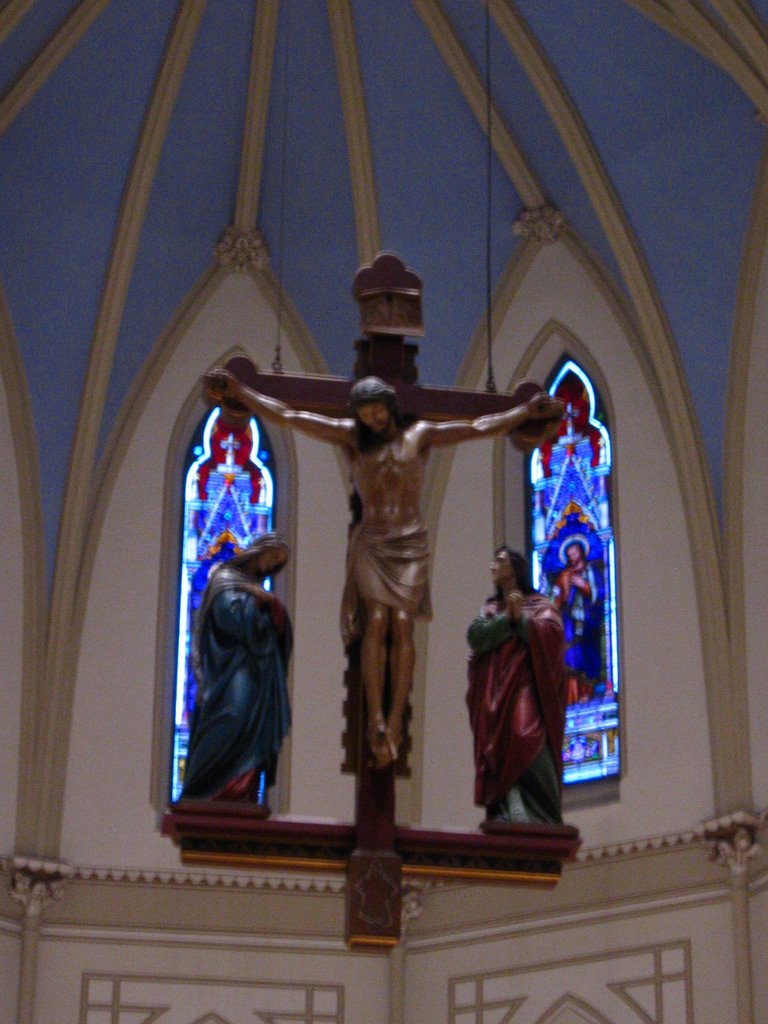
I didn't take any photos of the little priory chapel but here is the crucifix in the main church of St Dominic's. (I'd gone there for All Saints' Day when this photo was taken. What I did not expect was that I would be taking the wine up at Offertory. Someone asked me to do so at Offertory itself! I was not quite prepared for this and forgot to wait for the bread to be passed to the priest before returning to my seat. Ah well, it seems that I am not destined to have "ordinary" masses at St Dominic's.)

The previous day, we'd gone to the National Gallery of Art and since I'd spent time looking at American artists in Mexico, I went to see the special exhibition of John Constable's Six-Foot Paintings in the US! Constable started painting six-footers to attract attention at exhibitions and such. (Artists must always know what's commercial.) Constable started off by painting full-scale sketches of his work and then doing a polished version after that. It thus provides an idea of his thinking as he worked. The Six-Footers were done throughout Constable's career and therefore also show how his style progressed over time. One point which struck me was how the style in the final product began to look more and more like the more fluid and less polished style of his sketches, over time.

The National Gallery of Art is actually quite amazing. It was started off as a donation by Andrew Mellon to the nation in the hope that others would follow his example. And they did. Today, Bill Gates and Warren Buffet don't build museums/galleries. They look to improve public health around the world, and raise educational standards. Apparently the Gates Foundation is now one of the largest donors in the world, in the area of health, surpassing many countries' contributions. But they apply a private sector perspective on looking at effectiveness of aid, which perhaps state donors are less able to do. So income inequality in the US may be pretty stark but it is very difficult for anyone to resent Bill Gates' billions if he is helping to eradicate polio or whatever.

Sunday, November 12, 2006

Catrina, Posada and Diego Rivera

We spent most of our last day in Mexico wandering around the city, through the parks and the streets. The parks are great - cool shady oases in a bustling city. Not very busy too - we did see people walking their dogs in the park (Mexicans appear to be dog people) - but they were never overly crowded.

We also popped in on the Museo Mural Diego Rivera which is a museum with one main exhibit, a single mural by Diego Rivera which takes up a whole wall. It was originally in a hotel lobby- the hotel was destroyed in an earthquake but the mural managed to survive. Now, the mural was extremely controversial because Diego went and painted in a line which said "God does not exist". He was forced to paint it out but evidently God has a sense of humour, or else the mural would have been destroyed with the hotel!

Anyway, here is a small section of the famous mural. I took only one photo before being informed that I had to pay 5 pesos more for the pleasure of taking photos. So I stopped. At the very centre of the mural is El Calavera Catrina, arm in arm with her creator, Jose Guadalupe Posada. (For more on Posada and the creation of a cultural icon, here is a link.) The little boy holding Catrina's hand is Diego himself and reflects Diego's admiration for Posada. Behind them is Frida Kahlo, Diego's wife and a famous Mexican painter in her own right. I did not know until coming back and reading something about her that Frida was in a serious bus accident in her youth and she was essentially living in pain all her life. She painted many self portraits and a lot of it portrayed her pain, both physical and from her marriage to Diego. Diego had a habit of portraying his family members in his work - this mural featured his previous wife, his son (if I recall correctly), amongst others. He didn't have any children with Frida (the bus accident). The painting included politicians like Benito Juarez, and the Mexican dictator Porfirio Diaz. It also featured some of his themes, eg, family being evicted from their home, repressed worker, wicked banker etc. I liked Diego's work - the colours, the folklorish style, the density and detail. Most of all I liked his (socialist?) view that art belongs to the masses and hence his interest in public art and large murals.

This post brings me to the end of our stay in Mexico. Most of the backpackers in our hostel are moving on to other parts of Mexico and even South America but sigh, we are not amongst them. The Canadian girl is going down to Central America (where she hopes to learn Spanish) for a total of 3 months, the British vegetarian couple and the tall German girl are all off to Oaxaca. It is apparently only us kiasu Singaporeans who read US travel advisories on the situation in Oaxaca. The only other person here for a short stay was probably Hernand, the Peruvian who went on some of the same tours as we were. Hernand speaks as much English as I do Spanish so our conversations were necessarily limited. But I did manage to convey that we were studying administration and to get that he would be leaving for Peru the night just before we returned to the US. Maybe I am getting the hang of Espanol after being mistaken so many times as a hispanic.

Adios!

Layers of the Past - Mexico Day 3

Today was yet another free tour to the National Museum of Anthropology (Museo Nacional de Antropologia). Let me just give a little buzz for Mexbus, the company which runs all these tours for the hostel. The guides are knowledgeable, well-informed and speak good English. Although yours truly went and opened her mouth and supplemented the guide’s vocabulary at some points.

The National Museum of Anthropology is a real treasure trove of the cultural history of Mexico and the people who have lived in this area of Mesoamerica for 3,000 years prior to the arrival of the Spanish. It starts, literally, in the Stone Age when Early Man lived their hunter-gatherer lives. We saw a mammoth skull with the remainder of a stone weapon lodged in it, indicating that human beings had killed that animal. From these early beginnings, we saw how Man started to settle down and establish little farming communities, before moving on to the later rooms where the artefacts from Teotihuacan and the early Aztec world were on display. We saw how the early civilizations lived, and buried their dead (together with the utensils they used in life). Our guide (Leo again) showed us this mask which displayed how these early people perceived their world. Half the mask was a skull, the other half a living face (quite an ugly one), symbolizing again the duality of life and death.

There was a similar mask at the Teotihuacan room, where the skull is surronded by the rays of the sun (note the similarity of the sun's rays to those emitting from the Lady of Guadalupe, see previous post). I mentioned earlier that we only saw a selection of artifacts found in the Pyramid of the Moon at the Teotihuacan complex. Others were here in the Museum of Anthropology. The museum has re-created the pyramid façade of the temple of Quetzalcoatl and Tlaloc and painted it to show the original colouring. There is also a display of skeletons – probably of sacrificial victims. They are arranged the way they were found, some with necklaces of jaws around their necks. The display’s alarm system is pretty sensitive, as we found whenever anyone leaned forward to take a closer look.

The largest and most impressive room we went in was the Aztec (Mexica) Room. The first thing we saw was the Aztec “calendar”, hanging high up against the wall. Apparently it was not really a calendar – it was meant for some other purpose but a huge crack at the back of the “calendar” resulted in it remaining unfinished. But the Calendar shows how exact Aztec astronomy was. There were 18 months of 20 days each, i.e. a total of 360 days. There were also 5 “extra” days, which were supposed to be “bad” days where people generally stayed home and didn’t do much.

There was one rather stark exhibit – this huge stone circle which was carved around the sides with scenes depicting how many peoples/territories that particular Aztec king had conquered. The circle has a hole scooped out in the middle – this, we were told, was where the hearts of sacrificed victims were put. See the stone and other photos from the museum here.

We also saw in the room a family tree of the line of kings, including Montechzuma and Cuauhtemoc, the last king who died fighting the Spanish (his name means "the eagle has fallen" in the Aztec language). The story of how a few hundred men under Hernando Cortes managed to defeat the Aztec Empire is sad and tragic. The story is that the Aztec god, Quetzalcoatl, who was thought to be white-skinned, had left his people but promised to be back in a certain year. That year (our 1531) came and so did the Spanish. The Aztec mistook them for the returning God and treated them as such. But that was not enough for the Spanish. In the end, the Aztec were defeated by three factors: (i) new weapons (firearms) and animals (the horse), (ii) new diseases like syphilis and smallpox and (iii) their own harsh treatment of their conquered peoples – the Spanish found it easy enough to turn the native peoples against their Aztec rulers. The Spanish then proceeded to thoroughly destroy Aztec civilization. They pulled down pyramids and build churches; they took the altars of temples and put crosses on them to convert them to Christian altars; they even took the circular stones with the holes in the middle and turned them into baptismal fonts for use in the conversion of the natives! Some examples were in the museum. I also found on-line a rather nice little flash presentation on the conquest - click here.

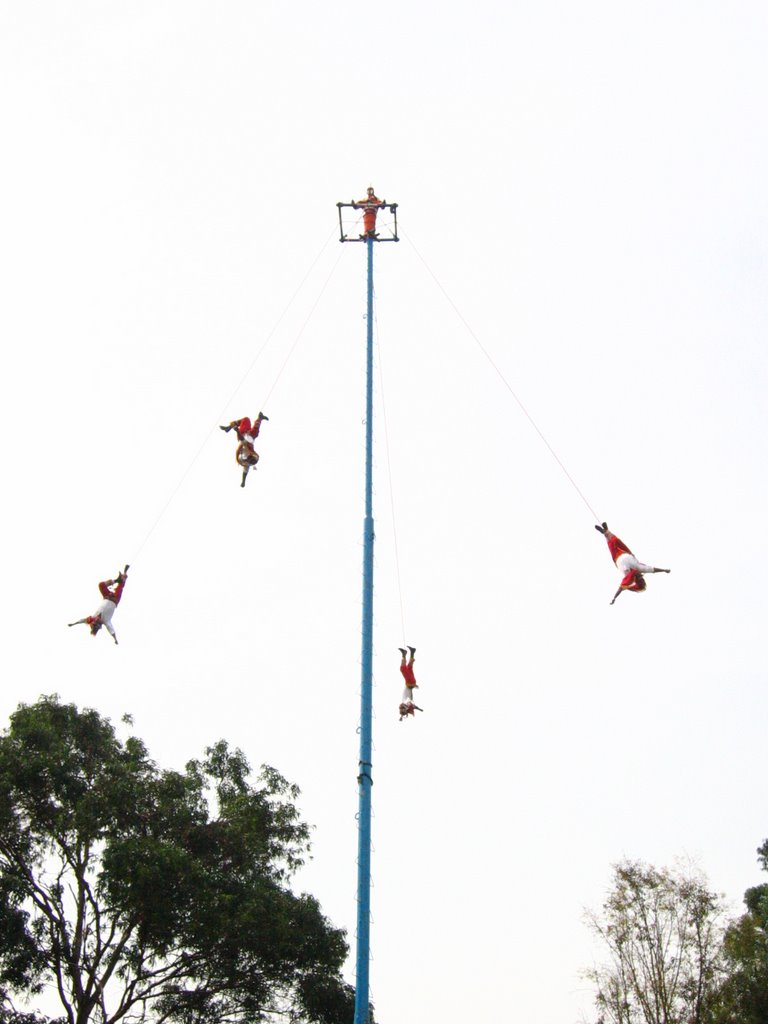
The museum has also interesting "live" exhibits. We saw a performance by the flyers of Papantla, or the Voladores de Papantla. Four men are tied to a maypole, they gradually lower themselves down whilst rotating from the pole. There is a fifth man standing on top of the maypole playing flute music. See video link of the flyers at my Multiply page (see link on left).

After the tour ended, we continued wandering around the museum on our own. There are other interesting rooms there – the room of the Oaxaca people, and the huge Maya room where there is a re-creation of a temple and the tomb of a Mayan king (Pacal) with the king himself interred there. I wish we had time to go to Chichen Itza! (But apparently whilst the pyramids there are shorter than those at Teotihuacan, they are steeper so the climb would have been even more painful).

All in all, it was fascinating. As I said before, the quality of the museums in Mexico City is excellent. In this museum, there are even some English language posters up and this really helped me to understand the exhibits, even without a guide. More than that, I thought that it really showed the layer upon layer of history which each group of people laid down in this area of Mesoamerica. From the early Pleioscene to the Teotihuacan people, and the Aztecs of Tenochtitlan, each group has left its mark in the area. But they were not the only ones – the Mayans, and the Oaxacan people, and the people along the Gulf of Mexico also had their own separate cultures and traditions. These people traded with each other, and traveled from place to place – creating a whole rich and separate civilization which is truly very different from any other I have encountered on my travels.

Wednesday, November 08, 2006

In the Historic Centre - Mexico, Day 1

Did I mention previously that our hostel has a tie-up with Mexbus, a tour company? So today we went on a free tour of the Historical Centre of Mexico, i.e. our neighbourhood. We started off in front of this huge map of the area in the pre-Hispanic times. There were two major cities in the area, Tenochtitlan and Tlatelolco. Tenochtitlan was the political and military centre of the Aztec world and Tlatelolco the economic centre. The two cities were on an island in the middle of a lake. After the Spanish conquered the Aztec, they started filling in the lake and Mexico City expanded on this reclaimed land. The Spanish also pulled down all the Aztec temples and used the stones to build churches next to the temple. But the churches are so heavy that they are now sinking into the earth... requiring a lot of conservation effort. Divine retribution?

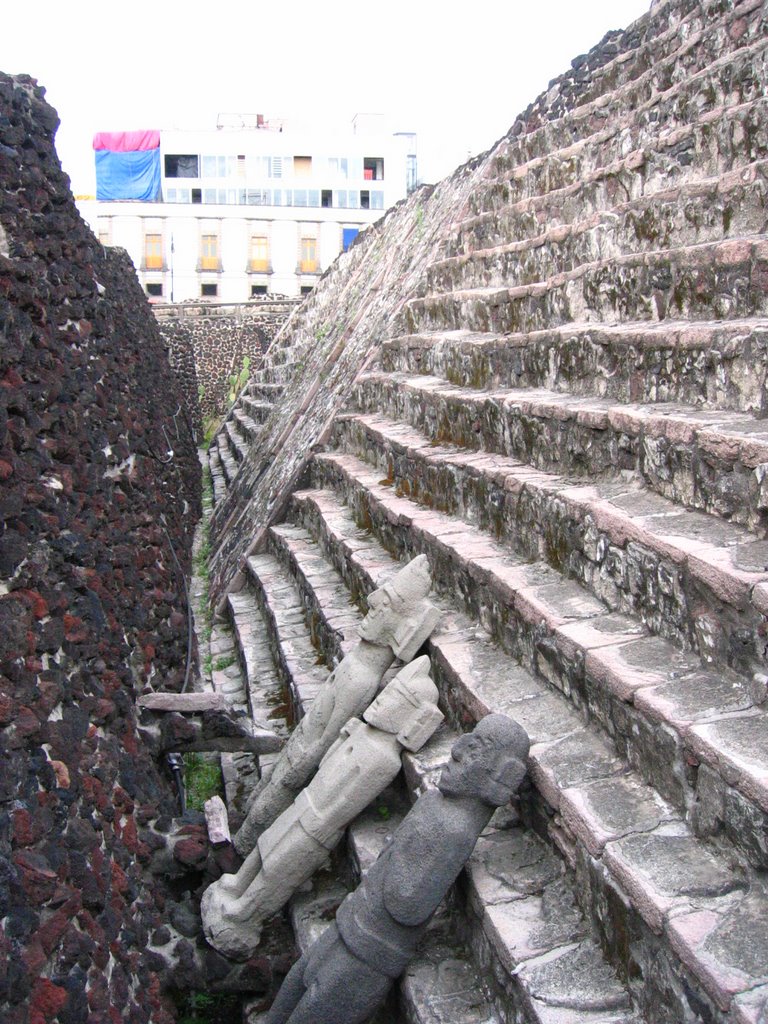
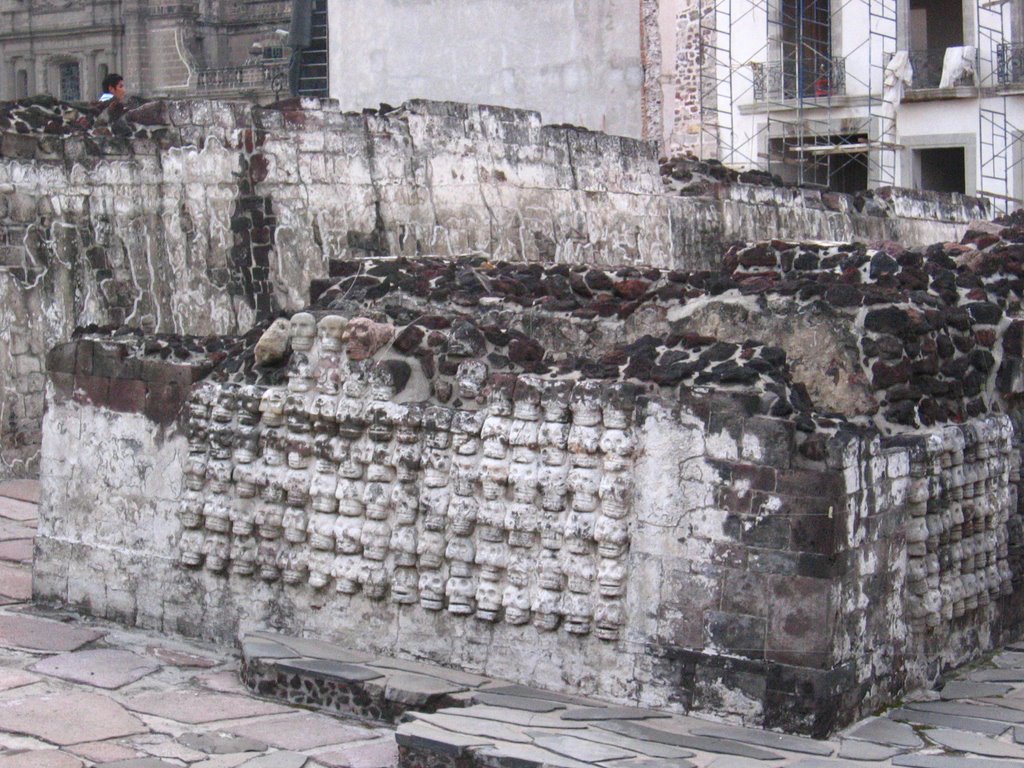
The Aztecs too had problems with their temples sinking into the earth. But they had a simple solution for that. Just build another temple over it. Remember, they were pyramid builders. So what you see on top is just the outermost layer, on top of a much older structure. There is a huge excavation site just next to the Catedral, of the Aztec Templo Mayor (Great Temple). The inner walls of the older pyramids are exposed to view here. We visited the site and the accompanying museum after the tour. There is this a macabre altar with human skulls all around it. That would have been the altar of the God of War.


Our next stop was the National Palace, where we were introduced to the murals of the famous Mexican painter, Diego Rivera. He has a series of murals up one staircase and down one wall of one of the palace courtyards. He was a communist and definitely anti-Spanish, anti-Catholic, so the Aztecs look like poor victimised people and Cortes and the Catholic church like murdering conquerors, making conversions by the sword. Truth to tell, the behaviour of the Spanish was also horribly cruel but they must have felt that anything was better than a religion that cut out the hearts of its adherents. Talk about relative moralities! Our guide (Leo) took us through the paintings in detail - Diego's prejudices aside, they also presented a lot of information about the pre-Hispanic world. There was a picture showing some of the religious rituals - playing a ball game called pelota; the Voladores de Paplanta or the Paplanta flyers. None of the more grisly rituals like cutting out hearts, although Leo told us that sometimes the victors of the ball games got the knife. Sacrificing the lives of some people, would ensure the survival and prosperity of the rest. Or, as someone in our group said, "life, for life." In one corner of the National Palace was a little display from the Day of the Dead celebrations. In one way, the culture of the Aztecs is still alive and well. Day of the Dead displays feature skeletons (or Katrinas) dressed up in fancy outfits, shrines and altars feature more skulls (we were to see a fine example at the old basilica of Our Lady of Guadalupe the following day). Its got this very tribalistic feel to it.

We next stopped over at the Catedral. I was amazed at the number of masses. There must have been about 8-9 altogether, 4-5 in the morning and another 4 in the evening. I went to the 5pm mass later that day. The Catedral itself is ornate. The first thing we saw was a huge chapel just inside the catedral, all covered in gold leaf. The main alter itself has tall gold-leaf covered columns on each side. I suppose this is after the Spanish style, with Mexican overtones. There were two large pipe organs. One is from Spain, the other Mexican-made. The Mexicans also have an interesting custom. There was a picture of our Lady on one of the walls with all these medals, and little photos stuck around the frame. Apparently, if someone has survived a brush with death, or recovered from a serious illness, the practice is to put up one of these little medallions or trinkets on the frame as a form of thanksgiving.

We then went on to view various buildings in the historic part of Mexico - the building in which the Spanish Inquisition was held (they brought it over from Spain), the Post Office building, the Opera House and the National Art Museum. The tour ended after that and we then went off on our own. We went back to the Art Museum, and had to enter by the back entrance because the front was being blocked by the group of Oaxacan protesters who were camping in the square just outside the museum. The museum itself (and this is true for all the Mexican museums we visited) was excellent. Of course some English explanations of the works would have been nice but this is a Spanish speaking country, after all.

We ended off our day with a tour around the ruins of Templo Mayor (as mentioned earlier). It is really an absorbing archaeological site and it is incredible to think that this was just one small part - and around and below me lie far more of the ancient city of Tenochtitlan.

Photos from Mexico Day 1 here! Day 2- will feature visit to Teotihuacan (and more pyramids).

Tuesday, October 17, 2006

An afternoon with JFK

This morning, we went to a new church - Sacred Heart of Jesus, on 6th Street about 15-20 minutes walk away from our hotel. So near and we did not know about it till now!

It is a lovely church - all stark stone outside and very warm and welcoming on the inside. The wall behind the alter is painted a warm crimson colour and this contrasts with the white alter piece.

It was also a most amusing mass. First of all, it was a memorial mass for St Hedwig. Yes, St Hedwig, wife, mother, queen and saint. Who is she, you may ask. As did we. So here's a link to St Hedwig. Her statue in the church was restored by the Polish Veterans' Association and re-dedicated at the mass, and there was a relic of the Saint available for veneration after the mass. The presiding priest is a round, tubby, Friar Tuck-like priest. He has an Irishman's gift of the gab and he showed it in his lengthy, "informal" prayers of intercession. He prayed for ill members of the parish, the two young men who were coming back from Iraq, and so on and so forth. He also speaks fairly quickly - rushed through the Nicean Creed really quickly. In his sermon, he highlighted the generosity of St Hedwig - she endowed monastries and things like that. He linked this up with a request to the congregation to be generous in their offerings....

(Incidentally I have a feeling that Sacred Heart was merged with St Hedwig's Parish, which is why there were also references to how St Hedwig parishoners lost their parish).

In the afternoon, I went to the John F. Kennedy Presidential Library and Museum. We went through the museum which is really a multi-media exhibition on JFK's Presidency. It featured a lot of his speeches - he is such a good orator. It also showed a little about his legacy, including of course the Kennedy School of Government at Harvard... It was a strangely moving visit. There was an exhibition room featuring the role of Robert Kennedy as Attorney-General - looks as though his contribution to JFK's short Presidency was substantial. The Kennedys are a truly tragic family. Anyway, I bought replica JFK campaign badges for my room mate and myself. Now I have a JFK badge and a Mao badge, haha!

Saturday, September 23, 2006

Museum of Fine Arts

I went to the Boston Museum of Fine Arts (MFA) on Thurs 21 September. The MFA was holding a special exhibition, "Americans in Paris" which showcased the work of a group of American painters such as John Singer Sargent, James McNeil Whistler (of Whistler's Mother fame) etc. It was a bit of a rush because I didn't realise that the exhibition would be ending on 24 Sep (when I would be in Vermont). So I rushed over after my ethics class and rushed back before the afternoon class.

Unfortunately the ticket counter did not accept my Harvard card because it is a staff not student card (it is one of the peculiarities of our stay here) and so I only got a student discount of $2.

The exhibition itself was good. It did not just present the artworks but also gave a sense of the life of the artists in Paris and of their subjects. The painters were very much influenced by the work of the Impressionists (in particular Monet) and also by the life of the Parisians. Some of them lacked commissions and so ended up painting each other - as Bohemians, or as "flaneurs" which are these young men about town types (sort of French Bertie Woosters, I imagine). Better known ones (such as Sargent) got commissions from Americans in Paris.

One of the "big" paintings of the exhibition was "Madame X" by Sargent. I was pretty pleased to see this one because I was looking for it at the Metropolitan Museum in NY and it was not there! Apparently there is a scandalous story associated with the portrait. The sitter, Madame Pierre Gautreau, was originally portrayed with the strap of her dress falling down her shoulder. However, the Paris Establishment thought it was shocking (even though L'Art du Nu was still very much on display at the time) and Sargent's reputation as a portraitist suffered. Mdme Gautreau was actually an American and so the story is that the Parisians were attacking the painting because they didn't like this American out-Frenching the French.

Leaving the exhibition, I took a peek at the MFA main collections - specifically the Impressionists! I must say that the collection displayed was quite small but pretty select. There was one Renoir of a couple dancing - "Dance at Bougival" and a few Monets (including some waterlillies, and a portrait of his wife dressed in a kimono).

Anyway, the exhibition ticket does allow me free re-entry within 10 days but to be honest, not sure whether I want to trek all the way back so soon. It is quite a long journey from Cambridge. Partly, because I have to take the Green Line train - this is a short little train with only two carriages and which are few and far apart so the train gets crowded quickly. The Museum is also free Wednesdays after 4pm so there is really no need to rush down. Essentially, would like to see more of the American painters and the US is the best place to see them. (Just like France is the best place to see French painters and the Tate is the best for Turners!).

Sunday, September 03, 2006

At The Met

A note on my visit to the Metropolitan Museum of Art on 2 Sep. It is a large museum, rather eclectic (or is that "comprehensive"?) in its mix of exhibits and artwork. As someone was saying, a combination of the dear old British Museum and National Gallery (plus many other things, including Suzhou gardens!). The Met can be all things to all men.

The main part of my time was spent in the American collection. Partly because once in the US, it makes sense to see works by US artists. But also because after the Musee D'Orsay, the museums of Florence, and the Egyptian and Grecian collections at the BM, it was time to see something new. The American collection is dominated by one man – George Washington. First of all, the large painting of “George Washington Crossing the Delaware” by Emanuel Leutze. I did not realise before that it was painted on such a monumental scale. The picture is of Washington looking resolute, standing on a small boat. His men are around him, some breaking the ice before the boat and the others rowing the boat onward. Other boats behind follow his lead. Facing this painting is another large painting of Washington and Lafayette (another Revolutionary General, I suppose) supposedly talking at Washington’s plantation, Mount Vernon. Above this, two portraits of George and Martha Washington. More portraits of George dot the other rooms.

The other series of paintings in the American Collection which I enjoyed very much were the landscapes by the “Hudson River School”. These painters were inspired by the thought of showing God’s presence in nature and include Thomas Cole, Asher Brown Durand and Frederick Church.

Guided by Frommer’s, I also chose to spend a few moments in the European section to look at the “Studiolo Gubbio”, which is essentially a small wood-panelled study room. The panelling represents bookshelves and cabinets on which are various books, scientific devices (of the day) and includes a bird in a cage. The Met’s note:


“This detail is from a study, (or studiolo), intended for meditation and study. Its walls are carried out in a wood-inlay technique known as intarsia. The latticework doors of the cabinets, shown open or partly closed, indicate the contemporary interest in linear perspective. The cabinets display objects reflecting Duke Federico's wide-ranging artistic and scientific interests, and the depictions of books recall his extensive library. Emblems of the Montefeltro are also represented. This room may have been designed by Francesco di Giorgio (1439–1502) and was executed by Giuliano da Majano (1432–1490). A similar room, in situ, was made for the duke's palace at Urbino.”

The Met also featured the Temple of Dendur, which is an ancient Egyptian shrine presented to the US govt by the Egyptian government. Whilst this is one of the Museum’s principal exhibits, I was disappointed in that it lacked sufficient detail and background to give visitors a better sense of the historical context of the shrine, its place in the community and so on (unless I missed this totally).

What else did I see at the Met? The Tiffany collection was lovely – lamps, vases (see lovely irridescent flower vase on the right), windows in beautiful glowing colours; the 4 knights charging down the middle of the hall were fun. See some other photos here.

Yes, I also visited the Store. Prices are a lot cheaper than those in Singapore – only to be expected.

In general, the Met is a most worthwhile place to spend a morning or a day (if time permits). Especially, with student discounts ($10 as compared to $20).

Starting the Day Right...

Related Posts Plugin for WordPress, Blogger...