Showing posts with label France. Show all posts

Saturday, December 22, 2018

Paris : Shopping and Eating

Galerie Vivienne
I always like to leave a free day at the end of a holiday to do a little shopping and also so that there is time to squeeze in that one last activity.  Then we can go back home with no regrets... But before we get to that, let’s first do the round up for food and shopping in Paris.

I have, even before my Konmari stint, stopped buying souvenirs on holiday and started buying specialty food.  But even so, it is possibly to have lots of fun shopping for food or even just cruising the shops.  So here are my highly personal shopping “to-Dos” in Paris:

1.  Walk through their covered passages.  I wanted to be a “flaneur” and walk around the elegant
covered galleries of Paris.  I forgot (silly me) that the French shopkeepers don’t work on Sundays and the galleries were closed. I did manage to find one (Galerie Vivienne)  which was open to people who just wanted to walk through, and it was full of charming old-fashioned shops which made me wish I could go in and explore further.  So try going there on a weekday, to get away from chain stores and discover something unique to bring home from Paris.

The queue outside Louis Vuitton, Galeries Lafayette
2. Look at the Louis Vuitton Queue at Galeries Lafayette, which spills out into the corridor...  .... I just went to the Galeries branch of Angelina, where I enjoyed a glass of their famous chocolate (I got it cold, which is probably a crime but it was a warm afternoon).  I had a hot chocolate at Café de Flores on another day, which is another must-do.

3. Visit Shakespeare & Co.  I just said that I don't buy souvenirs but there is always the exception that proves the rule.  For me, it is that one book from Shakespeare & Co (see earlier post), so I can get it stamped with the bookshop logo.  

4. Gawk at Le Bon Marche - Le Grand Epicerie.  
I loved the huge food hall where there are so many exotic foodstuffs on offer, from all over the world.  I bought some biscuits and other edibles to take back to the office. There are also a few counters where you can sample the fresh seafood (cooked on the spot for you), or get a quick sandwich (we did this) and also an extensive boulangerie section.  .

5. Have it all at G. Detou - ah, the owner’s boast is true they do indeed have everything (j’ai de
J'ai de tout
tout) an aspiring baker could ask for, all packed within the two little shop units which make up this old-fashioned shop. As Clothilde from C&Z says, it’s magic!  Like her, I got pearl sugar, about 1 kg worth...  that's going to be a lot of choquettes.  But that's one item you can't get anywhere in Singapore.

There are many other kitchen equipment shops in the vicinity of Les Halles, as documented here.  In particular E. Dehillerin, which like G. Detou, is an old fashioned little shop with wooden shelves going up to the ceiling, all filled with amazing copper pots and pans.

6. Buy a baguette! The French buy a baguette every day.  You had better do it too.  There is a great boulangerie just below my sister's apartment, so that is where we got our daily bread.

7. Buy cheese at the airport!  ‘Cos then you can be assured that it is packed for air travel and won’t stink up your luggage.  I got a slab of Comte, and a little round of Camembert.

We had a nice time eating in little bistros and restaurants around Paris, including Breton buckwheat crepes at a creperie in the St Michel area, steak frites (steak with fries, another classic meal) and a simple salade Nicoise at a small cafe on the same road as G. Detou.

But I thought I would mention a few in particular, in case you are looking for a (moderately priced) place to go to after you've finished a morning's sight-seeing:

Whimsical decor at La Fourmi Ailee
1.  After a visit to Notre Dame, when visiting the Latin Quarter, try La Fourmi Ailee, at 8, rue du Fouarre, Saint Michel. It is a charming little place, where the walls are covered with paintings including one of a tortoise and a series of Chinese characters.

I had a yummy fresh pasta dish with tomatoes and black olives.  Warm, hearty fare at reasonable prices.  There were only a few diners when we got there but the place filled up swiftly thereafter.

Mona Lisa as painted
by the computer
2.  Near the Louvre, you can find the Cafe de la Regence, 167 rue St Honore.  It is an elegant brasserie, with bookshelves and paintings lining the walls.  It was a little strange however to see a pixelated Mona Lisa on the wall just beside our table.

When in France, embrace French food.  So I ordered a duck confit (duck cooked in its own fat) and a bowl of French onion soup topped with a crust of bread and cheese - it's as traditional and French as you can get.  The duck drumstick was tender and tasty, and it was accompanied by the most marvellous tiny new potatoes!    The onion soup is such a French classic but it is so filling that it could be a whole meal in itself.  I was glad that we shared it.

Beef bourguignon
3. After visiting the Sacre Couer, or when wandering around Montmartre: Try L’Anvers du Decor, 32bis Rue D’Orsel.  This is definitely not in the super-crowded area just next to Sacre Coeur, so the serving staff had time to go through the menu with us.  

It is supposed to be famous for its beef dishes so I had the beef bourguignon with French beans on the side - lovely and tender meat, hearty, rich stock.  And of course this is another French classic meal.  My sister had a pot of mussels though.

Les Nympheas
Moving outside Paris, we had a lovely outdoor lunch in Les Nympheas in Giverny, just outside Monet's house.  The name translates to "water lilies" in English and is obviously a reference to Monet's iconic work.  The little restaurant is surrounded by a veritable sea of flowers and so we were happy to sit outdoors for once, where we were able to enjoy the sunshine and the beautiful blooms around us.  Go early, to beat the crowds and visit the garden after lunch.

I had a quiche for lunch but my mother and brother-in-law tackled the rabbit dish.  It looked rather yummy but the quiche was really very good so I have no regrets.

Quiche at 3 Rue Pichet
In Chartres, we had lunch at 3 Rue Pichet.  This is another small unpretentious, charming restaurant where the waitress brings the menu for the day on a little chalkboard.   I ordered a salmon and potato dish - well cooked and tasty but it was a little light, even for me.

My mother took the quiche and my sister the duck served in a broth with carrots, potatoes and bacon (!) with a crust of bread on the side.

So we had lots of tasty meals but I have to give praise where it is due, so  lots of kudos go to our favourite Chef, my dear Brother-in-law who would whip up something yummy most evenings so we could have home-cooked, value-for-money food rather than go out to eat.  He did a great steak frites, prepared a salad of buffalo mozzarella and after a day of sightseeing we got back to a dinner of asparagus, his famous roast potatoes, savoury sausages and a baked vegetable dish (I can't remember what vegetable exactly). And that was really eating like the French :-)

Dinner en famille
More photos will be put on Flickr, when I get round to it.

Last but not least... we did go for that one last activity in Paris ... a totally touristy activity, a boat cruise down the River Seine!  And so I end off this series of posts on Paris with a photo of the Eiffel Tower:

Au Revoir Paris!


Saturday, December 15, 2018

A Jewel of Cathedrals - Chartres

Chartres Cathedral
Chartres Cathedral, or more properly called Notre Dame de Chartres, is a jewel of Gothic architecture.  The first church on the site was built as early as the 4th Century, but was destroyed a few times and rebuilt each time.  Charles the Bald, the grandson of the great Charlemagne, donated the "Sancta Camisia", or the shift of the Virgin Mary, to the church and it became a place of pilgrimage.  (The shift is still to be found in the cathedral today).   Eventually, after yet another fire, Bishop Fulbert built a vast cathedral which was completed in 1037.  Whilst some part of this building was destroyed by fire, the bell tower and part of the front face remained.  The church was rebuilt and extended further (including the addition of another tower), and finally consecrated in 1260 in the presence of King Louis.  Today, the cathedral is renowned for its spectacular stained glass windows dating from the 12th and 13th centuries, its medieval crypt and the mysterious labyrinth embedded in the centre of its nave.  It is no wonder that this famous cathedral is a UNESCO World Heritage Site.

The North Rose Window
To say that the cathedral is beautiful is an understatement.  It is magnificent!  The tall vault above the nave, the majestic pillars, lead the eye up to the heavens.  The statues in the screen around the choir are so intricate and expressive.   The stained glass windows, with their vibrant colours and beautifully detailed panes - I could spend hours just trying to work out what scenes they depict.

We managed to get to the cathedral  in time for the tour by THE authority on Chartres Cathedral, Malcolm Miller.  Miller has been giving his tours since 1958!  He doesn't have a fixed tour per se, but brings visitors to different parts of the cathedral each time.  Apparently he is not really affiliated with the cathedral per se but they support his tours and he is listed on their website.  But you need to get in touch directly with him to check whether he is holding the tour on a particular day.  We were lucky enough to go on a day when he was conducting his tour. (There is another English language tour available so you can go on that if you miss Miller's tour).

Indeed his knowledge of the cathedral was truly encyclopaedic.  He pointed out the various biblical stories told in the stained glass windows, similar to how perhaps the illiterate peasants would have learnt the bible stories way back in the Middle Ages.

Detail - Adam and Eve
He also revealed the deeper theological references within the windows - for example, that whilst the tale of Adam and Eve described the Fall of Man, the Parable of the Good Samaritan spoke of God's Salvation through Jesus Christ.  In the parable, the traveller represents Adam, cast out from paradise; the priest and the Levite walk past him; but Christ is the Good Samaritan who brings him to safety and promises to return for him.  On a more prosaic note he also showed us the details in the windows which showed who had donated the cost of their production - be they tradesmen, or nobles etc.   More on the cathedral's stained glass windows can be found here.

Miller also took us outside the church, to take a look at the statues adorning the doors and entrances to the church.  He showed us the Last Judgement, found at the South Porch of the church.  Christ sits above the doorway, with Mary and John the Evangelist on either side, the angels above and around him.

We decided to go on a second tour, around the crypt.  The tour was in French but since you can't go to the crypt on your own and that was the only tour available... we went on it.   (Most of the people in the tour didn't speak French so we were all in the same boat).  The crypt is the largest in France and it is here that the early origins of the cathedral are most obvious, as being underground, it survived all the fires above.  The cathedral was rebuilt on the foundations of the crypt, and you can still see the ancient pillars on which the building above rests.  Old, faded murals on the walls also reflect the antiquity of this place.

The Labyrinth
The other well-known feature of Chartres cathedral is its labyrinth.  In the old days, pilgrims would walk the labyrinth (some on their knees).  It was symbolic of the twists and turns of life, the trials and false turns made along the way.  But eventually, the pilgrim could reach the centre where the way out was straight towards the altar, i.e. to God's saving presence.

When we were there, labyrinth was partly covered by chairs. It is revealed fully some days (I believe Friday afternoons).  I did not realise it was such a large labyrinth - reaching out to almost the entire width of the nave.

Around the altar, are the little chapels and shrines.  We saw the Lady of the Pillar (a local devotion to the Blessed Virgin), the Sancta Camisa as mentioned earlier.

In addition, there was a small little side shrine devoted to St Therese of Lisieux.  Beside it, preparations were being made to add one more - for St Therese’s parents, the newly canonised St Louis and Zelie Martin!  The first couple to be canonised as saints for their unique role in creating an exemplary Catholic family environment for their children.

We ended up spending the entire day in the Cathedral, without even going anywhere else in Chartres!  But it was indeed a day well spent, absorbing the beauty of the surroundings and praying in this sacred place.

More photos will be put up here.

Chartres Cathedral - Interior


Saturday, December 01, 2018

A Day in Montmartre


The Basilica du Sacre-Coeur de Montmartre
Aside from our mini-pilgrimage to the Catholic sites in Paris and its environs, the other "theme" of this holiday is probably getting a glimpse into the lives of the Impressionists.  Not so much their paintings (been there done that), but where they lived and worked.  Today, our visit to Montmartre covered both areas, starting with our visit to the Sacre Coeur and then, after lunch, around the Musée de Montmartre.

Montmartre is the "hill of martyrs", so named after the first Bishop of Paris, St Denis, who was decapitated here.  A most appropriate place to site this beautiful basilica!  The building itself is rather new - construction started in 1875 and was completed in 1914, a mere 39 years after!  It is truly a pilgrimage, having to walk up the hill to get to the basilica (and braving the touts along the way) but of course it was one we willingly made :-)  We were rewarded of course by a spectacular view over Paris.

We got here in time for morning mass (it is our routine now) and we celebrated the feast day of that most French of saints, Joan of Arc.  Maybe it is because we are visiting so many French Churches this visit, but I find they do love their French saints - St Joan, St Ursula, St Vincent de Paul, St Louis IX, St Therese of Lisieux etc - whose images appear in the stained glass windows and whose statues pop up in the various little shrines. Whilst mass was in French, the choir was a small group of nuns and their pure, sweet voices needed no translation to be appreciated.  They continued to sing even after mass had ended, which added to the atmosphere of faith and joy which I felt during my time here.

St Joan, as peasant girl
and warrior maid
After mass, we explored the huge church in greater depth. It was not my first time here (I think more like my third?) but it has been sufficiently long ago for memories of previous visits to have dimmed (although I do remember coming for Sunday mass here, the entire building packed despite its size).  We admired the humongous mosaic above the altar (apparently the largest in France), and wandered around the little chapels, many of which were dedicated to the French saints.  But there are two conspicuously non-French saints featured.  First, there is a chapel for St Ignatius of Loyola (also called the Chapel of the Jesuits, it was certainly funded by them), who apparently came with his companions to the nearby Church of St Pierre (of course there was no chapel in those days) and it was here that they started the "Society of Jesus", or the Jesuits.  Another chapel has a sign to commemorate the visit by St John Paul II to the basilica in 1980.

I did not know that the Basilica is the venue for perpetual adoration of the Eucharist, something which started way back on 1 August, 1885!  Pilgrims come here to spend the night in the guesthouses here and take their turn to pray before the Eucharist.  Maybe it is an idea for another time.

For more photos, look here.

Life is Art
We had lunch at a little bistro somewhere down the hill. Due to our unfamiliarity with the area, we did not realise that we would have to make our way back again to get to the Musée de Montmartre, where we intended to spend the afternoon!  Ah well, the exercise was probably good for us.  It was also quite pleasant to wander around the narrow, steep streets of the area.  Montmartre formed no part of Baron Haussmann's plans for Paris and so it has no gracious boulevards or majestic squares.  It is full of staircases, twists, and turns, with a little bit of graffiti in the corners.  And when you turn around the corner there is indeed a little square, but full of shops and street artists plying their trade.  And all of a sudden, you feel that you have indeed walked back into a picture which Renoir could have painted, of people just enjoying the sunshine and each other's company.
12 Rue Cortot

The Musee de Montmartre is described as the "most charming museum in Paris" and indeed it is full of atmosphere.  We could almost see Renoir sketching in the garden, with Toulouse-Lautrec wandering in for a visit before going off to one of the nearby caberets (maybe the Caberet du Lapin Agile, or "Agile Rabbit", or the Theatre du Chat Noir, or the "Black Cat", or the Cabaret du Moulin Rouge, named after one of the windmills, many of which were once found here ).  Above the gardens, Suzanne Valadon would sit in her studio painting away at her easel.

Suzanne Valadon's atelier-apartment
The visit starts off with a short video on the history of Montmartre, before leading us through the gardens and to 12, Rue Cortot, where some artists (including Renoir) had their studio.  It is here that the collections of the museum can be found, with paintings of Montmartre over the years, and also featuring works by Toulouse-Lautrec, Suzanne Valadon, her son Maurice Utrillo and others.   We ended up with a visit to Suzanne's studio apartment right on top of the building.  Of course I am an utter dunce when it comes to art and aside from the big names (Monet, Renoir) I tend not to be so familiar with the others, including Suzanne.  But she had an interesting life - starting off as a model/muse for Renoir, Toulouse-Lautrec and Degas, and then going on to be an artist in her own right.  She was completely self-taught, except for what she picked up by observing and talking to the artists she was modelling for.  Got to respect a woman like that.

It was indeed a day of contrasts, from the sacred to the secular, from the serene beauty of the Basilica to the more tumultuous, vibrant life of the Bohemians.  But together, both Sacre Coeur and the Musee de Montmartre bring together and tell the story of this little corner of Paris.


Sunday, November 18, 2018

Saints Extraordinaire


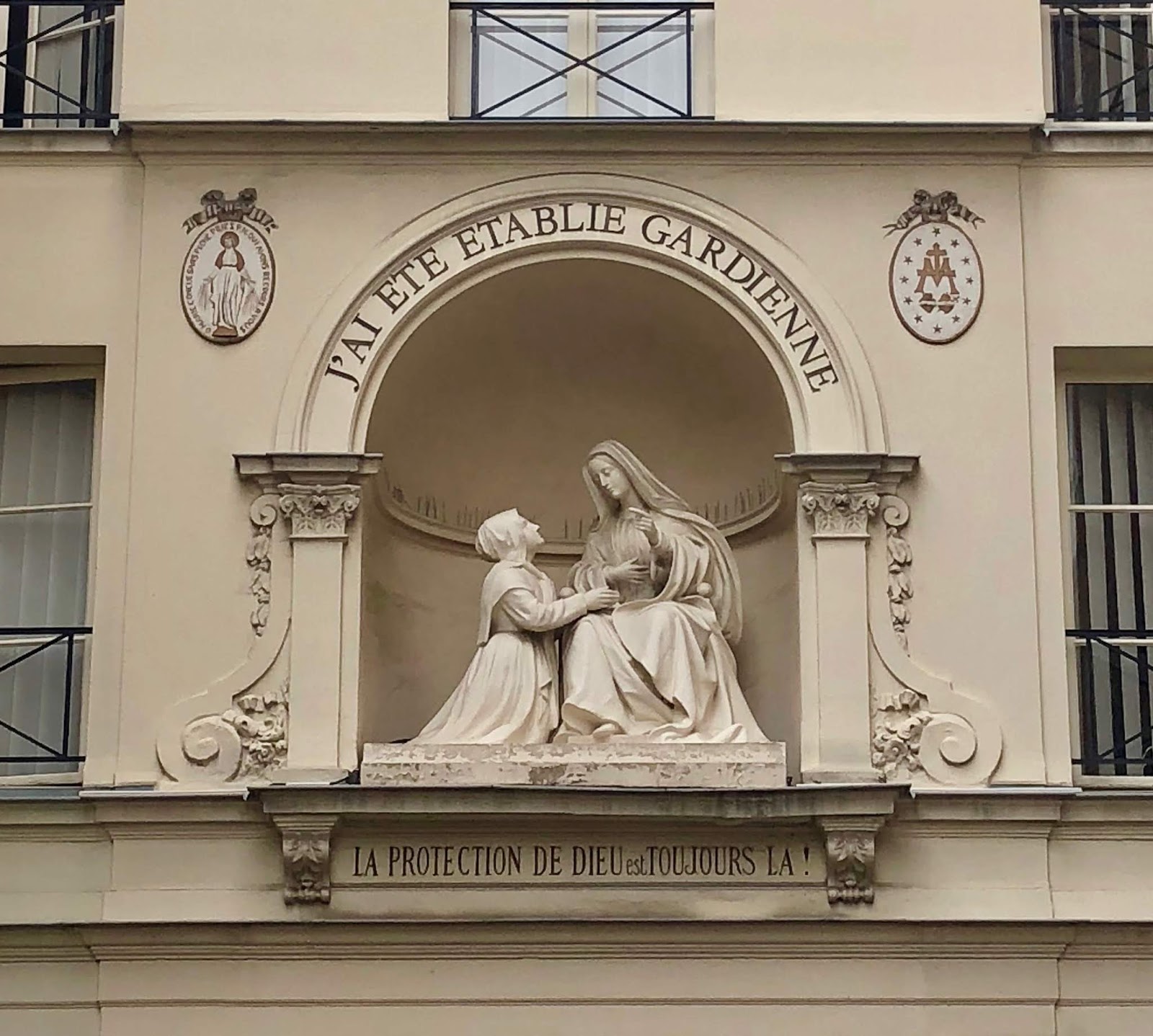
St Catherine praying at the feet of Mary
In a little corner of the left bank of Paris, just behind the trendy St Germain area, is "Religious Orders HQ".  We came here to visit the Chapel of the Miraculous Medal, but found also the motherhouse of the Mission Etrangers de Paris (MEP), and the Espace Nicholas Barre of the "Souers de L'Enfant Jesus"!  Without them, my life would indeed not have been the same!

The visit to the Chapel was one of the more significant stops on our mini-pilgrimage.  Hidden behind an insignificant little entrance way on the Rue du Bac, this is the original quarters of the Sisters of Charity (also called the Daughters of Charity), co-founded by St Vincent de Paul and St Louise Marillac.  It was here that the Virgin Mary appeared to St Catherine Laboure, then merely a novice of the order.  A detailed account of Catherine's story is here, but I shall give a short summary: Catherine had a vision of Mary, seated on a chair.  Mary asked her to have a medal made, with the image of Mary with beams of lights emitting from her hands on one side, and with the Sacred Hearts of Mary and Jesus on the other.  Around the person of Mary, the words, "O Mary, conceived without sin, pray for us who have recourse to thee". Thus, the medal is more properly known as the "Medal of the Immaculate Conception", and confers graces and blessings on the wearer.  Catherine had the medal made but her identity and role in its making was kept secret for most of her life.  She was subsequently canonised as a saint.

The Chapel at Rue de Bac
The Chapel of the Miraculous Medal itself is a shrine containing the perfectly preserved bodies of St Catherine Laboure and St Louise Marillac.  It also holds a reliquary containing the undecayed heart of St Vincent de Paul, which had been removed earlier from his then undecayed body.  Unfortunately, the body of this great saint subsequently decayed after being affected by a flood.   We visited his shrine later on, just around the corner.

Anyway, we had timed our visit to the chapel in good time to attend the morning mass, but it was quite crowded what with all the groups of pilgrims coming from all over and seats were in short supply.  So we had to split up. But we were fortunate, for others could not even get a seat! I took some time to admire the chapel - it is truly a little jewel, with lovely mosaics covering the arch above the altar, and on the side chapels.  On the left of the altar is St Joseph, bearing the Christ child, and on the right, Mary holds a globe in her hands.

It was a powerful experience being there for mass and even after, as the pilgrims stayed back for quite some time after mass ended, to venerate the saints and to pray at the foot of the altar.  Thereafter, we went to the little shop and bought lots of medals and got them blessed by one of the priests who said mass.

We went next to the Shrine of St Vincent de Paul, just around the corner. It was behind yet another nondescript door but what splendour awaited us on the other side!
.
Magnificent shrine of St Vincent de Paul
The shrine is richly decorated, with an ornate ceiling and pillars along the sides.  The bones of St Vincent, covered in wax to create a wax model, are in a transparent case above the altar, and apparently you can get nearer if you go up a staircase behind the altar.  Well, we did not know it at the time and so did not go up...

Two other, lesser known saints lie along the side aisles of the church - St Jean-Gabriel Perboyre and St Francois-Regis Clet, both martyred in China.  More of their background is told in this article.  These two martyrs are priests of the order of the Congregation of the Mission (CM), which is a missionary order set up by St Vincent de Paul (again).  They are also called Vincentians, or Lazarists.  The main church is this shrine of St Vincent de Paul and hence this is where the other two saints were laid to rest.  Interestingly, the one society St Vincent did not found is the Society of St Vincent de Paul!  It was in fact set up as a lay society by a French lawyer, Blessed Frederic Ozanam, who was inspired by St Vincent to do this work for the poor.

After the visit to the shrine, we went back to Rue du Bac to have lunch at La Grande Epicerie de Paris, the food section of Le Bon Marche, Paris' oldest department store.  We had a simple sandwich there and thereafter made some purchases (mostly goodies for the office) before making our way onward.

The "Meridian Line"
After lunch, we went on to our next stop, the Church of St Sulpice. St Sulpice was born in 570AD (!) and died in 647.  He was the Bishop of Bourges and was greatly concerned with the poor and the sick.  The current church replaced an older one on the same site and was built by the then Parish Priest, Jean-Jacques Olier (1608-1657).  It is the second largest church in Paris, smaller only than the Notre Dame and includes a seminary as well.  There are a number of interesting features about this church, such as its impressive pipe organ, and more unusually, its "gnomon", which is an astronomical device meant to help determine the dates of important church feasts.  The gnomon was featured in the Dan Brown book, "The Da Vinci Code", and called a "Meridian Line".  It was meant to act as a red herring to confuse those who sought the grail... ... but the use, and description of the line in the book were in fact erroneous.  Even so, due to the book's popularity, the number of visitors to the church increased, all looking for this device.  So much so that there was apparently a small notice indicating that a lot of the details about the gnomon in the book were in fact wrong.  I didn't see the notice, but then again I never even realised that the obelisk had anything to do with the Da Vinci code ...

After this visit, we had certainly seen enough churches for the day, so we went to the Cafe de Flores for hot chocolat and tarte au citron.  Then back home to rest.

More photos of the Miraculous Medal here, of the Shrine of St Vincent here and of St Sulpice (from both this and a previous trip) here.

Sunday, October 28, 2018

Monet's Garden at Giverny

A perfect garden, a perfect day.

The Water Lily Pond at Les Jardins de Claude Monet at Giverny

I have always wanted to visit the incredible gardens of Claude Monet at Giverny. And this time, with my garden-loving mother around, it seemed like the perfect opportunity! Especially since my brother-in-law kindly took leave to drive us there.  So off we went in our little rental car to Giverny.

Monet established his family at Giverny in 1883 when he was 43 years old.  It was not a conventional family.  His first wife had died some time after the birth of her second child, following which Monet became "romantically involved" with the wife of a friend.  She and her children, stayed with Monet and his children at Giverny.  Monet was already an established painter, and his home and gardens in Giverny provided the inspiration for some of his most famous and spectacular works.  More on Monet's life story is here.

Monet found inspiration in the Japanese aesthetic for his art, and I like to think that he was also inspired by the beautiful Japanese gardens for his Water Garden too.  We walked down a little pathway to emerge at the water lily pond.  The pond was like a mirror, reflecting the sky, the trees and plants surrounding it.  As we strolled around the pond, different aspects of the pond appeared - the willow, draping its branches over the bridge; the boat (and boatman) going across it; the multi-coloured flowering plants.  On the pond, the lily pads floated, and reeds peeked above the surface.  It was as though I had walked into a Monet painting.  Indeed, this was what Monet wanted to do when he created his huge images of his garden for the Orangerie museum (his gift to France, which I had visited on a previous trip), to create an entire world in itself, without horizon, of water, lilies and light.

We went next to the formal gardens beside his house.  It was full of beautiful spring flowers, a blend of colour and light - again, just like a painting!  I learnt however that they plant with the season in mind, so that the gardens are flowering all the time.

The formal gardens
Monet's first studio
From the gardens, we entered Monet's house.  The first room we went in contained Monet's collection of Japanese Ukiyo-e (woodcut) prints, including those by great masters such as Hokusai. But the highlight was visiting his first studio, a large room overlooking the garden, with big windows all along the side.  The walls were covered by his paintings (replaced since by reproductions) so visitors could admire his genius.  Monet subsequently moved into another studio and it would appear that this became the family living room.

Going upstairs, into the bedrooms, gave an even better view of the grounds and there were even more paintings.  In his bedroom - paintings by other Impressionists, including Renoir.  There was another bedroom, I believe the one used by his stepdaughter who was living in the house after his death.

The front entrance and the house
Going downstairs again, we saw the dining room and the most enviable kitchen, with its tiled walls, copper pots and gigantic kitchen table.

In short, this was truly a comfortable and welcoming family home for Monet and his family.

With this visit, as well as my earlier trip to Rouen, to see its famed cathedral, I have really had the oppportunity to see for myself how the artist reperceives his subjects - whether it is the lily pond, or the formal garden, or the ancient cathedral - and transforms it into a masterpiece.  What a privilege!

But this was not the end of our day.  My sister wanted to do a little more sightseeing before returning to Paris so we went next to the little town of "Le Petit Anderlys".

It's a charming little village, with its half timbered houses, ancient church and fortress on a hill,  Chateau Galliard built originally by Richard the Lionheart of England.

Half timbered houses, Le Petit Anderlys
 Indeed, visiting this little town reminds me just how much history this corner of France holds.  It was from Normandy, of course, that William the Conqueror hailed from.  His descendants linked Normandy and England for so many years, and it was here that so many battles between the French and the English were fought (and thereafter, the battles of WWI and II).

There is so much more to learn and see.  One day I must really do a proper visit to Normandy!

Many more photos here.


Saturday, October 06, 2018

A Pilgrimage to Nevers


St Bernadette's shrine, in the convent chapel
(no photos of the saint are allowed)
You are going to Nevers?  Pour-quoi?

Apparently that’s what my sister’s colleagues said when she told them that we are going to Nevers.  I suppose that these days, the French are not that religious and so they do not know that St Bernadette's intact body rests in a quiet convent chapel in this small town.

My mother and I had made a pilgrimage to Lourdes previously, where we saw the grotto where the apparitions of the Blessed Virgin appeared to Bernadette, and various places associated with the Saint's life.  (The entire series of posts can be found here).

So this time round, visiting the shrine of St Bernadette was definitely going to be a stop on our mini-pilgrimage.  Bernadette's body rests at the convent of St Gildard, where she first entered as a postulant to join the Sisters of Charity of Nevers. The Sisters had had a small  school in Lourdes, and had taken in Bernadette as a pupil, so when she entered religious life it was a natural choice for her.  The convent of St Gildard was where she spent the rest of her brief life, dying as she sat in a chair in the infirmary.  Today, the convent has become a place of pilgrimage and retreat centre, called Espace Bernadette.  We walked through the quiet grounds, visited the little museum on the life of the saint, and went for mass in the chapel where we also prayed by the body of St Bernadette.  A replica of the grotto at Massabielle is beside the chapel, but it was so hot that we didn't linger there.

Inside the Chapelle of St Joseph
Nevers itself is about two hours from Paris, so we got there around 11am+, just in time for mass (in French).  It was on 25th May (so you know how late this post is), so we celebrated the feast of St Philip Neri.  There was a small group of schoolchildren and they were the special guests sitting next to the altar.  Later on, we saw them exploring the grounds, worksheet in hand, looking for the answers to their assignment.

The convent itself is surrounded by its grounds - gentle meadows and gardens.  There is also the little Chapelle of St Joseph was where St Bernadette was originally laid to rest. She was exhumed for inspection in 1909, 1919 and 1925.  Each time, it was found to be intact even though the skin has darkened over time (it is covered with a wax mask).  There is in fact a detailed write-up about the condition of the body, including the organs (the liver was found to be still soft).  After the last inspection, the body was placed in the shrine in the chapel. And, of course, Bernadette was canonised as a saint!

Our Lady of the Waters
Coming here, it is easy to picture Bernadette walking down the garden paths, going all the way from the big convent building to the shady and peaceful corner where stands Our Lady of the Waters.  It was a favourite spot of Bernadette's as it was this particular image of Our Lady which reminded her of the One she met.  

We also visited the museum, which features some of Bernadette's belongings - the clothes in which she came to the convent, the apothecary scales which she used to weigh medicine (she worked in the infirmary) and the chair she died in.  There are also a few of her writings featured.  

According to the tourist sites such as this one, there are other things to see in Nevers such as the cathedral, a former ducal palace and a ceramic museum.  But we didn't really have time for a visit.  By the time we finished visiting the convent (taking into account our break for lunch after mass) it was late afternoon and we had to catch our train back to Paris.  So we walked through the old town, past a large park full of children practicing their roller-blading, and past the old town walls.  Then we wandered back to the train station and took our two hour train journey back to Paris.

A tiring day but one, according to my Mum, which helped her check off one more thing off her Catholic Bucket List.

More photos here.

The old town wall and cathedral beyond

Sunday, September 02, 2018

Notre Dame, St Chapelle and Latin Quarter

St Chapelle by Candlelight
Four Seasons
Undoubtedly, the highlight of this second day in Paris was our concert at Sainte-Chapelle. Vivaldi's Four Seasons sung through the chapel.

Sainte Chapelle was built by King Louis IX (later St Louis) to house the Crown of Thorns (at least what was thought to be the crown of thorns).  Completed in 1248 (!), it is a beautiful medieval chapel with tall windows of magnificent stained glass. Whilst there has been some destruction over the years (for example during the French Revolution), apparently two-thirds of the stained glass is original, and the chapel underwent an extensive restoration fairly recently.   It is one of the most difficult attractions to get into in Paris, due to the small size and the length of the queues outside.  So I thought that the best way was to combine the visit with this classical music concert.

Indeed it was a very special experience.  The queues were long, it is true, but needed in any case to get through security and into the chapel.  As the sun was still shining (days are lengthening at the end of May) we still got to see the stained glass lit by the light of the evening sun outside.  The strains of "Air on a G String", followed by the "Four Seasons" filled the chapel as the light slowly faded outside.  But then the exquisite screen, just behind the musicians then took prominence.  It was really an unforgettable evening!
Chapel of the Crown of Thorns

After the concert, we were surprised when the rain started    pouring down when we left.  The day had been so bright and sunny that we were not expecting such strong, gusty winds nor the torrential rain.  It was as though we were experiencing Singapore's own two seasons (tropical heat and thunderstorms) in this one day!

But back to how we spent the day.  We started off at Cathedral of Notre Dame at the Ile de Cite, which I have been to twice during previous visits to Paris. But as always, you find new things to see.  This time, I particularly noticed the chapel devoted to the Crown of Thorns relic (moved over from Sainte-Chapelle during the French Revolution).  I am always rather sceptical as to the authenticity of these relics but one can and should remember the symbolism of the crown of thorns, and the suffering of Christ which he endured on our behalf.

Restored - the Visit of the Magi


The Cathedral itself is undergoing its own slow process of restoration.  The exterior has been largely completed and within, various areas have already been restored.  The screen around the high altar is in progress, so half of it looks a little grubby whilst in the other half, the expressions and features figures in the key biblical scenes have emerged from centuries of dust and grime.

Within Shakespeare & Co
After our visit to Notre Dame, we had lunch across the Seine in the Latin Quarter and from there we last visit to Paris.  This little bookshop is so popular with tourists that it has even managed to start up its own little eatery on the side.  But I like it for the quirky little upper room, with its beautiful view of the towers of Notre Dame, and the resident cat (I didn't spot the cat but I did see the cat bed!).

I bought a book (of course) - David Leibovitz's The Sweet Life in Paris which I had borrowed previously from the library.  I like his irreverent style, his self-deprecating humour, and the yummy recipes sprinkled throughout.  My sister read the book prior to moving to Paris and apparently can relate to the tussles with the French bureaucracy both within government and with the service standards and processes in even the commercial retail establishments.  My mother too ended up reading the book during the rest of our stay.

Christ child meets John the Baptist
We continued to stroll around the Latin Quarter, visiting the church of Saint Severin, famous for its gargoyles, stained glass, and magnificent architecture.  It has also got a majestic pipe organ, so the church is also famous for its sacred music performances.  We were lucky that someone was rehearsing whilst we were there  - click here for my video.  The stained glass is huge - so you can actually see every single detail clearly!  There were more small churches in close proximity to St Severin, but we didn't go visiting them (two in one day is quite enough).

We also walked on the banks of the Seine, itself a UNESCO World Heritage Site.   On Pont Neuf we took in the views over the Seine including the impressive  Conciergerie, a palace turned prison turned Department of Justice.  We ended the day with dinner, and of course the concert at Sainte-Chapelle.

A long but enjoyable day!  More photos here.

The classic view of the Conciergerie  with the tourist boat sailing past

Saturday, June 13, 2009

Friday, June 12, 2009

Lourdes and the Pilgrimage Industry

Lourdes used to be an obscure little village. Then came the apparitions and nothing was the same. Lourdes today is probably the most visited pilgrimage centre in the world (followed, apparently, by Our Lady of Guadalupe – so now I've visited the two most popular Marian shrines in the world - see this post).

Evidence of the tourism industry is apparent throughout – hotels everywhere, lots of Paris-style cafes along the roads and most of all, lots and lots of gift shops. Attractions-wise, they are pretty much all religious. Aside from the Sanctuary, we visited the birthplace of Bernadette and Le Cachot, the little hovel Bernadette's family was staying in when she first saw the apparitions.

Many people come here also to walk in the footsteps of St Bernadette. 2008 was the 150th Anniversary of the Apparitions and a route is marked on the roads in blue for those who want to visit the sites associated with Bernadette.

The shops sell mainly religious artefacts, including the candles for the candlelight procession and the ubiquitous bottles for Lourdes water. My mother brought with her 4 Listerine bottles, courtesy of a relative. My mother explained herself: “they are flat and easy to pack”, but the Lourdes water bottles were themselves also reasonably packable. Well, we had bought a few larger 500ml ones and several small little bottles to fill and give away. The shops also open pretty late, particularly those near the entrance of the Sanctuary, to catch the late night shoppers after the candle procession.

Our last hour in Lourdes was spent (I am sorry to say) not in prayer and contemplation but in doing some last minute shopping. I did not buy myself any rosaries but did get a few rosary bracelets. It would have been nice and convenient for saying the rosary on the tour itself coz it was certainly a little more difficult getting the rosary ring out of my bag quickly, when Father decided it was time to say a few decades.

My mother, on the other hand, spent some time looking for the perfect statue of our Lady of Lourdes. She ended up buying three, one for my grandmother, one for her god daughter and one for ourselves. Of course, they were neatly packed in her hand luggage as the check-in luggage had all been packed. So when we subsequently went through the metal detector she was stopped and her statues scrutinised for potential explosives.

But despite the hotels, shops and cafes, nothing can take away from the peace of Lourdes. It is a place of prayer and healing. So on our last day here, we did do a tour of the Sanctuary for one last time, washed our faces in Lourdes water, and checked on the candle we lit the previous night. The rain of the previous day was replaced by sunny skies and so we sat across the river from the grotto and said a quiet prayer that the peace of Lourdes would stay with us.


See more of my photos here.

Thursday, June 11, 2009

Monks in the Basilica


Monks in the Basilica
Originally uploaded by Taking5
I saw this group of monks walking around the rosary basilica. Hmmm.... learning about the commonalities between Buddhism and Christianity? Anyway, surely not an everyday sight in Lourdes.

Drinking the Waters of Lourdes

The individual pilgrim has to make his own journey in Lourdes, too. Throughout the day in Lourdes, masses are said in various languages. The Chapel of Reconciliation is open for confession and pilgrims also can take the Way of the Cross. But there are other traditions here in Lourdes – going for a bath, washing one's face in Lourdes water, and so on.

We had gone for the Way of the Cross on our first day at Lourdes, after the International Mass. There are two Ways of the Cross here in Lourdes – one for the disabled, and one for the able bodied – up a hillside. Walking up the hill in the heat, looking at these huge, full-sized statues, really did bring out the meaning of the Way of the Cross for all of us, journeying together with Christ on Calvary. It was also a good preparation for confession as we were called to examine our conscience during this journey.
Our second day in Lourdes was largely set aside for individual prayer and reflection. Having said, that, it was a very busy day starting with mass at 6am! This was the English language mass for the day at Lourdes and since we were the largest group that morning, Father was the main celebrant at mass and we had to provide the lectors for the morning, choose hymns and so on.

Of course, it was a drippy, drizzly morning so we were all there in our raincoats and umbrellas. But being at the grotto in the morning was wonderful and mass was indeed a very moving and meaningful experience. We were invited to approach the altar and the spring after mass and I took the opportunity to insert the petitions I had brought in the box provided.

We went back to the hotel for breakfast. What is really wonderful about breakfast is that our tour leader (who has a very good relationship with the hotel) has arranged hot food – omelette and sausages – for us, in addition to the continental buffet breakfast which is its standard offering. Very welcome on the cold morning. And we needed it, because the next item on our busy schedule was the baths. “Wash your face in the spring” was what Our Lady said to Bernadette (and that was all she did) but we modern pilgrims want to immerse ourselves in it. (Note that Our Lady also told Bernadette to eat the grass, but none of us are actually doing that.)

I was a little nervous, I must admit. It was a drizzly, windy morning. The water was said to be cold. We would be going in starkers. But in the end, it was over too quickly. We got there about half an hour before the baths were due to open, and sat there waiting. There are a group of volunteers who pray the rosary aloud so the atmosphere was one of prayer. The baths themselves are divided into cubicles, and at any moment there could be about 4 people going into the cubicle – undressing under the shield of a cloak, in the bath proper (a curtain separates the bath from the rest of the cubicle), change back into one's clothes etc. I was really a little excited anticipating the bath itself. Went in, and was somehow very quickly whisked out of the cloak and into a wet towel. Deftly done, I don't know how they did it. Then a quick prayer for my intentions and then I got dunked for a second or so into the water, then it was all over. One of the characteristics of the baths is that somehow there are no towels, but you dry off very quickly. Nonetheless, I got a little cold waiting in the windy, drizzly entrance way for my dear mother to emerge from the bath.
Went back to the hotel to warm up a bit and get ready for the rest of the day. It is fortunate that our hotel is so near the grotto because I think we went too and fro about 5-6 times today. After a brief rest, we went back to the Sanctuary, this time to visit the Rosary Basilica for the first time and also the upper Basilica of the Immaculate Conception above it.

But just beneath the Upper Basilica is the Crypt, the original church built on top of the grotto in response to a request by Our Lady to Bernadette. It was therefore built in the 1850s or so and what is so moving about it is that every single block of stone has an inscription on it, each thanking Our Lady of Lourdes (Notre Dame de Lourdes) for graces received. Most are in French (obviously) with a very few are in English – I saw one thanking Mary for being “Cured of Deadly Cancer”. I really like this tradition which I first noticed in Provence last year (although there it was not so much thanksgiving but "in memoriam"). It gives a sense that this is not just some beautiful building but a focal point for a particular community.

We then went to the Upper Basilica. Its beautiful stained glass windows depict the story of Bernadette, incidents in the Old/New Testament, and portray individual saints. But the majority of the pilgrims spend their time in the Rosary Basilica, which is at ground level. This Basilica got its name because all the originial 15 Mysteries of the Rosary are depicted in mosaics around the basilica. The “new” Mysteries of Light are also present, but these mosaics adorn the front of the basilica instead. I spent some time here after going for confession, praying the Rosary.

Lourdes is a place where many come to get a plenary indulgence (remission of the temporal punishment due for all sins committed). i.e. to shorten or remove time in Purgatory. For this manifestation of God's grace, we need to either take the baths or do the Way of the Cross, go to confession, receive the Eucharist, and pray for the intentions of the Pope. But what I realised was that by going through these activities in faith and prayer, I did emerge feeling spiritually cleansed and closer to God and this is the true grace which one receives from the experience.
That evening, we watched the candlelight procession. It is almost as meaningful as taking part in in directly because now you really get a good overview of what is going on and a better sense of how large the procession really is. After the procession, we lit our own candle beside the grotto.
We went back to sit and pray outside the grotto for a while. My mother was getting chilly so we left after about an hour or so but a few members of our group (we were to learn) would spend most of the night there in silent prayer.
Peace!

Wednesday, June 10, 2009

Lourdes – a place of pilgrimage for the universal church


Lourdes, Lourdes. Whoever thought that there would be so much to see and do? Our time there was so packed that it is difficult to make sense and describe the many different experiences and impressions. After some reflection I thought I could describe it from three different perspectives.
First, as a place of pilgrimage, it is a meeting point for the universal church. Second, where individuals can intensely experience the Lord.
Lastly, it is where the pilgrimage industry can be observed. Not such a spiritual experience but certainly quite interesting to observe.

But first, a little context setting. Lourdes is essentially a pilgrimage town, with hotels, shops and restaurants serving the pilgrims there. We are staying in a hotel just a 5 minute walk away from the Sanctuary, and overlooking the River Gave which Bernadette was supposed to cross when she first saw the apparition of Our Lady. The Sanctuary itself is sprawling – it comprises the Grotto, with a statue on the spot where the apparition appeared and the spring flowing vigorously from the ground. By the Grotto, are the taps from which we can fill our bottles with the water of Lourdes. Then there are the churches – the original Basilica of the Immaculate Conception built directly above the Grotto, and then in front of it the Rosary Basilica, which contains a mosaic for each of the original 15 Joyful, Sorrowful and Glorious Mysteries of the Rosary and in front of it, the latest 5 Luminous Mysteries. Below our feet – the Underground Basilica of Pius X. Across the River, the Church of St Bernadette. There is also a chapel of reconciliation, for confessions. All this just to accommodate the multitudes of pilgrims who throng Lourdes! For more details on Lourdes, St Bernadette, here is the link to the official Lourdes site (check out the little interactive site at the bottom of the screen for a virtual tour of Lourdes!)
Now for the rest of my post.
My first impression was that Lourdes is indeed a meeting point for the universal church. Never have I felt so much the sense that I am in a true community of believers, from all over the world. Since it was Wednesday, we started the day off going for the International Mass, held in the cavernous underground basilica. Mass is said in 6 languages – French, Italian, Spanish, English, German and Dutch. So here we were, with people from all over the world, coming here together and praying in so many languages but yet everyone knew what was going on and able to follow the same mass together. At the beginning of the mass, a priest would “introduce” the various groups of pilgrims, by language group – so a French priest introduced the pilgrims from various French-speaking countries (cheers erupt when each group is announced), followed by the Italian-speaking pilgrims, the Spanish, the English (including a group from Singapore and Malaysia, ie us!!), the German and finally the Dutch-speaking pilgrims. The main celebrant was a French bishop; the readings said in three languages with the reading in the other three languages flashed overhead on the large screens around the basilica; the languages are alternated for the gospel reading. No sermon, but a song about Bernadette ends the mass.
But this is only one of the “mass activities” here in Lourdes. Lourdes is a place where the sick take pride of place. They have special reserved areas during the mass, and in the evening there is a special Blessing for the sick, where the sick move in procession to the Underground Basilica where we together adore the Blessed Sacrament.
But the culmination of any visit to Lourdes has to be the candlelight procession. Our Lady said to Bernadette, that she wanted people to come in procession here. The candlelight procession is long, very long. And this is not even the peak of the pilgrimage season! We assemble about half an hour before the procession and find a place to stand. We have our own banner (Malaysia/Singapore) and arranged ourselves behind it. Behind us, there is an Irish group behind us from Waterford and also a German group. The rosary is said in the same six languages, with the leaders from the different language groups taking turns to lead the “Hail Marys”. We take one hour to say the rosary, as songs are sung after each decade. As we recite the rosary, we walk in procession slowly, behind the statue of Our Lady, around the great field in front of the two Basilicas until we get to the square right in front of the basilica. Even by the time the statue reaches the front of the basilica again, there are still pilgrims starting to make their way around the square.

Carrying our candles high, we move in a snaking “S” shape pattern (see video below) till we reached the front of the Basilica. We end off with “Salve Regina”, which we have been learning over the past few days but I must admit I still wasn't very good (and I am not able to sing it now either). Finally, we offer the sign of peace to all those around us. The crowd disperses, back to our hotels, and then to our own homes. But we bring a little of the peace of Lourdes with us.


More photos of Lourdes here.

Starting the Day Right...

Related Posts Plugin for WordPress, Blogger...