More Assisi shots here. More on the Order of Friars, Minor, here.
Sunday, June 07, 2009
Visiting St Francis
More Assisi shots here. More on the Order of Friars, Minor, here.
Friday, June 05, 2009
Meeting Padre Pio
The morning was enlivened by an experience of the passionate Italian character. We waited some 45 minutes for our bus. Our tour leader called the coach agency to check on the driver and learnt that it was caught in traffic. But the agency head was not pleased with the driver and (apparently) scolded him for being late. He protested that he had woken up at 4.40am after sleeping at midnight checking the routes. Despite this early start, he could not get to the hotel on time because of Rome's heavy traffic. Our tour leader observed that he was surprised that the tour agency had not booked a hotel room for the driver; important so that he would start off the day well rested when he picked us up, instead of already been on the road for a couple of hours. Anyway, the driver argued (at great length, and very noisily) with his agency on the phone en route – note that the nature of the Italian is such that he has to gesture every now and then, taking his hand off the wheel in the process. I saw Father put his hand in his pocket for his Rosary, to pray for a safe journey and for the driver.
Indeed, we were to spend much time saying our rosary. Father is building up slowly. We said two rosaries, the Sorrowful and Glorious mysteries. Unfortunately the second round was after lunch and it was a drowsy group repeating our Hail Marys.
Padre Pio. But the high point of the visit was definitely the time spent at the side of the body of Pio. The serene face of the saint, resting in his glass coffin, surrounded by those who had come to venerate him. Pio, in his long life, had thousands upon thousands of fans. In fact, if anything, he was able to generate the kind of passionate following which people normally bestow on pop stars and actors. The museum featured some of the letters which Pio received, apparently so many that the Capuchins had to deploy their friars to help open and answer his mail. Similarly, the queues for his confessional were so long that a queue ticketing system had to be introduced. The biography also describes how a group of local, “Pious Ladies” were so jealous of the time the saint spent on anyone else that they would push and shove aside people who were waiting for him at the confessional. Indeed, as the biography states, it would seem that his greatest trial was not so much the stigmata which marked his hands, feet and side but dealing with the masses who came to see him every day, and the problems the Pious Ladies gave him!Wednesday, December 03, 2008
Goodbye Hwei Yen
I look at the pictures of a warm, friendly girl and find it so shocking to think of how terrifying her last hours were. It was a fate she did not deserve, and neither did any of the other people who died at the hands of the terrorists.
I look at her photos and think that this could be anyone's daughter, anyone's sister, anyone's colleague, anyone's friend. And maybe that's why everyone in Singapore feel it so much. Singapore is such a small country. Her husband's family go to the same church I do, they went to the same schools as my family members did. We mourn for her because she is our daughter, sister, colleague and friend.
Rest in peace Hwei Yen.
Sunday, December 03, 2006
Contemporary Music and Jazz, played by Russians
I enjoyed the classical performance more. I like chamber music and love strings. Favourite was the second piece by Vladimir Martynov, entitled "Autumn Ball of Elves". Gridenko introduces each piece before the ensemble plays it - I thought this excellent practice as it makes the piece more accessible to the audience, as compared to the rather "atas" expectation that the whole audience will understand what is going on through reading the programme notes. Martynov is a minimalist composer and he believed that the high point of music came in the 19th Century with pieces such as "Overture to a Midsummer Night's Dream"; everything else is in decline. His composition certainly did not bring to mind Titiana and Oberon. Rather, I was reminded more of the Elves in Middle Earth. The piece opens with a rather charming, minuet-like theme which is then interrupted by short spiccato passages played by one viola and one violin. This is repeated several times with the main theme getting shorter and shorter with each repetition. The middle portion is played mainly spiccato; it is very rhythmic and reminded me of Frodo racing away from the Black Riders and the river rising up to block their passage. The last section is variations on the theme which is really rather pretty and recalls Rivendell to me. It ends on a slightly melancholic note. The composer was in the audience and Gridenko (the leader of Opus Posth) called him up to the front of house, next to the stage. As he was dressed in a polo t-shirt I don't think he was quite prepared for this public appearance.
The third composition was by Iannis Xenakis and this is supposed to be an "avant garde" composition. It is supposed to be "destructive" and indeed it sounded terrible. But it was far more interesting to watch! Could really see the players working to deliver the strange and distorted sounds the composer required. As the piece progressed I could see the bows shedding horsehair. The cellist in particular had several strands hanging off the tip of his bow. After the end of the piece everyone had to re-tune their instruments. Talk about destructive!
The jazz section was quite interesting altho' I didn't enjoy it as much. What made it enjoyable was the way you could see the Slavic soul coming out. The double bass player (Volkov) stood throughout the performance and his whole body moved in time to the music as he played. The guitar player flung his hair about and did some head banging but you would expect that of a guitarist. This expressiveness was also apparent (but less so) in the classical performance. I suppose it is a Russian thing; we had a word with the organiser of the event post-performance and she said that when she worked with the German ensemble they held themselves more formally whilst playing.
Whole Programme:
Philip Glass - The Company
Vladimir Martynov - Autumn Ball of Elves
Iannis Xenakis - Aroura
Pavel Karmanov - Green DNK (pronounced Denka - Green DNK is thus a play on Gridenko's name)
~ Interval ~
Jazz Improvisations
Friday, November 17, 2006
Dominicans and Constable
Anyway we started mass with the psalmody. I had no idea where to find this and the Dominican across the aisle had to assist. Mass proceeded as per normal after that. It was the feast day of St Martin of Tours so the sermon referred to the story of how he gave half his cloak to a beggar, etc and what "we as Dominicans" can learn from St Martin. Apparently the Dominicans don't take a vow of poverty and Martin of Tours was famous for his hermitlike existence. The liturgy of the Eucharist took place next and all the priests started moving up towards the altar and took turns saying their lines. At some points (eg the consecration of the bread and wine) it was a chorus. I stayed put. I do know my place. At communion, of course there was only one (lay) recipient. Was not sure whether to go but the main celebrant gave me a little nod and up I went. I can't say I enjoyed mass, but I did appreciate the experience.
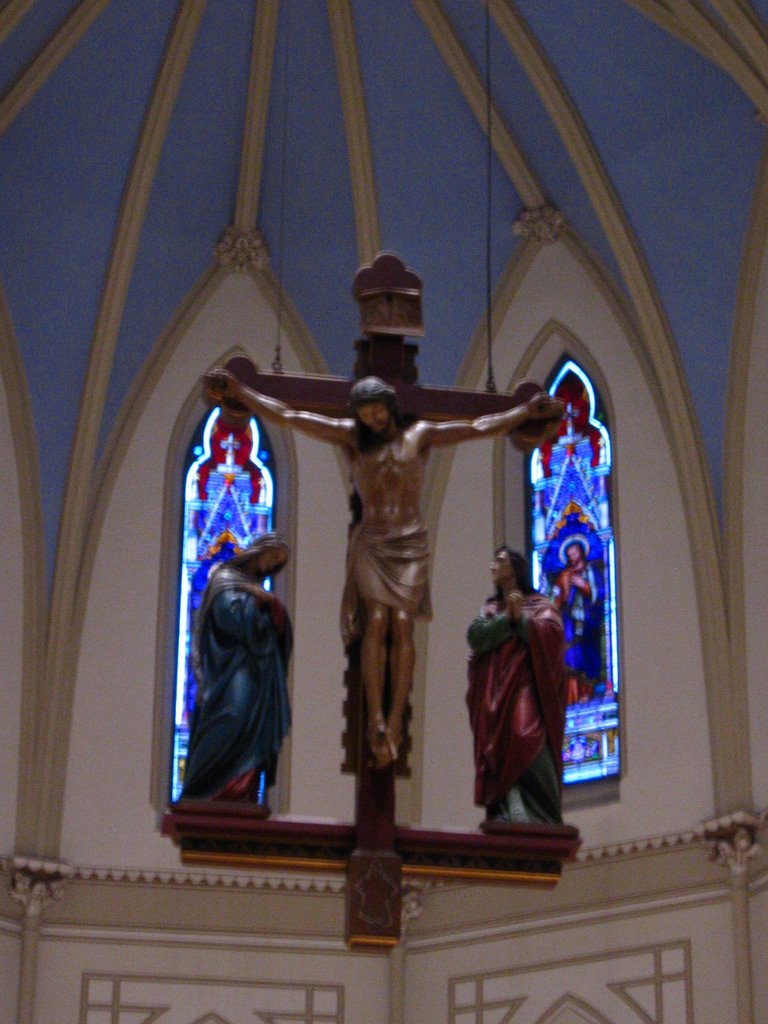
I didn't take any photos of the little priory chapel but here is the crucifix in the main church of St Dominic's. (I'd gone there for All Saints' Day when this photo was taken. What I did not expect was that I would be taking the wine up at Offertory. Someone asked me to do so at Offertory itself! I was not quite prepared for this and forgot to wait for the bread to be passed to the priest before returning to my seat. Ah well, it seems that I am not destined to have "ordinary" masses at St Dominic's.)The previous day, we'd gone to the National Gallery of Art and since I'd spent time looking at American artists in Mexico, I went to see the special exhibition of John Constable's Six-Foot Paintings in the US! Constable started painting six-footers to attract attention at exhibitions and such. (Artists must always know what's commercial.) Constable started off by painting full-scale sketches of his work and then doing a polished version after that. It thus provides an idea of his thinking as he worked. The Six-Footers were done throughout Constable's career and therefore also show how his style progressed over time. One point which struck me was how the style in the final product began to look more and more like the more fluid and less polished style of his sketches, over time.
The National Gallery of Art is actually quite amazing. It was started off as a donation by Andrew Mellon to the nation in the hope that others would follow his example. And they did. Today, Bill Gates and Warren Buffet don't build museums/galleries. They look to improve public health around the world, and raise educational standards. Apparently the Gates Foundation is now one of the largest donors in the world, in the area of health, surpassing many countries' contributions. But they apply a private sector perspective on looking at effectiveness of aid, which perhaps state donors are less able to do. So income inequality in the US may be pretty stark but it is very difficult for anyone to resent Bill Gates' billions if he is helping to eradicate polio or whatever.
Tuesday, November 14, 2006
Cultural Learnings of America
And this is where Mr Bean meets Reality TV. Many of the people interviewed were ordinary folk who were not aware that Borat was an invented character. He went to a humour coach, an etiquette coach, met feminists, car salesmen and attended a dinner party in the Deep South of the USA (where he brought a black prostitute as his date). Half of these people are now sueing Cohen for tricking them. Its incredible that more people didn't see through his strange behaviour.
There were also incredibly funny scenes which were staged -my favourite is where Borat and his producer engage in a nude wrestling match and run all over the hotel in the nude.
I am trying to work out exactly what makes it such a popular movie and have concluded that it lies in the deliberate way Borat sets out to offend every single last sensibility of politically correct America. Somehow Borat makes it politically correct to enjoy a crude, vulgar movie which helps them laugh at themselves.
Was quite surprised to see that Borat is opening in Singapore, 28 Dec. Well worth watching and it will be interesting to see Singaporeans' reactions.
Sunday, November 12, 2006
Catrina, Posada and Diego Rivera
We also popped in on the Museo Mural Diego Rivera which is a museum with one main exhibit, a single mural by Diego Rivera which takes up a whole wall. It was originally in a hotel lobby- the hotel was destroyed in an earthquake but the mural managed to survive. Now, the mural was extremely controversial because Diego went and painted in a line which said "God does not exist". He was forced to paint it out but evidently God has a sense of humour, or else the mural would have been destroyed with the hotel!
Anyway, here is a small section of the famous mural. I took only one photo before being informed that I had to pay 5 pesos more for the pleasure of taking photos. So I stopped. At the very centre of the mural is El Calavera Catrina, arm in arm with her creator, Jose Guadalupe Posada. (For more on Posada and the creation of a cultural icon, here is a link.) The little boy holding Catrina's hand is Diego himself and reflects Diego's admiration for Posada. Behind them is Frida Kahlo, Diego's wife and a famous Mexican painter in her own right. I did not know until coming back and reading something about her that Frida was in a serious bus accident in her youth and she was essentially living in pain all her life. She painted many self portraits and a lot of it portrayed her pain, both physical and from her marriage to Diego. Diego had a habit of portraying his family members in his work - this mural featured his previous wife, his son (if I recall correctly), amongst others. He didn't have any children with Frida (the bus accident). The painting included politicians like Benito Juarez, and the Mexican dictator Porfirio Diaz. It also featured some of his themes, eg, family being evicted from their home, repressed worker, wicked banker etc. I liked Diego's work - the colours, the folklorish style, the density and detail. Most of all I liked his (socialist?) view that art belongs to the masses and hence his interest in public art and large murals.This post brings me to the end of our stay in Mexico. Most of the backpackers in our hostel are moving on to other parts of Mexico and even South America but sigh, we are not amongst them. The Canadian girl is going down to Central America (where she hopes to learn Spanish) for a total of 3 months, the British vegetarian couple and the tall German girl are all off to Oaxaca. It is apparently only us kiasu Singaporeans who read US travel advisories on the situation in Oaxaca. The only other person here for a short stay was probably Hernand, the Peruvian who went on some of the same tours as we were. Hernand speaks as much English as I do Spanish so our conversations were necessarily limited. But I did manage to convey that we were studying administration and to get that he would be leaving for Peru the night just before we returned to the US. Maybe I am getting the hang of Espanol after being mistaken so many times as a hispanic.
Adios!
Tuesday, October 31, 2006
Lincoln Memorial

But the highlight of the day was our visit to the Lincoln Memorial at the end of the day. It was a solemn and awe-inspiring experience. We got there just before sunset (daylight savings is over so it gets dark at about 5.30pm or so now). The Memorial is a simple Grecian building. The huge statue of Lincoln looks out down a long reflecting pool to the Washington Monument, which is reflected in the waters. The statue shows Lincoln’s great height – his legs look rather lanky. The face is sad, but shows Lincoln’s determination to persevere despite the odds. On each side of the statue are two of his famous speeches – the Gettysburg Address and the Second Inaugural Address – which highlight his moral vision and purpose. Here’s the Gettysburg address and extract of the Second Inaugural address:
Gettysburg:
"Four score and seven years ago our fathers brought forth on this continent, a new nation, conceived in Liberty, and dedicated to the proposition that all men are created equal.
Now we are engaged in a great civil war, testing whether that nation, or any nation so conceived and so dedicated, can long endure. We are met on a great battle-field of that war. We have come to dedicate a portion of that field, as a final resting place for those who here gave their lives that that nation might live. It is altogether fitting and proper that we should do this. But, in a larger sense, we can not dedicate -- we can not consecrate -- we can not hallow -- this ground. The brave men, living and dead, who struggled here, have consecrated it, far above our poor power to add or detract.
The world will little note, nor long remember what we say here, but it can never forget what they did here. It is for us the living, rather, to be dedicated here to the unfinished work which they who fought here have thus far so nobly advanced. It is rather for us to be here dedicated to the great task remaining before us -- that from these honored dead we take increased devotion to that cause for which they gave the last full measure of devotion -- that we here highly resolve that these dead shall not have died in vain -- that this nation, under God, shall have a new birth of freedom -- and that government of the people, by the people, for the people, shall not perish from the earth."
Second Inaugural Address:
"...Neither party expected for the war, the magnitude, or the duration, which it has already attained. Neither anticipated that the cause of the conflict might cease with, or even before, the conflict itself should cease. Each looked for an easier triumph, and a result less fundamental and astounding. Both read the same Bible, and pray to the same God; and each invokes His aid against the other. It may seem strange that any men should dare to ask a just God's assistance in wringing their bread from the sweat of other men's faces; but let us judge not that we be not judged. The prayers of both could not be answered; that of neither has been answered fully. The Almighty has his own purposes. "Woe unto the world because of offences! for it must needs be that offences come; but woe to that man by whom the offence cometh!" If we shall suppose that American Slavery is one of those offences which, in the providence of God, must needs come, but which, having continued through His appointed time, He now wills to remove, and that He gives to both North and South, this terrible war, as the woe due to those by whom the offence came, shall we discern therein any departure from those divine attributes which the believers in a Living God always ascribe to Him? Fondly do we hope--fervently do we pray--that this mighty scourge of war may speedily pass away. Yet, if God wills that it continue, until all the wealth piled by the bond-man's two hundred and fifty years of unrequited toil shall be sunk, and until every drop of blood drawn with the lash, shall be paid by another drawn with the sword, as was said three thousand years ago, so still it must be said "the judgments of the Lord, are true and righteous altogether".
With malice toward none; with charity for all; with firmness in the right, as God gives us to see the right, let us strive on to finish the work we are in; to bind up the nation's wounds; to care for him who shall have borne the battle, and for his widow, and his orphan--to do all which may achieve and cherish a just and lasting peace, among ourselves, and with all nations."
Wednesday, October 18, 2006
Carly Fiorina at the KSG
Yesterday's talk was by Richard Holbrooke, former US Asst Secretary of State and Former US ambassador to the UN. He was talking on the topic, "Fighting the War on Terror: A Short-Term Vision for a Long-Term Conflict?". It was an interesting talk - he was attacking the semantics of "War on Terror" - terror is a tactic and not any individual, who exactly is the war on? Of course he is a Democrat. Lawrence Summers (Treasury Secretary under Clinton, also former President of Harvard) was in the audience and he exchanged pleasantries with Holbrooke. And whilst we are talking about Harvard big names, I suppose I should add that last Friday Amartya Sen was walking through the KSG Courtyard.

Anyway, let me get to the true subject of my post - the talk by Carly Fiorina, which was this evening. Now I must admit I had pretty high expectations. Carly has a reputation for being a good speaker. And she has just published her book and is promoting it (she was signing copies after the event at the COOP). So I expected a few excerpts (of the more exciting points).
So the session starts off with what was a pretty fawning introduction (Carly said thank you for a very "generous" introduction), and if that was not bad enough it was long-winded as well so we cringed through this lengthy speech.
Carly focused her own comments on leadership - business is about the people, so you have to address people issues in leadership and managing change - and uttered truisms about how people are people wherever they are. She alluded to her own departure from the Board but sort of slipped around what happened. Difficult for people who weren't following the fortunes of HP or didn't skim through her book prior to the talk (which I did) to work out what was going on. I can look at it charitably and say that she didn't want to bad-mouth people in public, but I can also say that she wanted to increase the incentive for people to buy the book! And although her book is titled "Tough Choices" she didn't actually tell us about any of these choices except that it was her decision to say openly, despite the bad press it would attract, that she was fired from HP rather than that she had decided to step down.
I suppose my takeaways are as follows:
- Change - it's a slow process, especially in large organisations. Individuals don't like change - it's great in theory, but should preferrably happen to someone else. So needs patience and discipline. Changing during bad times is even worse - more difficult for people to stay the course and easier for them to lose faith in the leader.
- Importance of processes to appraise and enhance the performance of Board members.
She spoke for only about 20 minutes and then there was some Q&A. The two hosts on stage monopolised the Q&A for about half an hour. Unfortunately the fawning host asked some fawning questions. Whilst the other gentleman asked better questions, I must say the student questions were excellent! One asked Carly to respond to unfavourable reviews of her book (in The Economist and Financial Times) which questioned her leadership but she chickened out! and said that everyone is entitled to their opinion. Another asked her to talk about what she felt her weakness was and how she addressed that. She said that her weakness was that she didn't know anything about technology and therefore it was important to have people around her who were good at technology, that it is about being aware of your weakness and having the humility to acknowledge and address it. Again, I see this as a cop-out because I thought that the question pertained to a personal weakness rather than a knowledge gap. (Oh, and she didn't answer the question on whether she intended to run for public office!).
I personally respect Carly and what she has achieved and I do think (from the little I know) that she was hard done by her Board. And maybe after having high expectations it would have been a let-down in any case. So it is a bit of a pity because I do think she had an opportunity to gain supporters (esp if she wanted to run for public office) this evening and it ended up being a bit of a "poor me" session.
Tuesday, October 17, 2006
An afternoon with JFK
It is a lovely church - all stark stone outside and very warm and welcoming on the inside. The wall behind the alter is painted a warm crimson colour and this contrasts with the white alter piece.It was also a most amusing mass. First of all, it was a memorial mass for St Hedwig. Yes, St Hedwig, wife, mother, queen and saint. Who is she, you may ask. As did we. So here's a link to St Hedwig. Her statue in the church was restored by the Polish Veterans' Association and re-dedicated at the mass, and there was a relic of the Saint available for veneration after the mass. The presiding priest is a round, tubby, Friar Tuck-like priest. He has an Irishman's gift of the gab and he showed it in his lengthy, "informal" prayers of intercession. He prayed for ill members of the parish, the two young men who were coming back from Iraq, and so on and so forth. He also speaks fairly quickly - rushed through the Nicean Creed really quickly. In his sermon, he highlighted the generosity of St Hedwig - she endowed monastries and things like that. He linked this up with a request to the congregation to be generous in their offerings....
(Incidentally I have a feeling that Sacred Heart was merged with St Hedwig's Parish, which is why there were also references to how St Hedwig parishoners lost their parish).
In the afternoon, I went to the John F. Kennedy Presidential Library and Museum. We went through the museum which is really a multi-media exhibition on JFK's Presidency. It featured a lot of his speeches - he is such a good orator. It also showed a little about his legacy, including of course the Kennedy School of Government at Harvard... It was a strangely moving visit. There was an exhibition room featuring the role of Robert Kennedy as Attorney-General - looks as though his contribution to JFK's short Presidency was substantial. The Kennedys are a truly tragic family. Anyway, I bought replica JFK campaign badges for my room mate and myself. Now I have a JFK badge and a Mao badge, haha!
Monday, October 09, 2006
The Midnight Ride of Paul Revere
And that is where the interesting bit about Lexington and Concord begins (at least for those people who are not US history buffs). Where was the "shot heard around the world" fired from? The two towns have differing opinions. (Incidentally it is somewhat grandiose to call it a shot fired around the world? Had as much impact as the length of Cleopatra's nose?) Yes, there was a skirmish at Lexington before the skirmish at Concord. And the minutemen and militia fought in both places (see the two minutemen statues below). But history seems to favour Concord - it was where, apparently, the order was given to stand and fight, and chase the British out of town.
Both Lexington and Concord have statues of Minutemen. Lexington's (left)
The big hero of Lexington and Concord, of course, is Paul Revere. However we found out that the poem by Longfellow is not really factual. Apparently Revere made it to Lexington but not to Concord. Revere got caught on his way to Concord and the chap who made it through was one of his two companions, a doctor with a good horse. He alerted Concord to the impending arrival of the British, and the rest, as they say, is history. Except that the doctor's place in it seems to have been taken by Revere. I guess it would have spoiled the poem.