Showing posts with label travel. Show all posts

Saturday, March 07, 2020

One day in Wuhan (武汉)

Yellow Crane Tower, Wuhan
I've been struggling a bit with this post.  Just over a month after I had visited the city, news started emerging of a number of unusual pneumonia cases emerging.  Yes, I visited China and went to Wuhan in mid-November, as the start of my cruise through the magnificent Three Gorges of China.    And at end December, China would officially report the news that a new disease, what would become known as COVID-19, had struck the city.

In the end, I've decided to proceed.  I'm not trivialising the seriousness of the disease which has (to date) struck tens of thousands, and killed significant numbers as well, both in China and around the world.  But I think that others deserve to know that this is still a lovely city visit, particularly in November, and that the area has indeed so much to offer tourists. And so, I will proceed to recount my visit there.

Mine was not a long visit - just around a week.  After arriving late the previous night, we spent a full day in Wuhan, then took the train to Yichang the next morning where we boarded the Century Legend which took us down the Yangtze River, to Chongqing City. So, if you ever want a one-day leisurely itinerary for Wuhan, do read on.  But if you have a longer stay, you may want to read more here.

One aspect of life in China which we wanted to experience was its "cashless society", where all the hawkers had their own QR code for WeChat Pay or AliPay.  Just a few weeks before our departure, these two ubiquitous payment apps had extended their services to foreign tourists.  In the event, it was not possible to use WeChat Pay but fortunately the AliPay payment service was quite easy to figure out and we could use it to also pay taxi drivers, and to link up AliPay to DiDi (the Uber of China), so we could also hail and pay our taxi drivers via DiDi.

Re Gan Mian and Lotus Root Soup
We used DiDi for the first time when taking the taxi for our breakfast in Hubu Alley, the famed street food alley of Wuhan.  I have to admit though, that by the time we made it there, it was really more like our brunch.  We had a bowl each of Re Gan Mian (热干面), which literally translates into spicy dry noodle dish.  The sauce is served on top of the noodles, with a sprinkling of spring onions on top.  I also got some minced pork with mine.  We had this with lotus root and pork bone soup, and a serving of "Dou Pi" which came a little later.  Dou Pi is essentially rice wrapped in layers of egg, with diced beancurd and I think more minced pork within.  It was all quite tasty but the next day we walked around the corner from our hotel and found a number of little eating stalls and what we in Singapore would call coffee shops, all full of Wuhan residents eating their breakfast before going to work.  We had quite a quick, tasty meal of chee cheong fun, a prata-like dough pancake and some dumplings, washed down with soya milk.  Much better value for money and much more convenient.

The immortal and the crane over the tower
After our brunch, we made our way to the the Yellow Crane Tower (黄鹤楼), a very famous historical site here in Wuhan.   It's one of the "Four Famous Towers" of China, originally built for military use on the top of a hill where it has a commanding view of the region and the river running through the city.    The building is not the original tower; it has actually been rebuilt a few times but apparently a tower has been on this site ever since around 220AD. 

Entering the tower, we admired this large wall mural just inside.  It tells the story of how the tower originally came to be built.  Briefly, a wine merchant, Xin, gave shelter (and wine) to a visiting monk.  Some tales indicate that the monk was actually an immortal come to earth in disguise!  Anyway, the monk visited repeatedly and every time Xin gave him food and shelter.  To show his gratitude, the monk painted a crane on the merchant's wall.  The painting was animated to show the crane dancing, bringing lots of visitors to the shop.  So Xin grew rich, and as a sign in turn of his gratitude built the tower.  The tower is also immortalised in the classic poetry of China, with the poets Cui Hao and Li Bai both writing about it.  Indeed, Cui Hao's poem is probably particularly apt - it tells how the crane has departed, leaving a city bereft, and the poet left far from his homeland.  I reproduce it here.

The pond in the compound of the Yellow Crane Tower
昔人已乘黄鹤去,此地空余黄鹤楼。
黄鹤一去不复返,白云千载空悠悠。
晴川历历汉阳树,芳草萋萋鹦鹉洲。
日暮乡关何处是?烟波江上使人愁。

After climbing all the way to the top of the tower and admiring the view, we made our way through the compound to the peaceful, scenic Chinese Garden adjacent to it.  The centrepiece of the garden is a large pond, surrounded by weeping willows.   A few fountains gush quietly in the centre.  To one side, a low wall is covered with the carved forms of cranes - flying, walking, and doing all sorts of things.  Following the example of the famous Tang poets, there is also a poetry gallery here, featuring two poems by Chairman Mao, housed in their own pavilion!

A double-sided embroidery screen
We spent quite some time in the Yellow Crane Tower and its surrounding compound, but we had one more stop to make on our 24-hour stopover in Wuhan, in Tan Hua Lin. 

Tan Hua Lin is also part of old Wuhan, but of a much more recent date.  It's like the "western quarter", where all the Europeans stayed.  Here there are a few churches, including a former Canossian convent, and western houses where the various European merchants and traders stayed.

Today, it is full of souvenir shops, art galleries, and embroidery shops.  Wuhan is one of the well known "schools" of embroidery in China (another one is Suzhou, for example).  The embroidery shops show beautiful exemplars of Wuhan embroidery.  These include huge framed pieces - either to hang on the wall or the beautiful double-sided screen which I have shown in the photo on the left.  Each stitch is like a brush stroke, so delicate and precise.  You can also buy small little embroidered bags or table screens.  Embroidery equipment is also on sale - my friend bought herself an embroidery frame, which she dismantled and carried around on her shoulder.  Myself, I was just glad to see that this area also had a few cat cafes!  Sadly we did not have time to make a longer stay in one of them.

We ended the day off with dinner, close to the hotel.  The next day, we would spend travelling - by train to Yichang, where we would then take a coach to the cruise ship which would take us to the next part of our journey, down the Yangtze River, and through the heart of China.

My Three Gorges Flickr album is here.

Saturday, February 03, 2018

Tokyo Neighbourhoods: Ginza and Tsukiji Market


Tsukiji Market
 If you have not visited Tsukiji market, you have not visited Tokyo.  Due to the problems found on the site of the “new” Tsukiji market, this famous fish wholesale mart had not yet shifted at the time of our visit, so we decided to take a trip and see the old market before it was torn down. The other reason is of course that we went to find the freshest, yummiest sashimi to tuck into.

Now if you read all the websites, they give you lots of advice on how to get there - the need to get there at the truly unearthly hour of 3am in the morning, bring warm clothing because it is pretty cold in the market etc etc.

Within the inner market
None of this was relevant to us as we were not so fanatical as to make the 3am trip to the market.  Insteadwe went there after the wholesale market is opened to visitors, after 10am.  The area itself is a cavernous place, and at this point in time it had mostly emptied out, with the remaining stallholders mostly just cleaning the place up.  But I could see why there was a need to redevelop - shops cramped together; the floor was uneven and the lighting dim.   Big styrofoam boxes line the narrow lanes between the stalls and every now and then we have to get out of the way as a little electric vehicle transports yet another load of boxes out of the market.

We walked around the stalls but quickly returned to the outer market.  It was still in operation - here is where tourists can buy themselves some yummy seafood, which is what we did.  But it was a bit late so we did not have much to choose from.  I have to admit that I had a much better food experience my previous visit to Tsukiji, with my Japanese-speaking colleague.  We had our fill then of Uni, grilled shellfish, prawn sashimi, all washed down with some crab soup.

Outer market - selling tuna
Nonetheless, it was still quite interesting to walk around the small buildings and shops.  One stall was selling freshly cut tuna, from a gigantic fish - half of it had already been cut and sold.  I wondered how long this gigantic fish had been swimming around in the ocean, until some fishing boat had hauled it in and brought it here for sale.  I don't think I am going to stop eating tuna but somehow the sight of the fish reminded me that we should also not eat to excess, and neither should we waste.  Anyway, I bought my lunchtime sushi from another stall.

Famous Wako building
After eating our sushi, we walked over to Ginza.  Technically this should have been in the “shopping neighbourhoods” post but then it would have been a really long post.  Ginza is the most exclusive shopping district in Japan.  You can read all about what to see and do in Ginza here.

The famous 4-chome intersection in Ginza is in fact where all the famous stores are - Wako, Mitsukoshi, Ginza Place (where the Nissan car gallery is) etc.  We went to Mitsukoshi, where we were delighted to find a quiet and restful oasis  - Mitsukoshi has a whole floor worth of space to rest, have a meal or cup of tea whilst looking at the roof tops of the surrounding buildings.

From here, we could see Mikimoto pearls - where Melania Trump had visited just two days earlier.  Ah yes, we visited Tokyo the same time as Donald Trump..... probably that also accounted for the helicopters flying around overhead too.

Ginza Place - opposite Wako
We didn't buy anything from Mitsukoshi, although we did wander around the store and visited its Food Hall in the basement (great temptation, but I did not succumb).

But we did manage some purchases at Uniqlo!  The Ginza Uniqlo is Uniqlo's flagship store - it is the largest in Japan with its 12 floors.  However, much of the merchandise was repeated across floors so I was not as bowled over by the selection as I had hoped to be.  Also, because it was selling more wintry clothing, my choices were further limited.  But, since there were some quite sweet baby clothes, I got some for my cousins who just gave birth.

I would not say that I’m a Ginza shopper - I immensely preferred the buzz around Shibuya, for example and the more affordable range and variety around Shinjuku station.  But I’m happy to come here just for a short visit, to complete my Tokyo shopping experience.


Saturday, February 04, 2017

Osaka: Bright Lights, Big City

Glico Running Man!
Osaka!  Our last stop this visit.  We took the train down from Nara and were delighted to find that it stopped literally at our subway stop.  We spent a fun evening walking through Dotonburi, took our obligatory photo of the Glico Running Man, and ate some takoyaki.  The next day, we made our way to Himeji Castle.  We were so tired out after our day trip (and indeed, the last day of a holiday is a sort of anticlimactic day) that we decided to pursue a very minimalist agenda.  Food and shopping!

We went first to Kuramon market, which was literally down the street (our apartment was really very conveniently located).  We moved from shop to shop, sampling the wares and had a yummy seafood breakfast of uni (sea urchin), grilled scallop, oysters, sashimi.  We had a great time eating away, and taking in the atmosphere.  

Kuramon Market
We went next to Doguyasuji which is where all the restaurants and chefs around Osaka get their cooking equipment.  It was incredible!  If you ever wanted any Japanese cooking equipment, this is definitely the place to get it.  But since I have promised myself that I'm not buying anything new till I have Kondo'ed my kitchen, I was quite restrained.  The only thing I bought was some plastic food fridge magnets.  Yes, you can get the plastic food displayed in the window of Japanese restaurants here!  It is quiet an experience

Our big breakfast at Kuramon market did not stop us from having a crab kaiseki lunch at Kani Douraku.  There are actually a few branches of this very popular crab restaurant in Dotonburi, characterised by the gigantic crab right in front.  But it is very popular, so much so that even after 2pm there was no table available for those without a reservation.  We decided, nonetheless to wait and after about 20mins we were ushered to a table upstairs. 

Truly, no one does crab like the Japanese.  The best thing about their crab is it comes with the crab
The unmistakable signboard of Kani Dourake
legs and claws cut beautifully in half so that extracting the meat is truly effortless!  We had numerous dishes, including crab sashimi, boiled cold crab (my personal favourite) served with a delicate lightly vinegared dipping sauce, grilled crab, crab gratin, crab chawanmushi, crab sushi (another of my faves), crab hotpot (house specialty) and others.  Dessert was a scoop of ice cream floating in matcha.  Ummm..... It was one of those truly enjoyable meals.

After this heavy meal, we did some shopping to walk off the food.  Specifically we found our way to the duty-free cosmetic shops.  Now, Japan has a great tax refund system for tourists.  They figured out that there's a limit to how much duty-free the ordinary shopper can buy at the airport and even in 1-2 duty-free shops in the city centre.  And that it's definitely inefficient for hundreds of passengers to clog up a small tax refund counter at the airport.  So they allow selected shops here in the city centre to administer the tax refund programme (you can tell them by the big sign which they display prominently at the front of the shop).  You buy your goodies, they pack it in one of those transparent plastic duty-free bags and charge you the amount payable before tax only.  There's a little receipt stapled in your passport and that's it.  When we got to the airport, all we had to do was hand in the receipt (the customs officer didn't even bother looking at it).  Wonderful!

Anyway, we had a great time at the cosmetics shop.  We had done all the research beforehand (actually we had spent quite some time the last two nights reading through product reviews and recommended sites such as this one) and so we were all prepared to make our purchases.  In my case, I bought some Hadalobo products, plus the AHA cleaner by Cleansing Research and Lululun masks, amongst other things.  Plus my favourite Aqualabel Moisturiser by Shishedo.  We were so burdened with all our purchases that we had to go back to our apartment to deposit them (and have a little break) before making our way out again.  We had to buy some presents for family/friends, which we got at the 300 Yen shop in Shinsaibashi.  We ended off with an okonomiyaki (an Osaka specialty) meal before going back to the apartment to pack.

As a result of all this shopping and research (both for this and earlier trips), I'm now in a good position to recommend what gifts to buy for family and friends:
  1. Kit Kat and Glico products.  There are so many different interesting flavours for both Kit Kat and Glico Pocky.  Fun to try!  There are also regional specialties to enjoy, such as Takoyaki and Okonomiyaki-flavoured snacks.  It's great to bring back to the office (and is very popular!).
  2. Cosmetics and make-up.  Even if you can't buy enough to make up the 5,000 Yen required for the tax refund, the prices are still better than in Singapore.  Check out the link above (and there are many others) for shopping inspiration.  Great for female relatives and friends.
  3.  Stationery. I'm talking about fun, novelty and useful items such as erasable pens ("Frixion", no-staple staplers, cute post-its, etc.  Plus the best range of washi tape ever.  I've recently discovered washi tape and its great to find new designs at prices lower than in Daiso Singapore.  Go to places such as Loft, Tokyu Hands, and Ito-ya for the great range of stationery.
  4. Clothing, accessories, bags.  I have not done much clothes shopping in Japan.  But I do recommend looking for the tabi socks  in shops such as 3 Coins (it is a 300 Yen shop).  I also managed to find an Anello bag, one of the latest "It" bags - again very competitively priced compared to buying it in Singapore.  I really love my little blue backpack.
  5. Cooking items. Lots of novelty items. If in doubt, just buy the plastic food fridge magnets or keychains.  Brings a smile to my face every time.   
Ah, just writing all these posts really makes me feel like going to Japan again!  Glad we are planning another trip this year.  😊

Goodbye Osaka.
As always, more photos here.


Saturday, January 28, 2017

Himeji: Castle and Garden

Himeji Castle
My last visit to Kyoto, I had wanted to visit Himeji Castle, one of the oldest surviving castles in Japan and a UNESCO World Heritage Site.  But it was closed for renovation and major repairs, so it was not an option then.  But the castle has since been reopened to visitors and so naturally became one of the "must do" items for this visit.  

The town of Himeji is about an hour's journey from Osaka (train from Osaka station). We realised after looking at the fares that this was indeed one of those few occasions when it was worthwhile to purchase the one-day JR pass.  But it's only valid for JR, so other journeys still have to be paid for.  Since we were staying in the Dotonburi area, we had to find our way to Osaka station - easier said than done, given the numerous private railways, and the subway lines which intersect with the JR lines.  Maybe if we didn't want to "maximise" the use of our one day pass it would have been easier.... a lesson for another time...

Anyway, after adding another hour to our travel journey (to get to Osaka station), the train ride to Himeji was uneventful. Once there, it was clear that we didn't need a map to figure out how to get to the castle - it dominates the town, and the road from the railway station leads you right to the base of the castle grounds.

Himeji castle is a majestic, yet extraordinarily graceful building.  It's apparently supposed to resemble a white heron - and I suppose the wings of the building, beside the towering main keep, the white of the walls and the tiers of the roofs do support the idea of a bird in flight.   Yet, this beautiful and elegant building was very much a functional castle - built to be defended on top of a hill, with small windows piercing its sturdy walls to allow defenders to shoot cannon and arrows down on potential invaders.  A comprehensive description of Himeji Castle's history is here.  More about Japanese castles is here.

The castle is organised in several sections, with an outermost moat just in front of the castle wall.
The sturdy walls of the castle
 Once past the main gate, you enter the large open grounds right in front of the castle - a great photo opp - and walk all the way to the next section, just beyond the ticketing counters.  Here, things start to get more serious.  Internal walkways are much narrower and wind around the hill.  The sturdy walls enclose the last section, containing another courtyard and the castle well.  We went next into the keep, and climbed all the way up to the top where we admired the glorious 360 view of the castle grounds, and the Himeji region around that.  I could almost imagine myself a castle guard looking out for the enemy hundreds of years ago!

I have to say that whilst there were notices and placards here and there giving more information on the building (and also a little pamphlet) there could perhaps be more done to excite visitors about the Japan of that era.  There were not that many exhibits in the first place, and the ones which really caught my eye were the model of Himeji and the surrounding country side and the scale model done to aid an earlier restoration.  There was also a Himeji Castle app but it wasn't available in the Singapore app store and having to figure out how to switch to the Japanese store, then find the app, etc etc was just too much bother.  Which was a pity, because it was a real opportunity to learn more about Medieval Japan.

We followed our visit to Himeji with a a visit to the Koko-en Garden, just next to it.  Once part of the castle, the garden is now a separate attraction in itself.  Actually it is not one garden but nine  - each with their own name such as the Garden of Bamboo, the Garden of Flowers, etc.

Garden of the Lord's House, with Himeji Castle 
One of the most impressive gardens was the Garden of the Lord's House.  You enter via a long wooden corridor, over a pond.  On your left is a little cascade, trickling down from the rocks.  But on the right - a waterfall greets you, with its waters pouring into a large pond, with a quiet garden beyond that.  The leaves were gorgeous, glowing red. Himeji Castle rises in the background.  Indeed, a fitting sight for the lord of the manor!

My other favourite was the Garden of Summer Trees.  Indeed, it should be called the Garden of Autumn Foliage instead.  It is a smaller, more intimate garden than that of the Lord's House, meant for private pleasure rather than public show.  I could see myself sitting in the small shelter, reading a book and enjoying the brightly coloured leaves.

Garden of Summer Trees

We left Koko-en as the sun was setting, which meant also that we could watch as the skies around Himeji Castle darkened around the illuminated castle.

Where Kyoto is a city of temples, Himeji indeed stands out as a reminder of Medieval Japan.

Himeji at dusk

More photos on my Flickr album.

Saturday, January 07, 2017

Nara: Oh Deer Me!

Isuien Garden
Nara is one of Japan's ancient capitals, situated about 45min train journey from Kyoto.  Whilst many people do it as a day trip from Kyoto, we spent the night there, and travelled on to Osaka the next day.  With about 24 hours in Nara, we didn't have much time.  So since autumn leaves were the focus of our trip, we decided to spend the time at the famous gardens and parks of Nara.

Yoshikien Garden - Pond Garden
Japanese gardens are in themselves, an art form - carefully designed, beautifully executed, meticulously maintained. It is another way the Japanese express their love and appreciation of nature, flowers, and scenery.  Indeed, I really felt that the visits to the garden really refreshed the soul and delighted the eye.  The gardens are designed so that every step presents a different view and every turn surprises the visitor.  More about Japanese gardens and the different elements in the gardens can be found here and here and here.

We were indeed privileged to visit two very famous gardens in Nara, the Yoshikien and Isuien Gardens.  The Isuien Garden dates from the 17th Century and is famous for its use of shakkei, or "borrowed scenery".  Both gardens have ponds, and the pond in the second garden is supposed to be in the shape of the Japanese/Chinese word for water or "shui" (in Chinese).  But I couldn't quite make it out.

The Yoshikien Garden is just next to the Isuien and is made up of three gardens - the Pond Garden in front, then the Moss Garden and lastly the Flower Garden.  A small hill by the Pond is topped by a pagoda, with a charming view of the water and the tea house by the water.  Another tea house looks out into the Moss Garden - which was surrounded by the russet and red of the maple trees.  Sadly, there were not many flowers in bloom this time of year but nonetheless the Flower Garden was a charming spot, with a dry rocky river, a pavilion and more autumn foliage surrounding it.  I can just imagine how lovely it must be in spring or summer, with the flowers all in bloom.

After our stroll around the gardens, we went back to our ryokan.  We stayed in Nara Hakushikaso,
Kaiseki
which is really close to the Kintetsu Railway Station and also a short walk from both the gardens and Nara Park just beyond it (in fact the gardens are on the perimeter of the park).  We had to clean up and get dressed in our yukata (an informal kimono) in readiness for our yummy kaiseki dinner.  The dinner was served in our room - you can see from the photo our sashimi, soup, hotpot, tempura, pickles, chicken cooking on a hot plate, each with their own dipping sauce (or seasoning) as appropriate.

After dinner, one of the staff came in to lay out our futon beds.  I have to admit that it was quite comfortable and I woke up feeling refreshed.

Deer are everywhere
On our second day in Nara, we decided to walk around Nara Park.  Many of the important temples and shrines are actually in the regions of the Park and so it is well worth spending an entire day there, if you have the time, visiting the temples and wandering around the park.  We contented ourselves with walking around the park, looking at the imposing temples and of course, meeting the deer!

Indeed, it is not possible to avoid the deer, even if you wanted to.  They are everywhere!  But it is also important to remember that these are semi-wild deer and hence their behaviour can be unpredictable.  We saw a notice at the park warning us to be careful and there is also a video online for visitors to the park, advising visitors to only feed the deer the specially made deer crackers, being careful around them, etc.  I should admit that we did not bother buying deer crackers but saw many people with crackers not being able to "escape" from the deer who kept on following them for more. Later on, we also saw a deer trying to get the crackers directly from "source", ie one of the street vendors selling the crackers...  .... that's one smart deer.

Bridal Couple (and deer)
But in general, we really had a lovely time in the park, just walking around, watching the people interacting with the deer, against this gorgeous background of the park and also some of the nicest foliage we have seen thus far, over a little stream. (Note: parts of the park are best seen during cherry blossom period, whilst other portions have maples planted and these look best in fall.  So not all the leaves on all the trees are red).  
My dear father, when I showed him my photos, said that the scenery was so beautiful, it made fools of photographers.  i.e., any fool can take a great photo.  But I have to say that it was really such a beautiful place that it is no wonder we saw at least three wedding couples taking their bridal shots in the park.  Of course the deer became part of the bridal party.

So, it was a short stay in Nara but looking back, I will always remember it as a really special moment in our holiday.

As a;ways, more photos here

Sunday, December 25, 2016

Dining and Shopping in Kyoto: Beef and Sushi and Needles

Izuju Sushi - Mackeral Sushi and the "Mosaic" sushi
One of the best things about Japan is that the standard of the restaurants here are generally good.  We didn't really have any major "dining ambitions" here in Kyoto, beyond eating a good variety of the different Japanese meals, but most of the time, we just chose our restaurant based on what took our fancy.  Many a time, our picks surprised us!

As in my last trip, thought it is easier to summarise our foodie experience all together (with a little extra on a special shopping excursion at the end).  This time though, I've taken pains to try and identify/locate the restaurants, especially the better and more memorable meals:

Sushi, sushi

Izuju Sushi
Amazingly, during this short visit with a limited number of meals we went to two top sushi restaurants in Japan, at least according to Tsunagu Japan!  They are two very different sushi restaurants, one very traditional, and one totally modern.

I did not know previously that there is such a thing as Kyoto style sushi and that one of the best exemplars of this type of sushi is Izuju Sushi.  This was one of the few restaurants we went searching for based on its reputation.  Izuju is just across from the Yasuka Shrine, and is a small little restaurant with only a few tables.  Go early, or you'll have to queue!  Choices are limited - the restaurant is known for its mackerel sushi and inari and also this interesting "mosaic" type sushi.  Little ingredients (like pickles) are packed into the rice so the sushi itself is a complete meal.  There was also a seasonal special, on horse mackeral sushi.  The restaurant requests courteously to try their food without soy sauce, to better enjoy the flavour of the rice.  Indeed, I did not need soy sauce, as the flavours of the rice and fish are so fresh that any addition would diminish the overall experience.  There is a far more detailed blog post about Izuju here, so I won't go into more detail on the food, ambience, and the history of this well-known restaurant.

"Ikan Bilis"
The second restaurant, Sushi no Musashi, is in Kyoto station and we actually came by here the last time we were in Kyoto!  We rather enjoyed ourselves and so we came back here again.  This is a totally modern conveyor-belt, Tokyo-style sushi restaurant, with one of the largest selections of sushi toppings I've ever had - lots of different shellfish, sashimi and it's all really fresh and good.  Prices are reasonable, and no surprise, you will have to queue for this one too.  What I like is that they actually name the seafood that you're selecting - having said that I am not sure what the name of this particular fish is.  I just mentally called it "ikan bilis".

Where's the Beef

Blow-torching the beef
A few doors down from Izuju is a beef restaurant, "Kappo Bar Gyugyu Gion Honten".  It sells Kobe Beef but as prices are like 9,000 yen for a steak we had the "normal" Wagyu instead.  We got a seat downstairs, on the bar surrounding the kitchen so we had a good view of our food being cooked on the grill.  One of the more exciting dishes was this version of beef carpaccio.  The beef (sliced super thin) is lightly cooked with a blow torch and served with a lump of sushi rice, radishes, and some soy sauce.  It is literally two mouthfuls of food, but really yummy mouthfuls.  

Kameoka beef
Obviously, we had not eaten enough beef because the very next day, we found ourselves in another beef restaurant called Gyuraku in Kameoka (we were looking for a nice restaurant for lunch after our ride on the Sagano Romantic Train)  Here there is no mention of Kobe beef.  Rather, the restaurant proudly proclaims that it is using only the famous "black cattle" of Kameoka.  The beef itself is also available in the butcher's next door. It appears that Kyoto prefecture  is trying to promote its own beef products internationally and Kameoka is one of the leaders in this!

Anyway, we had a steak served on a hot plate and next to a hot stone.  So we can cook it further to the degree of done-ness we want.  The steak itself was good - moist and flavourful.  It gave us the strength and energy to make our dripping way back through the rain to Arashiyama.


Traditional Kyoto Cuisine - Kyo-ryori, and Yudofu 
Kyo-Ryori Manshige

Another unexpected or rather unplanned meal was our first in Kyoto, at Kyoto station.  We were really looking for the conveyor belt sushi but got lost in the massive station and found Manshige instead.  We were attracted by the promise of traditional Kyoto food (termed Kyo-ryori) and indeed, it was a charming meal full of dainty little dishes - including the tiniest, sweetest little new potatoes I've ever seen, and three of the tofu "lollies" which I remember from my last trip here.  In addition, there was a delicately flavoured soup made from seafood and which comes with a squeeze of lime (Thai influence?).  It was such a lovely meal, that it is no wonder that I subsequently found it on someone else's "best restaurant in Kyoto station" list.  And apparently it is a branch of a more famous restaurant somewhere else in Kyoto!

Yudofu Set Meal
We also took the opportunity to eat Yudofu, another Kyoto delicacy especially in the Nanzenji temple area - apparently all the vegetarian monks swear by it.  And the purity of the water here in the area makes for the most pure Yudofu ever.  Now Yudofu is really not the most exciting food in the world.  It is a few pieces of tofu in a stock flavoured with one piece of kelp. It is served in a claypot.  You put the cooked tofu in a dipping sauce, add radish, seafood and bonito flakes and that's it.  Fortunately, the dish comes with some side dishes as well - vegetable tempura, and other small side dishes such as pickled seaweed and some tuba tofu (Yuba is made by skimming off the the film off the top of soya bean when it is being cooked).

We didn't go to a famous restaurant for this one either. We tried to but it involved a 1 hour wait so we went to the less famous (and much cheaper) establishment called Goemon Chaya down the road.

Ramen

Black Ramen
Regular Ramen
Another "must have" when in Japan is the ramen.  We were walking home from Hanamikoji when we passed by Musoshin ramen restaurant and decided that a hot bowl of noodles was just the thing for dinner.  Musoshin prides itself on its tasty stock made from vegetables and chicken and indeed the rich, thick broth was very tasty.  It is so thick, it coats the noodles completely so each mouthful is full of flavour.  They also have a special "Gion Black Ramen" dish which features a black ramen stock, sprinkled over with black sesame seeds and served with some black seaweed on the side.... you get the picture.

Little did we realise that it is rated so highly - ranked 29th out of all the restaurants in Kyoto! Maybe it is the result of the very active calls to review it positively on Tripadvisor

Nishiki market 

Beef Pao
No visit to Kyoto is complete without a visit to Nishiki Market.  I had visited the market on my last visit to Kyoto but it's still worth a repeated trip.  We made our way there but it would appear that the sashimi stalls are not open on a Monday morning :-( Anyway, we had breakfast here, if conger eel tempura, a beef pao (courtesy of Kyoto foodie tip), takoyaki and matcha flavoured soy milk ice cream can be considered breakfast.  The conger eel tempura was not wonderful - it had been sitting a while and so was not that fresh any more.  At least they reheated it for me.  But the beef pao - hot, steamy, full of succulent meat - was something different and definitely worth a repeat visit during future repeat visits to Nishiki (yes I think another visit to Kyoto is a definite possibility).

At Misuyabari
After visiting Nishiki market we went looking for Misuyabari needle shop.  My friend had tipped us off to this shop - because she wanted us to buy her some decorative pins and the famously sharp needles the shop is famous for.  It was not easy to find - it is actually in an offshoot of the Teramaki Shopping Arcade - but behind the row of shops.  We had to go through a little alleyway, which opened into a courtyard garden and the shop was on the far side.  If interested, the directions are here.

The shop itself is tiny, and sells primarily needles, the decorative pins (ordinary pins but with little pinheads of dogs, cats, and many other little items).  It has a 360+ year history and apparently used to sell needles to the Imperial Palace!  The shopkeeper doesn't speak much English but somehow we managed to get by.

Tea for Two

Apple Tea
Somewhere along the way, we started having tea.  It started with a rainy visit to Arashiyama and a warm cosy English tea served in a traditional looking Japanese house.  Who would have expected to see scones and Earl Grey?  Although it turned out that the house specialty is actually an apple tea, complete with chunks of freshly cut apple.  It's a seasonal specialty so not always available.  Anna Maria is on the main street, on the way from the railway station to Tenryu-Ji temple.  It's a welcoming place and I certainly would recommend it to anyone who wants a little break from all the walking around (rainy day or not).We also decided to treat ourselves to a nice tea 


after tracking down the Misuyabari needle shop and making our purchases.  Our reward for effort, so to speak.  Lipton Tea House was started up apparently in 1930 as the British wanted to interest the Japanese in drinking Lipton rather than green tea. And to have a nice piece of cake with it.  I had a nice cheesecake.  But honestly it was just a nice break after all the walking (and BTW we had not had lunch, just all the snacking at Nishiki market).

We were amused to see two of the other patrons of the needle shop having tea here, too.

Well, I've come to the end of a long long post all about my Kyoto food experiences.  Or at least the more significant ones.  Glad that we had some new food experiences and also the chance to revisit a few old favourites.  Looking forward to my next visit to Kyoto (whenever it is)!


Sunday, December 06, 2015

Last Stop Hakodate

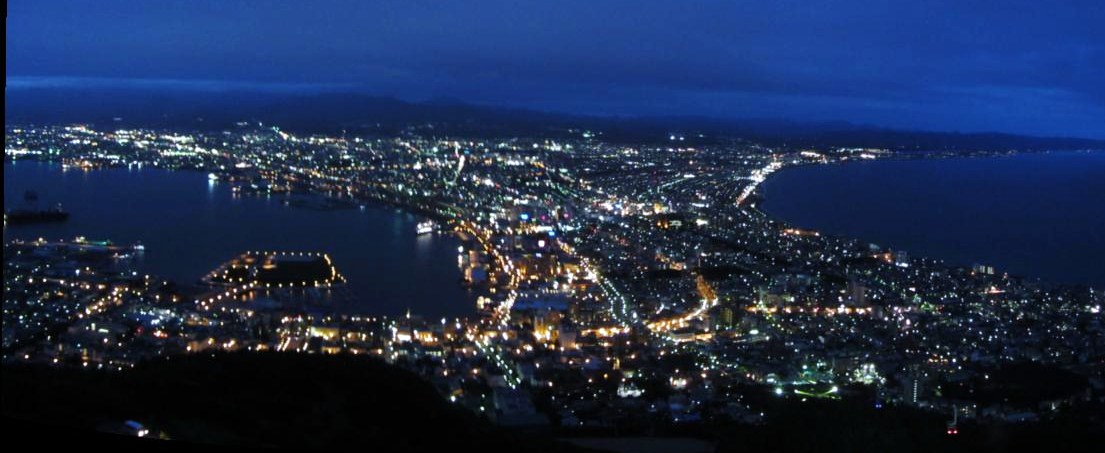
Nightfall - Mount Hakodate
We reached the last destination of our Hokkaido trip, Hakodate, where we would stay one night before flying back to Singapore via Tokyo the next day.  The good thing about flying ANA is that we can make use of the extensive domestic flight network, enabling us to see more cities.

Anyway, Hakodate, like Otaru, has lots of trade links to Russia, and from there to Europe.  It has imbibed considerable European influences as can be seen in the old city at Motomachi, where there are a few churches - Anglican, Catholic, and Russian Orthodox - next to each other. The British consulate is not far off, as is the old Hakodate Public Hall.

Converted Warehouses in Hakodate 
We had gotten a 2-day tourist bus ticket, so we happily rode around the old town, getting off whenever we felt like it.  Aside from the churches, we went to the old pierside area where the ships used to unload their goods, to be stored in the long warehouses along the pier.  Today, these warehouses have been converted for retail use, with little shops selling food, handicrafts etc within.  And it was here that we found out that just as Furano has "Delice" and Otaru "Le Tao", Hakodate's major cheesecake maker is "Snaffles"!  Snaffles have a few branches in Singapore, and I must say I rather enjoy eating their "catch cakes".  We had the opportunity to sample a wider range of Snaffles' products here too.

The number one tourist activity in Hakodate, though, is to see the night view from Mount Hakodate.  We  went up early - or at least so I thought - but by the time we got there, the place was really crowded with people lined three deep in order to get photos of the view. The view was beautiful, with the glittering lights outlining the city.

Hakodate morning seafood market
The view was nice, yes, but the highlight of our visit was definitely the morning seafood market.  Situated across the road from our hotel, we walked over for our seafood breakfast.  We started with sea urchin - freshly opened up, with some cooked shellfish on the side.  We ate it all up with gusto.

The market itself had many other little food stalls.  After hearing that Hokkaido (aside from melons) was also well known for its potatoes, I was glad that I finally managed to get one freshly baked potato with a dab of fresh butter inside.  It was indeed a good and satisfying snack and I also thoroughly enjoyed the matcha ice cream which rounded off my meal.

After going to Kyoto last year, Hokkaido presents an interesting contrast.  Settled in the early 20th century, it has a far more modern feel to it than the ancient capital.  I enjoyed the Hokkaido produce - potatoes, vegetables, melons and dairy products, and marvelled at the scenery - the majestic volcanos, serene lakes and the pastoral beauty of its flower fields. I look forward to my next visit to Japan....

Saturday, November 21, 2015

Sapporo station is the place to be

A room with a view
I have a confession to make.  Although we spent three nights in Sapporo, we spent most of our days outside Spporo, doing day trips.  As a result, we didn't see much of Sapporo at all, except for the gigantic and rather enjoyable Sapporo station (co-located with a gigantic mall!)

We stayed at the JR Tower Hotel Nikko Sapporo, located at the station itself.  We took the bus from Furano to Sapporo and were quite delighted to find out that the bus station was literally on the doorstep of the hotel.  It was such a breeze checking in! We had a room on a lovely high floor with a gigantic picture window.  We would spend much time sitting here, just taking in our beautiful view of Sapporo, with the mountains in the background.

Elder-friendly shower
The room itself was pretty decent but what I thought was truly thoughtful was its elderly friendly bathroom, with an enclosed area housing both shower and bath, with a stool to sit in, and the faucet placed at a comfortably low level (taller people could use another set).  The floor looked to be non slip and there were a number of well placed grab bars.  And what I like about Japan - differently coloured toothbrushes so you don't get mixed up on who's is who's. They do these little things so very well.

The beauty of staying at Sapporo station though is that it is handy for everything - buying our breakfast buns, a simple ramen meal, food souvenirs to take home, etc.  We also tried out one of the conveyor belt sushi restaurants here too - enjoyable but my  favourite sushi experience this time continues to be in Furano with the big pieces of fish.

Crab, many ways
We also had one of the most unique meals of our trip here - a kaiseki crab feast at Kani Honke crab restaurant.  The restaurant is a few streets away from our hotel and it is famous for its crab.  We chose from the kaiseki sets available, gorging on crab sashimi, boiled cold crab, crab sushi, baked crab in its shell, crab gratin in a cute little crab shaped clay dish featured in our meal.   There were different varieties of crab available, Alaskan king crab, snow crab etc.  I think we didn't get much more than a bit of the King crab leg but the flesh was really so sweet. Whilst it was fun to see all the different ways crab could come in, at the end of it just that cold boiled crab was simply perfect.  That's the beauty of fresh sea food. 

We also tried out the regional  specialty - "Genghiskhan" or "Jingisukan", named after the conquering Mongol.  It is essentially a mutton BBQ type dish and unfortunately we probably didn't know how to order it. The lean meat was fine but there was also some strange cuts which were quite tough.

I should probably have spent a little more time in Sapporo, visiting some of the sights here. But we could only get the hotel for three nights and so we decided to travel down to Hakodate and spend our last night in Hokkaido there, before flying back to Siingapore.

More photos of Sapporo here!.

Tuesday, November 10, 2015

Geological wonders - the Shikotsu-Toya National Park

We took a 1-day tour out of Sapporo to visit two caldera lakes, Lake Shikotsu and Lake Toya.  The tour took us also to the crater of Mount Usu, which is a live volcano (!) although its last eruption was in 1977 (quite a spectacular one, as it turned out) and a view of Mount Yotei, a mini-Mount Fuji.

I do recommend these day tours for people who want to see the country side but don't want to have to work too much for it.  The Chuo Bus tour we took left from the bus station just next to our hotel, was very informative, good value (includes lunch), and was very efficiently and well run (just what every good Singaporean wants).  We had an "audio-lingual" tour, ie we had our own set of headphones and so could select the commentary in the language of our choice (English, Chinese, Korean, and of course Japanese).  The commentary covered  quite a bit of background on the development of Hokkaido as well as on the places we were visiting, the flora and fauna of the region, and even (when we were getting back to Sapporo) on Sapporo gourmet delights.

Lake Shikotsu and our glass bottomed-boat

Columns on the floor of Lake Shikotsu
We travelled first to Lake Shikotsu, where we took a boat ride in a glass-bottomed boat from which we could view the lake floor.  The water is amazingly clear at the sides, although it did get slightly more murky the further out we got from the shore.  What was fascinating was that there were these columns appearing at the base of the lake.  The explanation was that this was caused by volcanic activity in the past, when caverns formed by magma collapsed, leaving the columns.  The crater eventually filled with water, creating the lake.  The lake itself is quite deep in the middle, so much so that it does not freeze even in the depths of the Hokkaido winter.  You can read more about Lake Shikotsu in this good write-up I've found on the Lake and surrounding mountains.

Our next stop would be at a little rest stop where (accordingly to the commentary) the locals were famous for their mushrooms.  So we had a yummy bowl of mushroom miso soup, tonnes of mushrooms within for the princely sum of 100Y!!!  A good deal indeed.

Two of the four cute little islands of Lake Toya
We went to Lake Toya next - this is another caldera lake, but with four cute little islands in the middle! No, we did not visit the islands.  Unfortunately for us.  But it was nonetheless an interesting visit, and we spent some time by the lakeside enjoying the scenery.

Lake Toya is clearly more developed and accessible than Lake Shikotsu - there's a few decent sized hotels here - I an see this place being very popular for say conferences or corporate retreats (if the Japanese have such things that is). We had lunch here. It was a pretty good lunch, lots of veggies, but also a hamburger and a panko-encrusted prawn.  

Mount Usu crater
Next stop - Mount Usu, an active volcano which last erupted in 2000-2001.  It was great fun, as we went up a ropeway to the top of the mountain and then saw the volcano crater. Apparently  there is a walk which takes you much closer to the crater's edge but we did not go there....

The mountain actually overlooks Lake Toya, so we had beautiful views of the lake from this vantage point, next to the little volcano Mount Showa Shinzan. Mount Showa Shinzan came up by itself in the middle of a farmer's field between 28 Dec 1943 and Sep 1945 as a result of volcanic activity in the region.   

Lake Toya with Mount Showa Shinzan
Mount Yotei was the last mountain we came close to on our tour.  Japan has a number of mountains which they call "mini mount Fujis", so called because of the regular symmetrical shape of its slopes.  Mount Yotei is one of them.  We did not visit it per se but we viewed it from Lake Toya and also drove near it.  We saw it from various points and this was one of the last photos taken - by this time, it was getting darker, so it looks rather moody from my photo.  
Mount Yotei
Lots more photos in my Hokkaido album on Flickr.

Saturday, November 07, 2015

Visiting Otaru

Otaru Canal
From Furano, we took the train to Sapporo, where we would stay for a few days, making day trips out to the surrounding areas. The first of these was to Otaru.  Otaru is an old shipping town, which historically was an important trading centre for countries such as China and Russia.  From the latter, European influences crept in. Today, Otaru is famous for its canal, old merchant houses, music boxes and beautiful glass.  It is also a handy day trip out of Sapporo.

I had forgotten to mention this earlier but it turned out whilst we were safely in Hokkaido, southern Japan was being lashed by Typhoon Nangka. We did, however, experience rather rainy weather on our visit to Shisaki- no-oka, near Biei, and it was likewise a rather windy day in Otaru, with the weather worsening as the day went along. 

But when we started the day, taking the train out from Sapporo station, it was a beautifully sunny day.  The
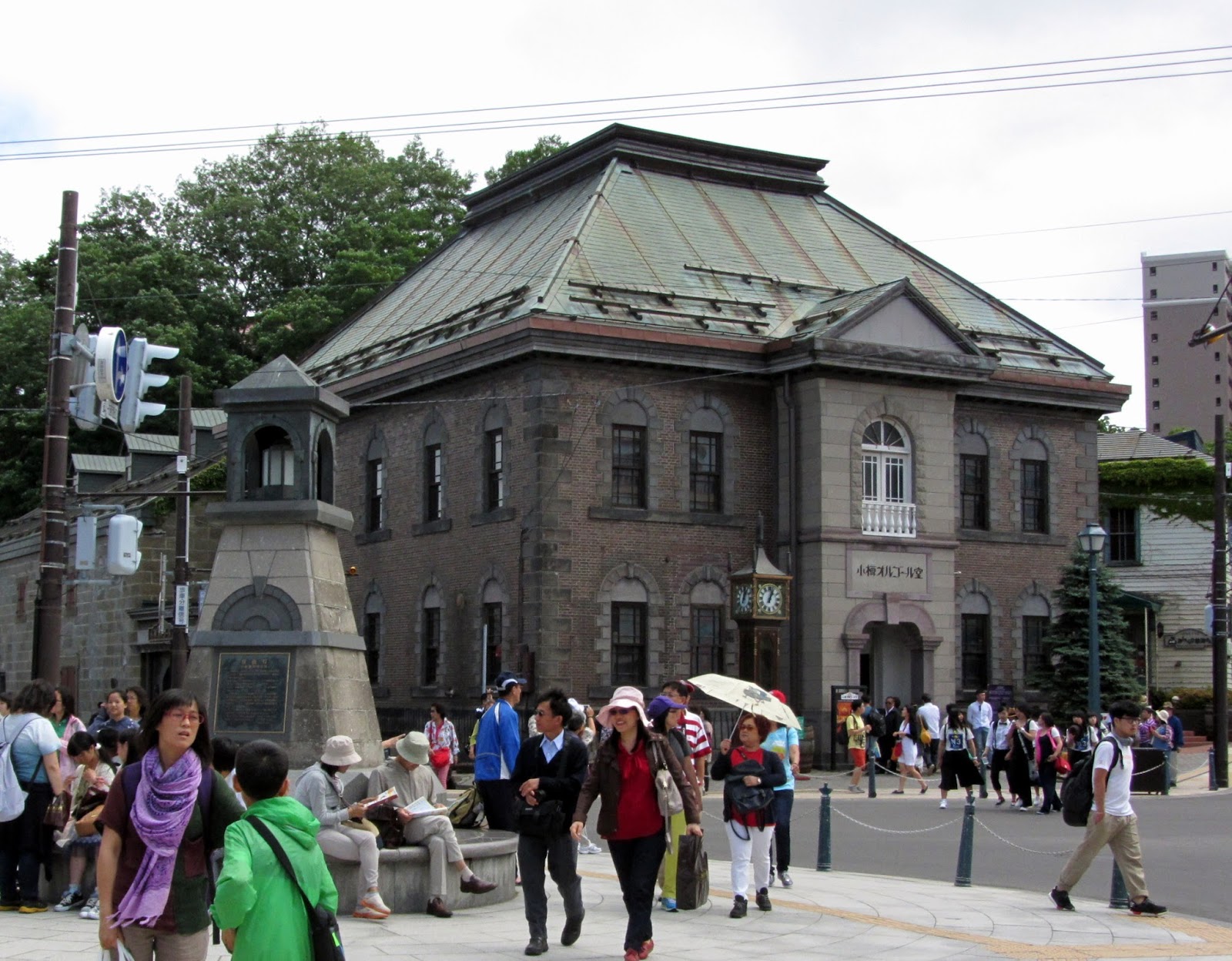
Otaru Orgel Doh - one of the glass shops,
with the steam clock in front
train would take us also down the coast in some sections, giving us the opportunity to to gaze at the cold blue waters of the sea. When we got off, at Otaru, we followed the crowds and sure enough, they took us to the canal where once upon a time the canal boats would load up from the warehouses situated on the sides of the canal. Today, the warehouses have been transformed to eating places, and tourist boats ply up and down the canal. Strapping young men in striped t-shirts also offer trishaw services - I suppose this is meant to establish Otaru's claim to be the Venice of the East, or at least of Japan. 

The other point of similarity between Otaru and Venice is, of course, glass. There are many glass shops  here
Music Box lovers rejoice!
in Otaru, along the main shopping street of Sakaimachi Street.  This was the old merchants' quarters, and these sturdy houses indeed look a little more European than Japanese at least to my eyes.  Today they are shops - mostly selling souvenirs, glass and music boxes.  Some times they combine the two and you can get a music box, with a little glass figurine of your choice perched on top!  
We spent some time looking for and finally found the Music Box museum.  The music boxes mainly feature European themes, and include a rather large organ which is really a music box!  

Other highlights of our visit include a steam clock (a gift from Vancouver, Canada), walking along the old railway line and taking a morning break at  Le Tao.  Le Tao is Otaru's answer to Furano Delice, with its own version of the Double Fromage cheesecake.  But it has expanded well beyond Otaru with branches in Sapporo as well.   We did have another break at Misono, a little ice cream parlour on the way back to the station.

More info on Otaru here and more pictures of Otaru at my Flickr page - Hokkaido album.

Starting the Day Right...

Related Posts Plugin for WordPress, Blogger...