Showing posts with label Mexico. Show all posts

Sunday, February 03, 2008

The thrill of seeing one's name in print

It has been more than a month since my last entry. Somehow, the new year has not exactly filled me with new, inspiring thoughts to pen down and share. It didn't start off too well - my mother was hospitalised for dengue fever and so we spent New Year's Eve in the hospital and New Year's Day paying another visit. Stressed, tired for most of the first week.

Anyway I have also been spending some time realising some of my self-publishing projects which I have been doing through Blurb. I received my "Blog Book" on my months in the US and Mexico, and also the rather slimmer journal on my brief trip to Siam Reap. Nothing particularly new or exciting for readers of this blog, contentwise, but definitely looks good on my bookshelf. My only problem is that after going through the text so many times, I don't find it particularly interesting to read right now; it is also irritating to find little errors scattered throughout the book. I look forward to taking the books up at a later date when my memory of what I wrote has dimmed a bit.

For my next project, I'm thinking of doing a family cookbook, something which combines my favourite recipes from my many many cookbooks :-) and recipes pilfered from various family members. It is going to be a really long haul project if I am to cook, photograph and then write about each one. Still, it is quite an interesting project which will occupy me for some time. And one which I can potentially take orders for!

In the meantime, may I proudly present my three self-publication projects:


Sunday, November 12, 2006

Catrina, Posada and Diego Rivera

We spent most of our last day in Mexico wandering around the city, through the parks and the streets. The parks are great - cool shady oases in a bustling city. Not very busy too - we did see people walking their dogs in the park (Mexicans appear to be dog people) - but they were never overly crowded.

We also popped in on the Museo Mural Diego Rivera which is a museum with one main exhibit, a single mural by Diego Rivera which takes up a whole wall. It was originally in a hotel lobby- the hotel was destroyed in an earthquake but the mural managed to survive. Now, the mural was extremely controversial because Diego went and painted in a line which said "God does not exist". He was forced to paint it out but evidently God has a sense of humour, or else the mural would have been destroyed with the hotel!

Anyway, here is a small section of the famous mural. I took only one photo before being informed that I had to pay 5 pesos more for the pleasure of taking photos. So I stopped. At the very centre of the mural is El Calavera Catrina, arm in arm with her creator, Jose Guadalupe Posada. (For more on Posada and the creation of a cultural icon, here is a link.) The little boy holding Catrina's hand is Diego himself and reflects Diego's admiration for Posada. Behind them is Frida Kahlo, Diego's wife and a famous Mexican painter in her own right. I did not know until coming back and reading something about her that Frida was in a serious bus accident in her youth and she was essentially living in pain all her life. She painted many self portraits and a lot of it portrayed her pain, both physical and from her marriage to Diego. Diego had a habit of portraying his family members in his work - this mural featured his previous wife, his son (if I recall correctly), amongst others. He didn't have any children with Frida (the bus accident). The painting included politicians like Benito Juarez, and the Mexican dictator Porfirio Diaz. It also featured some of his themes, eg, family being evicted from their home, repressed worker, wicked banker etc. I liked Diego's work - the colours, the folklorish style, the density and detail. Most of all I liked his (socialist?) view that art belongs to the masses and hence his interest in public art and large murals.

This post brings me to the end of our stay in Mexico. Most of the backpackers in our hostel are moving on to other parts of Mexico and even South America but sigh, we are not amongst them. The Canadian girl is going down to Central America (where she hopes to learn Spanish) for a total of 3 months, the British vegetarian couple and the tall German girl are all off to Oaxaca. It is apparently only us kiasu Singaporeans who read US travel advisories on the situation in Oaxaca. The only other person here for a short stay was probably Hernand, the Peruvian who went on some of the same tours as we were. Hernand speaks as much English as I do Spanish so our conversations were necessarily limited. But I did manage to convey that we were studying administration and to get that he would be leaving for Peru the night just before we returned to the US. Maybe I am getting the hang of Espanol after being mistaken so many times as a hispanic.

Adios!

Layers of the Past - Mexico Day 3

Today was yet another free tour to the National Museum of Anthropology (Museo Nacional de Antropologia). Let me just give a little buzz for Mexbus, the company which runs all these tours for the hostel. The guides are knowledgeable, well-informed and speak good English. Although yours truly went and opened her mouth and supplemented the guide’s vocabulary at some points.

The National Museum of Anthropology is a real treasure trove of the cultural history of Mexico and the people who have lived in this area of Mesoamerica for 3,000 years prior to the arrival of the Spanish. It starts, literally, in the Stone Age when Early Man lived their hunter-gatherer lives. We saw a mammoth skull with the remainder of a stone weapon lodged in it, indicating that human beings had killed that animal. From these early beginnings, we saw how Man started to settle down and establish little farming communities, before moving on to the later rooms where the artefacts from Teotihuacan and the early Aztec world were on display. We saw how the early civilizations lived, and buried their dead (together with the utensils they used in life). Our guide (Leo again) showed us this mask which displayed how these early people perceived their world. Half the mask was a skull, the other half a living face (quite an ugly one), symbolizing again the duality of life and death.

There was a similar mask at the Teotihuacan room, where the skull is surronded by the rays of the sun (note the similarity of the sun's rays to those emitting from the Lady of Guadalupe, see previous post). I mentioned earlier that we only saw a selection of artifacts found in the Pyramid of the Moon at the Teotihuacan complex. Others were here in the Museum of Anthropology. The museum has re-created the pyramid façade of the temple of Quetzalcoatl and Tlaloc and painted it to show the original colouring. There is also a display of skeletons – probably of sacrificial victims. They are arranged the way they were found, some with necklaces of jaws around their necks. The display’s alarm system is pretty sensitive, as we found whenever anyone leaned forward to take a closer look.

The largest and most impressive room we went in was the Aztec (Mexica) Room. The first thing we saw was the Aztec “calendar”, hanging high up against the wall. Apparently it was not really a calendar – it was meant for some other purpose but a huge crack at the back of the “calendar” resulted in it remaining unfinished. But the Calendar shows how exact Aztec astronomy was. There were 18 months of 20 days each, i.e. a total of 360 days. There were also 5 “extra” days, which were supposed to be “bad” days where people generally stayed home and didn’t do much.

There was one rather stark exhibit – this huge stone circle which was carved around the sides with scenes depicting how many peoples/territories that particular Aztec king had conquered. The circle has a hole scooped out in the middle – this, we were told, was where the hearts of sacrificed victims were put. See the stone and other photos from the museum here.

We also saw in the room a family tree of the line of kings, including Montechzuma and Cuauhtemoc, the last king who died fighting the Spanish (his name means "the eagle has fallen" in the Aztec language). The story of how a few hundred men under Hernando Cortes managed to defeat the Aztec Empire is sad and tragic. The story is that the Aztec god, Quetzalcoatl, who was thought to be white-skinned, had left his people but promised to be back in a certain year. That year (our 1531) came and so did the Spanish. The Aztec mistook them for the returning God and treated them as such. But that was not enough for the Spanish. In the end, the Aztec were defeated by three factors: (i) new weapons (firearms) and animals (the horse), (ii) new diseases like syphilis and smallpox and (iii) their own harsh treatment of their conquered peoples – the Spanish found it easy enough to turn the native peoples against their Aztec rulers. The Spanish then proceeded to thoroughly destroy Aztec civilization. They pulled down pyramids and build churches; they took the altars of temples and put crosses on them to convert them to Christian altars; they even took the circular stones with the holes in the middle and turned them into baptismal fonts for use in the conversion of the natives! Some examples were in the museum. I also found on-line a rather nice little flash presentation on the conquest - click here.

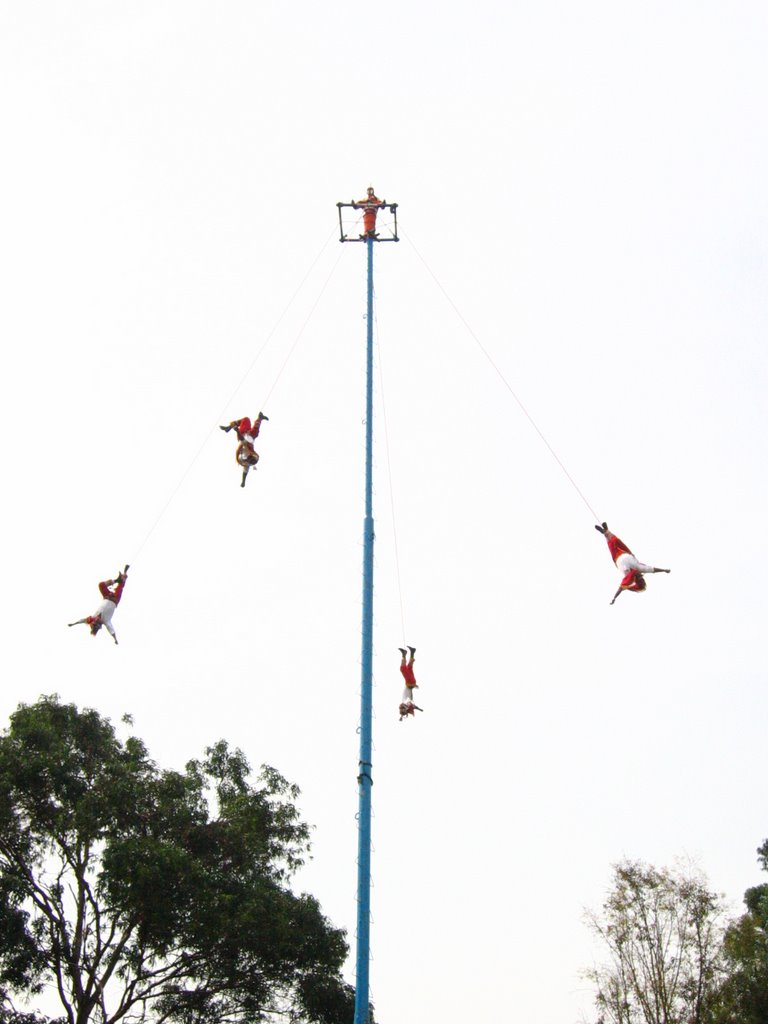
The museum has also interesting "live" exhibits. We saw a performance by the flyers of Papantla, or the Voladores de Papantla. Four men are tied to a maypole, they gradually lower themselves down whilst rotating from the pole. There is a fifth man standing on top of the maypole playing flute music. See video link of the flyers at my Multiply page (see link on left).

After the tour ended, we continued wandering around the museum on our own. There are other interesting rooms there – the room of the Oaxaca people, and the huge Maya room where there is a re-creation of a temple and the tomb of a Mayan king (Pacal) with the king himself interred there. I wish we had time to go to Chichen Itza! (But apparently whilst the pyramids there are shorter than those at Teotihuacan, they are steeper so the climb would have been even more painful).

All in all, it was fascinating. As I said before, the quality of the museums in Mexico City is excellent. In this museum, there are even some English language posters up and this really helped me to understand the exhibits, even without a guide. More than that, I thought that it really showed the layer upon layer of history which each group of people laid down in this area of Mesoamerica. From the early Pleioscene to the Teotihuacan people, and the Aztecs of Tenochtitlan, each group has left its mark in the area. But they were not the only ones – the Mayans, and the Oaxacan people, and the people along the Gulf of Mexico also had their own separate cultures and traditions. These people traded with each other, and traveled from place to place – creating a whole rich and separate civilization which is truly very different from any other I have encountered on my travels.

Friday, November 10, 2006

In the Streets of Mexico City

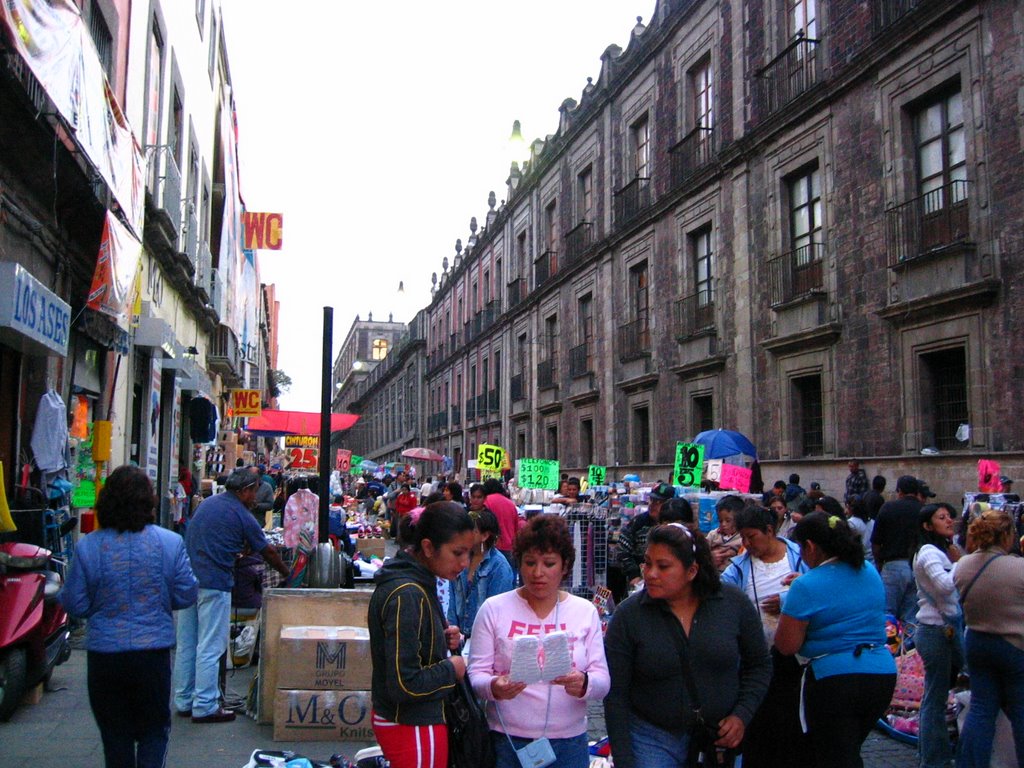
With 24 million people, Mexico City is one of the largest cities in the world. It is also one of the most ancient in the North America (founded in 1325, well before Columbus). But when we first arrived, about 10pm in the evening, the street outside our hostel was dark and deserted. Little did I know that the next morning, it would transform itself to part of one of the largest street markets that I have seen.

Around 8am each morning, people start to set up their stalls. Some have stands or tables on which they display their wares; others just put a tarpulin on the road. Anything and everything is for sale - accessories, clothes, bags, CDs/VCDs/DVDs, down to extension cords, towels, Christmas ornaments, lawn and house decorations and so on. We tried finding the borders of the market, but could not find the eastern border. There's a tremendous amount of buzz. People are calling out to customers, shouting at others to get out of the way and so on. And the traffic is trying to get through. Yes, traffic. What I'm still not clear about is whether there are any rules as to which streets are closed to vehicles when the market starts. There were traffic lights, but there was plainly no way for any vehicle to make its way through the stalls and human traffic. Then there was the occasion when this chap who had set up shop in the middle of the street had to move when a truck came down. Somehow, the market had made its own rules.

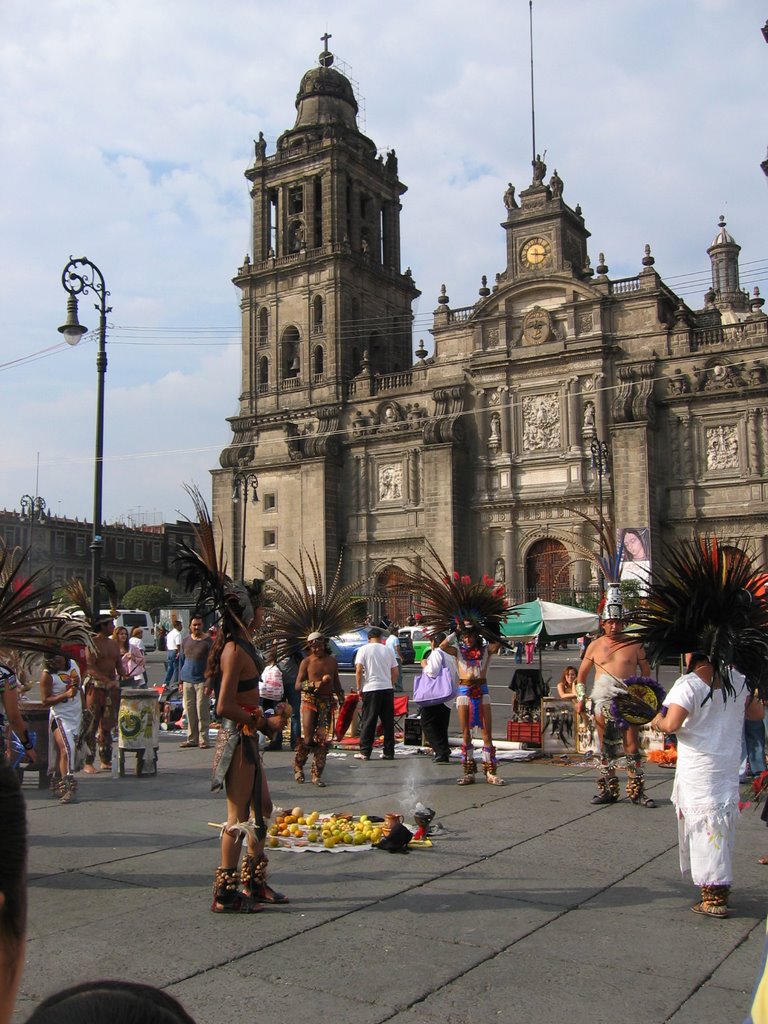
A different set of rules applies to the hawkers outside the Catedral. Whilst the large street market seemed to cater to locals, the hawkers outside the catedral catered to tourists - craft items, t-shirts, little sombreros, etc etc. There were shoeshine booths and also a little bird which picks your fortune out from a box. They do a busy trade but every now and then, someone raises an alarm and the hawkers, in the blink of an eye, pack up their wares or throw a blanket over them. Then we see a policeman walking down the street. So evidently, it is not legal to peddle goods outside the catedral area. But it is all a wayang. As long as the policeman doesn't see the actual goods, or an actual sale taking place, then he ignores the bags of goods and the covered items. Once the policeman walks off, it all starts again.

In front of the Catedral is a huge square - the Zocalo. This used to be the ancient ceremonial centre of the Aztecs but it has now been turned into a large square, or the Zocalo. Performing groups in the square draw the crowds - such as this group of Aztec dancers here. There are also folk dances performed on a stage in a corner of the square. It turns out that this is a "soft sell" of the people in Oaxaca to win sympathy for their cause - turfing out the unpopular governor of the province. So whilst you're watching the dancers twirl around, someone thrusts a flier in your hand.

The protesters are everywhere. They have camped outside major national monuments such as the National Art Museum (mentioned earlier) and in the Alameda Central (a park). There was one group which occupies the pedestrian crossing once the traffic stops and only marches off once the green man turns red. Apparently, the protests go beyond Oaxaca province. The Presidential Election (in July) was won only very narrowly and the people are disputing the result. Now that I'm safely back in Singapore it is also time to reveal that some bombs went off the first day we were there. But these were in the dead of the night so no one was injured and they were at very specific targets. So we were really quite safe :-) Oh yes- forgot to add that that the protesters also apparently invaded the Catedral and disrupted a mass the Sunday I was there! (Not the mass I went to though. Not sure whether that was good or bad).

So that's what the streets of Mexico City are like. Full of people, full of action. More stray dogs than I've seen anywhere else. Men making cloth flowers on one side of the Catedral. Beggars, shoeshine booths, protesters, performers. Lots of hawkers and the occasional policeman. And of course us tourists. (Incidentally, I was taken for a local quite frequently until I said my favourite phrase, "no hablo espanol" which of course means I can't speak the language!).

The Place where the Gods Began - Mexico, Day 2 Part 2

We visited two pre-Hispanic sites during our one-day tour.

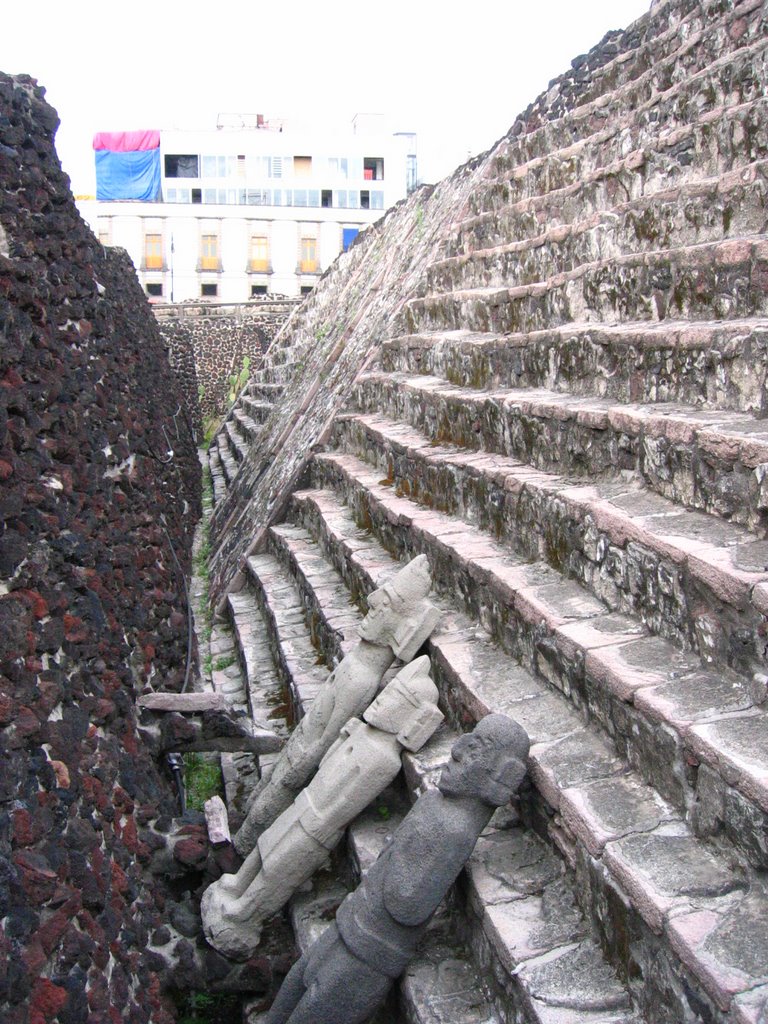
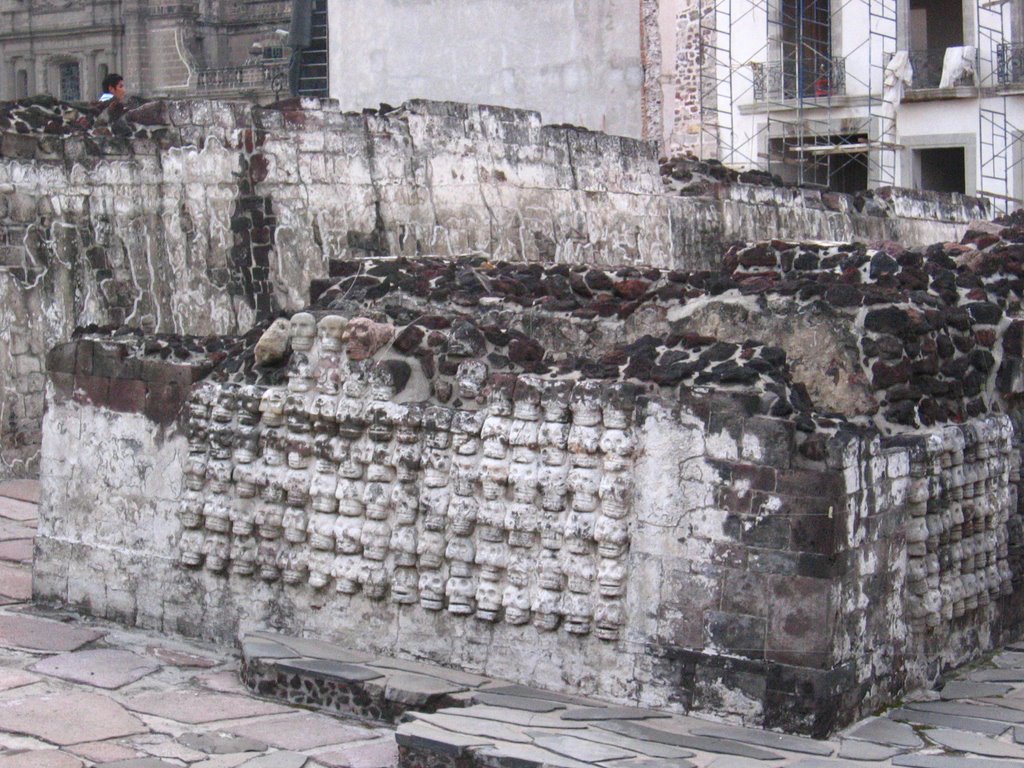
Our first stop, Tlatelolco ruins or what they now call the Plaza of the Three Cultures. There are the ruins of Tlatelolco, the Spanish church of Santiago Tlatelolco which stands next to it and finally the buildings of modern Mexico around the place. As mentioned before, Tlatelolco was a twin city to Tenochtitlan and was the commercial centre of the Aztec empire. Traders from all over would come to Tlatelolco bearing products from the Oaxaca area, the Mayan area and so on. However, much of it is probably covered up by modern Mexico today. The ruins we saw were again temple ruins, very similar to those of Templo Mayor in Mexico City. I guess the biggest buildings around were the temples themselves, and it was hard to get rid of them completely whilst the stone from smaller buildings could be easily carted away. We again saw how the pyramid builders operated - building a larger pyramid over a smaller one in order to enlarge the size of their temple. Our guide showed us one altar and told us that when it was excavated, there were about 170 skulls found with a hole punched through the cranium. They were probably strung together at that point for display. The last battles between the Aztec and the Spanish were fought at Tlatelolco, and it was here the Spanish empire came to an end. The plaza was also the place where a massacre of students took place in 1968. They were protesting (Mexicans love protests, I find) against the conditions of the day (whatever they were). The government did not want disturbances just before the Olympic Games took place and so they shot the students! Bizarre logic.
After Tlatelolco we went to the Guadalupe shrine (see last post) and then to a handicraft factory outlet. This was quite fun because we got to try the local tequila and try out corn bread with cactus (sans the spikes) and cheese topping. Aztec food?

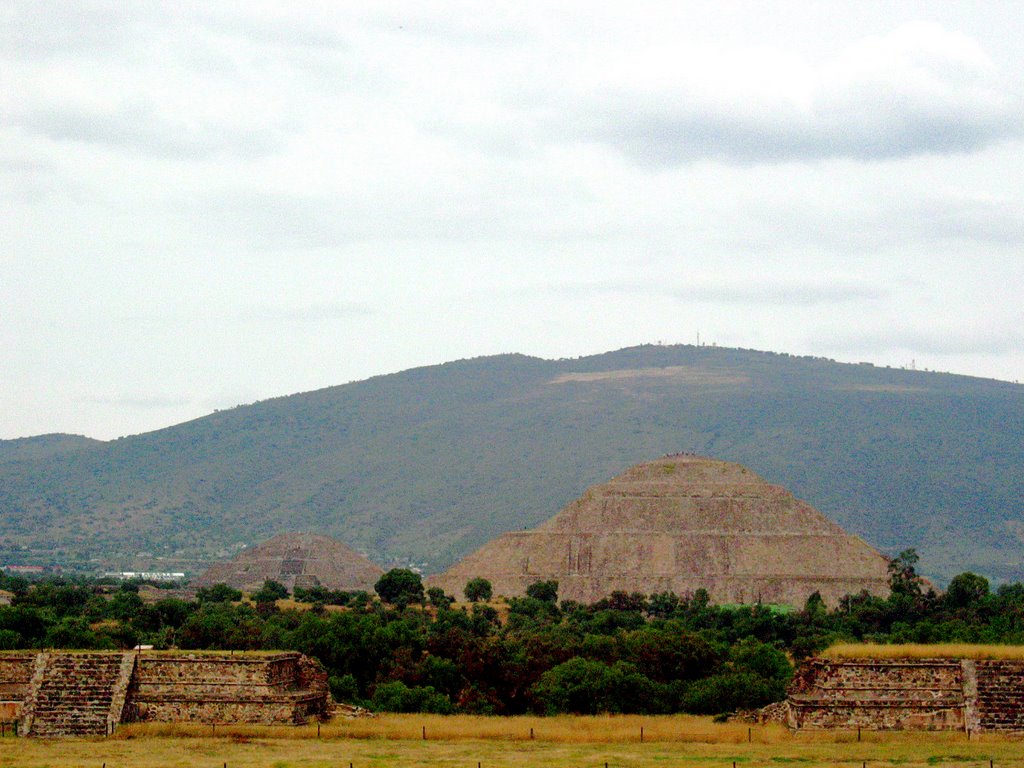
We then went on for our pyramid climbing expedition. Now, the Aztecs did not actually build the Teotihuacan complex. It had been built many many years earlier by a people now unknown. The Aztecs found the complex and found it so impressive, that they thought it must have been made by the Gods. So they called it “Teotihuacan”, or “the Place of the Gods”. It is a huge complex, with three pyramid structures and several temples all linked by this long “Avenue of the Dead” (apparently the Aztecs thought the buildings alongside were tombs). Just as was the case for Templo Mayor and Tlatelco, the pyramids were built in layers one on top of the other. And this meant that they covered up a lot of other things as well. So the starting point for the tour is a small museum displaying what archaeologists dug up out of interior of the Pyramid of the Moon. Other artefacts are displayed at the National Museum of Anthropology (where we went on Day 3). We visited the museum and after that started pyramid climbing.

The first pyramid was the pyramid of Quetzalcoatl and Tlaloc. Quetzalcoatl is the feathered serpent, thus symbolising the union between earth and sky. In the Aztec mythology, he taught the Aztecs about growing corn, about pottery and astronomy (their calendar). Tlaloc is the rain God, i.e. symbolising water. Apparently they are paired together in many representations. Aztecs believe in the duality of all things - fire and water, rain and earth, sun and moon. See video here for approach to the pyramid.

We then walked down the Avenue of the Dead to the Pyramids of the Sun and Moon. Now, in case anyone is labouring under any illusion that this is a nice, pleasant stroll, the Avenue of the Dead is not a straight road per se. There are a series of raised quadrangles which we have to climb up and down. I tried walking around one side only to see our guide lead us to the other side where she showed us some Jaguar heads.

The Sun pyramid is the highest of the 3 and it had rather steep stairs to clamber up. Anyway, I am pleased to say I did it! Panted a lot but that was probably the altitude, yah? The Pyramid of the Sun is shorter than the pyramid of Cheops in Egypt but has the same base and is apparently the third highest in the world. The view from the top is great except that it takes a lot to get there. I didn't climb up the Pyramid of the Moon. Felt that I had proved myself :-) And you don't get the best view of the pyramid on the pyramid itself, right? Not all in our group climbed up either - there were these Brit girls who happily sat at the bottom of the pyramid admiring the view too.

Also, spent some time wandering around the Temple of Quetzalpapalotl, or the temple of the plumed butterfly. It is a well preserved (at least I hope it is well preserved) little temple with beautifully carved columns. It was quiet and peaceful especially with the sun slanting in. Also visited this Palace of the Jaguars, where there are some beautifully preserved murals.
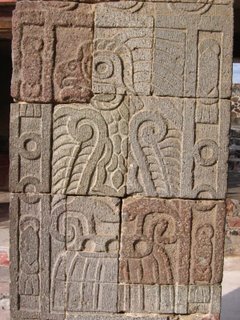
There are also many, many souvenir sellers around the Teotihuacan complex hawking little obsidian statues, silver jewellery, handwoven cloth etc etc - essentially the same stuff as at the handicraft museum but at a fraction of the price. Hmmmm...... I did buy something so as to average down my costs but when I compared it to the stuff in the little shops near the exit to the site, it seemed fairly comparable. Guess I didn't get a great bargain but at least I didn't get ripped off.

All in all, I find the story of Teotihuacan fascinating - how this people came so long ago to build these pyramids that lasted so long that those who came after them marvelled at their splendour. Sometimes the works of men do persist, after all.

See my Multiply page (link on left) for more panoramic views of Teotihuacan. The link to Flickr photos is here.
Wednesday, November 08, 2006

Our Lady of Guadalupe - Mexico, Day 2 Pt 1

Today we went on a 1-day tour to the ruins of Tlatelolco, the Shrine of Our Lady of Guadalupe and to the pyramids of Teotihuacan. It was the high point of our trip to Mexico, both literally and figuratively. Oh yes, it also featured a shot of tequila and a handicraft factory outlet so there were indeed many different types of 'highs'. I'm going to alter the chronological flow of events now, so that I can talk about the Aztec stuff separately from the Catholic stuff, and go straight to our visit at the shrine of Our Lady of Guadalupe.

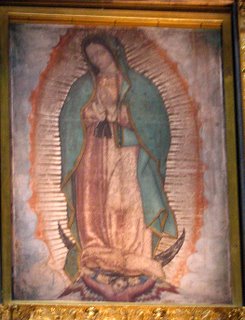
I must say I was more than a little excited at the prospect of visiting the shrine. The story is that Our Lady appeared to an Aztec peasant, Juan Diego. This was some 10 years after the Spanish conquest. He went to a priest and told him the story but of course the priest didn't believe him. Juan Diego asked our Lady for a sign and she told him to pick some roses which had miraculously appeared on a bush. He picked the roses, put them in his poncho and then went to the priest. He shook the roses out to show the priest and lo and behold, there on the poncho was an image of the apparition he had seen:

(FYI, I did photoshop this but it still isn't too good. Other photos can be found here.)

Mary appears with the rays of the sun about her, the moon beneath her feet and stars on her cloak. This was interpreted very positively by the Aztecs - the duality of sun and moon, day and night is important to them culturally - and apparently this played a big part in their acceptance of Catholicism (with Aztec characteristics). That the hill she made her appearance on was already sacred to the Aztecs helped too.

This tradition of special reverence for our Lady of Guadalupe is still very much present in Mexico today. On the way to the shrine, we saw a procession of pilgrims walking to the basilica. (We would later see them entering the church - see photo.) We got to the shrine itself soon after. It is a really huge complex, with a gigantic square with the new basilica at one end, and the old basilica along the adjacent side. The old basilica was in danger of falling over, so they built the new one and took some some remedial action on the old building.

The new Basilica is large - it seats some 8,000 people and holds masses every hour of the day. Of course, being on a conducted tour I could not go to mass so had to say a short prayer instead. On the outer wall of the basilica, there is a special altar which overlooks the square. This is used when mass is said in the square on special occasions - which includes Pope John Paul II's masses when he visted Mexico City. (There is a statue of the Pope in one corner of the Square, together with his Mobile Van.) Pilgrims (and tourists) were walking into the Basilica but there were a few who were going in on their knees - ow. The square is made partly of nice smooth stones (I think granite) but a lot of it is just rather rough looking paving stones.

Going into the Basilica, the poncho with the image of Our Lady is hung behind the altar. But, (and I think this is quite ingenious) there is a pathway which goes below the image and from here, looking up, the image is quite clearly visible. Of course, close scrutiny is not possible, especially as there are a few short travelators just at that point to keep the flow of people going, or so they can concentrate on their prayers. I was too busy trying to take photos on the travelator to do anything else.

We then visited the old Basilica (where I saw the Day of the Dead display). The columns have all been reinforced, and there is a lot of metal strutting inside the building. We then went to the gardens around the basilica, and our guide pointed out where the original apparitions to Juan Diego were supposed to have taken place. It is really a peaceful, quiet area. She then gave us about 20 minutes or so free time which I spent trying to find nice souvenirs to bring back so I can share the whole experience with others. Not so easy as it seems - the place has a lot of rather cheap looking stuff. So this is the sacrifice which I had personally to make - go shopping instead of taking the opportunity to spend in quiet prayer (and I do mean this, for all the doubters out there) ! But I felt quite happy after our visit and hopefully that was God's grace at work rather than the feeling of satisfaction at being able to get something halfway decent :-)

In the Historic Centre - Mexico, Day 1

Did I mention previously that our hostel has a tie-up with Mexbus, a tour company? So today we went on a free tour of the Historical Centre of Mexico, i.e. our neighbourhood. We started off in front of this huge map of the area in the pre-Hispanic times. There were two major cities in the area, Tenochtitlan and Tlatelolco. Tenochtitlan was the political and military centre of the Aztec world and Tlatelolco the economic centre. The two cities were on an island in the middle of a lake. After the Spanish conquered the Aztec, they started filling in the lake and Mexico City expanded on this reclaimed land. The Spanish also pulled down all the Aztec temples and used the stones to build churches next to the temple. But the churches are so heavy that they are now sinking into the earth... requiring a lot of conservation effort. Divine retribution?

The Aztecs too had problems with their temples sinking into the earth. But they had a simple solution for that. Just build another temple over it. Remember, they were pyramid builders. So what you see on top is just the outermost layer, on top of a much older structure. There is a huge excavation site just next to the Catedral, of the Aztec Templo Mayor (Great Temple). The inner walls of the older pyramids are exposed to view here. We visited the site and the accompanying museum after the tour. There is this a macabre altar with human skulls all around it. That would have been the altar of the God of War.


Our next stop was the National Palace, where we were introduced to the murals of the famous Mexican painter, Diego Rivera. He has a series of murals up one staircase and down one wall of one of the palace courtyards. He was a communist and definitely anti-Spanish, anti-Catholic, so the Aztecs look like poor victimised people and Cortes and the Catholic church like murdering conquerors, making conversions by the sword. Truth to tell, the behaviour of the Spanish was also horribly cruel but they must have felt that anything was better than a religion that cut out the hearts of its adherents. Talk about relative moralities! Our guide (Leo) took us through the paintings in detail - Diego's prejudices aside, they also presented a lot of information about the pre-Hispanic world. There was a picture showing some of the religious rituals - playing a ball game called pelota; the Voladores de Paplanta or the Paplanta flyers. None of the more grisly rituals like cutting out hearts, although Leo told us that sometimes the victors of the ball games got the knife. Sacrificing the lives of some people, would ensure the survival and prosperity of the rest. Or, as someone in our group said, "life, for life." In one corner of the National Palace was a little display from the Day of the Dead celebrations. In one way, the culture of the Aztecs is still alive and well. Day of the Dead displays feature skeletons (or Katrinas) dressed up in fancy outfits, shrines and altars feature more skulls (we were to see a fine example at the old basilica of Our Lady of Guadalupe the following day). Its got this very tribalistic feel to it.

We next stopped over at the Catedral. I was amazed at the number of masses. There must have been about 8-9 altogether, 4-5 in the morning and another 4 in the evening. I went to the 5pm mass later that day. The Catedral itself is ornate. The first thing we saw was a huge chapel just inside the catedral, all covered in gold leaf. The main alter itself has tall gold-leaf covered columns on each side. I suppose this is after the Spanish style, with Mexican overtones. There were two large pipe organs. One is from Spain, the other Mexican-made. The Mexicans also have an interesting custom. There was a picture of our Lady on one of the walls with all these medals, and little photos stuck around the frame. Apparently, if someone has survived a brush with death, or recovered from a serious illness, the practice is to put up one of these little medallions or trinkets on the frame as a form of thanksgiving.

We then went on to view various buildings in the historic part of Mexico - the building in which the Spanish Inquisition was held (they brought it over from Spain), the Post Office building, the Opera House and the National Art Museum. The tour ended after that and we then went off on our own. We went back to the Art Museum, and had to enter by the back entrance because the front was being blocked by the group of Oaxacan protesters who were camping in the square just outside the museum. The museum itself (and this is true for all the Mexican museums we visited) was excellent. Of course some English explanations of the works would have been nice but this is a Spanish speaking country, after all.

We ended off our day with a tour around the ruins of Templo Mayor (as mentioned earlier). It is really an absorbing archaeological site and it is incredible to think that this was just one small part - and around and below me lie far more of the ancient city of Tenochtitlan.

Photos from Mexico Day 1 here! Day 2- will feature visit to Teotihuacan (and more pyramids).

Tuesday, November 07, 2006

Hola! Mexico!


So, here I am in Mexico City. Flew in from Washington D.C. on Saturday evening. It was quite a tiring flight. First of all, the bus rode to Dulles airport from near our hotel took half an hour longer than expected - the bus driver hadn't a clue what he was doing and got lost repeatedly! I was napping happily and so didn't realise what was going on but at some point the passengers started yelling, "you're going the wrong way!" and "some of us have jobs we could lose because of this!". He finally got us to the terminal and these angry passengers stormed off threatening to complain. Did a self-check in at departure - the check-in staff just make sure our baggage isn't overweight and counts the number of bags we have. We then have to lug our baggage to the screening station where the chappie hauling bags told me "go to the other end and watch your bag drop down the chute, then you can go off." Not very reassuring. Finally of course at the security clearance, we find we have been randomly assigned for more thorough screening! Wonderful. Anyway the journey and checkin process took 2.5 hours in all so it was fortunate we gave a lot of time.

Arrived at Mexico City at about 10.30pm DC time and 9.30pm Mexico time. Finally checked in and found that our Hostal Moneda is indeed a true backpacker hostel... strictly no toiletries, not even a tumbler for my toothbrush and towels like sackcloth (good thing I brought my own) and worst of all no hairdryer.

Having said that, the hostel grows on one. There is breakfast and dinner provided (but this is a sort of risky business, yesterday was fine but tonight's food is somewhat scanty - good thing I have a spare banana) and there are tours going out from the hostel. There is also of course free internet access. I'm typing in this blog from one of the terminals. Meals are served on the roof of the Hostal.

It has a great view of the Catedral Metropolitan. The Catedral is lit up at night and I can see it every time I turn my head to the right. There is an open bar so I have a nice bottle of Corona beer next to me and some Mexican music in the background. As I said, it grows on one.

The patrons of this place are mainly European - not sure why. There are a number of Brits, Germans, etc. Not sure about the rest. We meet each other on the conducted tours and then at meals. We don't exchange names, it is really the backpacker life indeed.

Starting the Day Right...

Related Posts Plugin for WordPress, Blogger...