Showing posts with label catholic. Show all posts

Saturday, December 15, 2018

A Jewel of Cathedrals - Chartres

Chartres Cathedral
Chartres Cathedral, or more properly called Notre Dame de Chartres, is a jewel of Gothic architecture.  The first church on the site was built as early as the 4th Century, but was destroyed a few times and rebuilt each time.  Charles the Bald, the grandson of the great Charlemagne, donated the "Sancta Camisia", or the shift of the Virgin Mary, to the church and it became a place of pilgrimage.  (The shift is still to be found in the cathedral today).   Eventually, after yet another fire, Bishop Fulbert built a vast cathedral which was completed in 1037.  Whilst some part of this building was destroyed by fire, the bell tower and part of the front face remained.  The church was rebuilt and extended further (including the addition of another tower), and finally consecrated in 1260 in the presence of King Louis.  Today, the cathedral is renowned for its spectacular stained glass windows dating from the 12th and 13th centuries, its medieval crypt and the mysterious labyrinth embedded in the centre of its nave.  It is no wonder that this famous cathedral is a UNESCO World Heritage Site.

The North Rose Window
To say that the cathedral is beautiful is an understatement.  It is magnificent!  The tall vault above the nave, the majestic pillars, lead the eye up to the heavens.  The statues in the screen around the choir are so intricate and expressive.   The stained glass windows, with their vibrant colours and beautifully detailed panes - I could spend hours just trying to work out what scenes they depict.

We managed to get to the cathedral  in time for the tour by THE authority on Chartres Cathedral, Malcolm Miller.  Miller has been giving his tours since 1958!  He doesn't have a fixed tour per se, but brings visitors to different parts of the cathedral each time.  Apparently he is not really affiliated with the cathedral per se but they support his tours and he is listed on their website.  But you need to get in touch directly with him to check whether he is holding the tour on a particular day.  We were lucky enough to go on a day when he was conducting his tour. (There is another English language tour available so you can go on that if you miss Miller's tour).

Indeed his knowledge of the cathedral was truly encyclopaedic.  He pointed out the various biblical stories told in the stained glass windows, similar to how perhaps the illiterate peasants would have learnt the bible stories way back in the Middle Ages.

Detail - Adam and Eve
He also revealed the deeper theological references within the windows - for example, that whilst the tale of Adam and Eve described the Fall of Man, the Parable of the Good Samaritan spoke of God's Salvation through Jesus Christ.  In the parable, the traveller represents Adam, cast out from paradise; the priest and the Levite walk past him; but Christ is the Good Samaritan who brings him to safety and promises to return for him.  On a more prosaic note he also showed us the details in the windows which showed who had donated the cost of their production - be they tradesmen, or nobles etc.   More on the cathedral's stained glass windows can be found here.

Miller also took us outside the church, to take a look at the statues adorning the doors and entrances to the church.  He showed us the Last Judgement, found at the South Porch of the church.  Christ sits above the doorway, with Mary and John the Evangelist on either side, the angels above and around him.

We decided to go on a second tour, around the crypt.  The tour was in French but since you can't go to the crypt on your own and that was the only tour available... we went on it.   (Most of the people in the tour didn't speak French so we were all in the same boat).  The crypt is the largest in France and it is here that the early origins of the cathedral are most obvious, as being underground, it survived all the fires above.  The cathedral was rebuilt on the foundations of the crypt, and you can still see the ancient pillars on which the building above rests.  Old, faded murals on the walls also reflect the antiquity of this place.

The Labyrinth
The other well-known feature of Chartres cathedral is its labyrinth.  In the old days, pilgrims would walk the labyrinth (some on their knees).  It was symbolic of the twists and turns of life, the trials and false turns made along the way.  But eventually, the pilgrim could reach the centre where the way out was straight towards the altar, i.e. to God's saving presence.

When we were there, labyrinth was partly covered by chairs. It is revealed fully some days (I believe Friday afternoons).  I did not realise it was such a large labyrinth - reaching out to almost the entire width of the nave.

Around the altar, are the little chapels and shrines.  We saw the Lady of the Pillar (a local devotion to the Blessed Virgin), the Sancta Camisa as mentioned earlier.

In addition, there was a small little side shrine devoted to St Therese of Lisieux.  Beside it, preparations were being made to add one more - for St Therese’s parents, the newly canonised St Louis and Zelie Martin!  The first couple to be canonised as saints for their unique role in creating an exemplary Catholic family environment for their children.

We ended up spending the entire day in the Cathedral, without even going anywhere else in Chartres!  But it was indeed a day well spent, absorbing the beauty of the surroundings and praying in this sacred place.

More photos will be put up here.

Chartres Cathedral - Interior


Sunday, November 18, 2018

Saints Extraordinaire


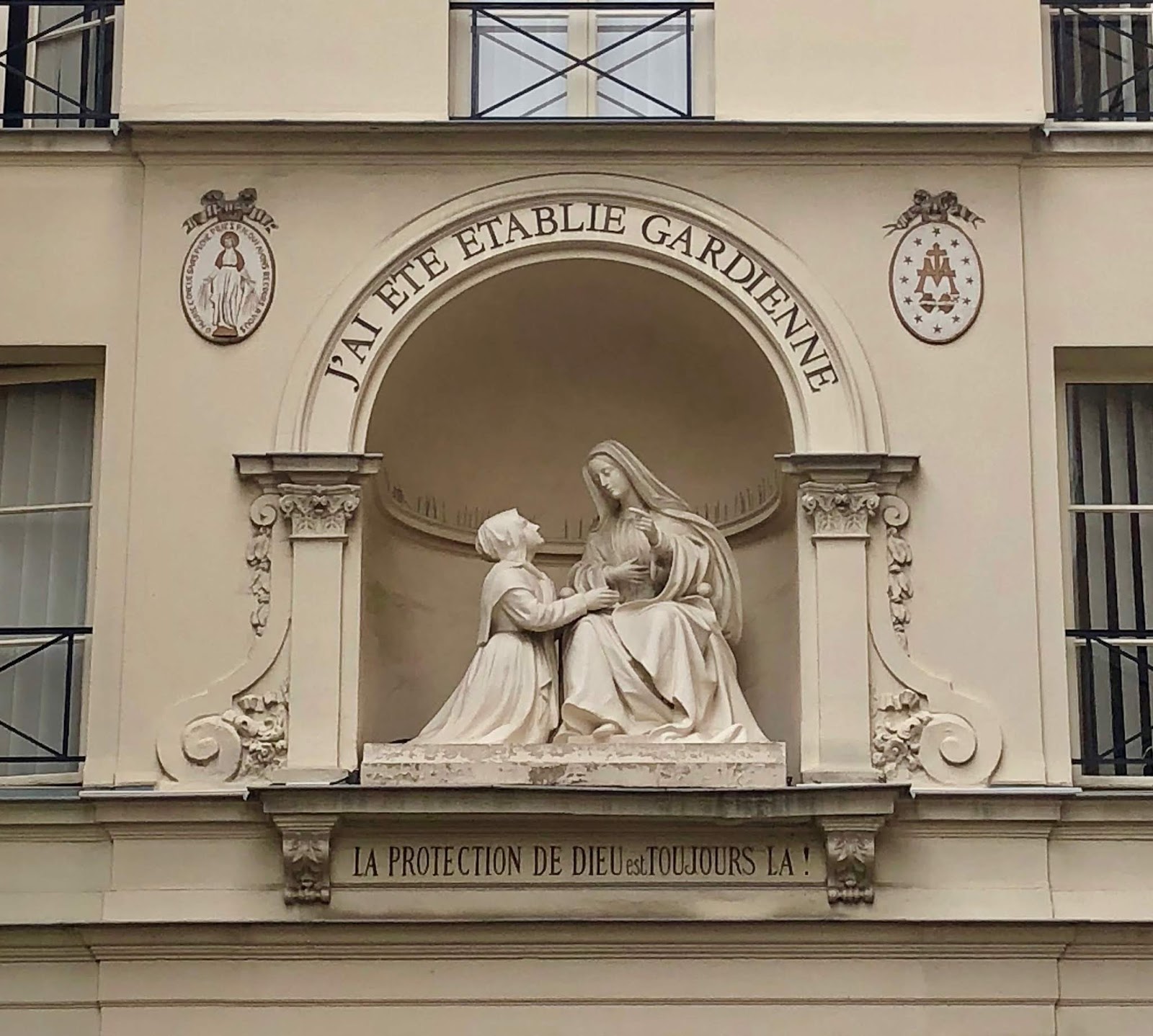
St Catherine praying at the feet of Mary
In a little corner of the left bank of Paris, just behind the trendy St Germain area, is "Religious Orders HQ".  We came here to visit the Chapel of the Miraculous Medal, but found also the motherhouse of the Mission Etrangers de Paris (MEP), and the Espace Nicholas Barre of the "Souers de L'Enfant Jesus"!  Without them, my life would indeed not have been the same!

The visit to the Chapel was one of the more significant stops on our mini-pilgrimage.  Hidden behind an insignificant little entrance way on the Rue du Bac, this is the original quarters of the Sisters of Charity (also called the Daughters of Charity), co-founded by St Vincent de Paul and St Louise Marillac.  It was here that the Virgin Mary appeared to St Catherine Laboure, then merely a novice of the order.  A detailed account of Catherine's story is here, but I shall give a short summary: Catherine had a vision of Mary, seated on a chair.  Mary asked her to have a medal made, with the image of Mary with beams of lights emitting from her hands on one side, and with the Sacred Hearts of Mary and Jesus on the other.  Around the person of Mary, the words, "O Mary, conceived without sin, pray for us who have recourse to thee". Thus, the medal is more properly known as the "Medal of the Immaculate Conception", and confers graces and blessings on the wearer.  Catherine had the medal made but her identity and role in its making was kept secret for most of her life.  She was subsequently canonised as a saint.

The Chapel at Rue de Bac
The Chapel of the Miraculous Medal itself is a shrine containing the perfectly preserved bodies of St Catherine Laboure and St Louise Marillac.  It also holds a reliquary containing the undecayed heart of St Vincent de Paul, which had been removed earlier from his then undecayed body.  Unfortunately, the body of this great saint subsequently decayed after being affected by a flood.   We visited his shrine later on, just around the corner.

Anyway, we had timed our visit to the chapel in good time to attend the morning mass, but it was quite crowded what with all the groups of pilgrims coming from all over and seats were in short supply.  So we had to split up. But we were fortunate, for others could not even get a seat! I took some time to admire the chapel - it is truly a little jewel, with lovely mosaics covering the arch above the altar, and on the side chapels.  On the left of the altar is St Joseph, bearing the Christ child, and on the right, Mary holds a globe in her hands.

It was a powerful experience being there for mass and even after, as the pilgrims stayed back for quite some time after mass ended, to venerate the saints and to pray at the foot of the altar.  Thereafter, we went to the little shop and bought lots of medals and got them blessed by one of the priests who said mass.

We went next to the Shrine of St Vincent de Paul, just around the corner. It was behind yet another nondescript door but what splendour awaited us on the other side!
.
Magnificent shrine of St Vincent de Paul
The shrine is richly decorated, with an ornate ceiling and pillars along the sides.  The bones of St Vincent, covered in wax to create a wax model, are in a transparent case above the altar, and apparently you can get nearer if you go up a staircase behind the altar.  Well, we did not know it at the time and so did not go up...

Two other, lesser known saints lie along the side aisles of the church - St Jean-Gabriel Perboyre and St Francois-Regis Clet, both martyred in China.  More of their background is told in this article.  These two martyrs are priests of the order of the Congregation of the Mission (CM), which is a missionary order set up by St Vincent de Paul (again).  They are also called Vincentians, or Lazarists.  The main church is this shrine of St Vincent de Paul and hence this is where the other two saints were laid to rest.  Interestingly, the one society St Vincent did not found is the Society of St Vincent de Paul!  It was in fact set up as a lay society by a French lawyer, Blessed Frederic Ozanam, who was inspired by St Vincent to do this work for the poor.

After the visit to the shrine, we went back to Rue du Bac to have lunch at La Grande Epicerie de Paris, the food section of Le Bon Marche, Paris' oldest department store.  We had a simple sandwich there and thereafter made some purchases (mostly goodies for the office) before making our way onward.

The "Meridian Line"
After lunch, we went on to our next stop, the Church of St Sulpice. St Sulpice was born in 570AD (!) and died in 647.  He was the Bishop of Bourges and was greatly concerned with the poor and the sick.  The current church replaced an older one on the same site and was built by the then Parish Priest, Jean-Jacques Olier (1608-1657).  It is the second largest church in Paris, smaller only than the Notre Dame and includes a seminary as well.  There are a number of interesting features about this church, such as its impressive pipe organ, and more unusually, its "gnomon", which is an astronomical device meant to help determine the dates of important church feasts.  The gnomon was featured in the Dan Brown book, "The Da Vinci Code", and called a "Meridian Line".  It was meant to act as a red herring to confuse those who sought the grail... ... but the use, and description of the line in the book were in fact erroneous.  Even so, due to the book's popularity, the number of visitors to the church increased, all looking for this device.  So much so that there was apparently a small notice indicating that a lot of the details about the gnomon in the book were in fact wrong.  I didn't see the notice, but then again I never even realised that the obelisk had anything to do with the Da Vinci code ...

After this visit, we had certainly seen enough churches for the day, so we went to the Cafe de Flores for hot chocolat and tarte au citron.  Then back home to rest.

More photos of the Miraculous Medal here, of the Shrine of St Vincent here and of St Sulpice (from both this and a previous trip) here.

Saturday, May 18, 2013

Candle for St Joseph

I had written previously about the chapel of St Francis next to the busy Hynes Convention Centre in the Prudential Tower, Boston.

I have not been back to Boston since my student days there, almost 7 years ago. But somehow, when I was at the Prudential Centre, my footsteps took me almost automatically to the chapel. The first thing I saw was the statue of St Joseph. So, since my grandmother passed away on the 1st of May, just over two weeks ago, it seemed like the right thing to say a rosary for her in this serene and prayerful place and thank St Joseph for his aid in granting her a tranquil death surrounded by those she loved and who loved her.

God bless you, Grandma!

Saturday, June 13, 2009

Friday, June 12, 2009

Lourdes and the Pilgrimage Industry

Lourdes used to be an obscure little village. Then came the apparitions and nothing was the same. Lourdes today is probably the most visited pilgrimage centre in the world (followed, apparently, by Our Lady of Guadalupe – so now I've visited the two most popular Marian shrines in the world - see this post).

Evidence of the tourism industry is apparent throughout – hotels everywhere, lots of Paris-style cafes along the roads and most of all, lots and lots of gift shops. Attractions-wise, they are pretty much all religious. Aside from the Sanctuary, we visited the birthplace of Bernadette and Le Cachot, the little hovel Bernadette's family was staying in when she first saw the apparitions.

Many people come here also to walk in the footsteps of St Bernadette. 2008 was the 150th Anniversary of the Apparitions and a route is marked on the roads in blue for those who want to visit the sites associated with Bernadette.

The shops sell mainly religious artefacts, including the candles for the candlelight procession and the ubiquitous bottles for Lourdes water. My mother brought with her 4 Listerine bottles, courtesy of a relative. My mother explained herself: “they are flat and easy to pack”, but the Lourdes water bottles were themselves also reasonably packable. Well, we had bought a few larger 500ml ones and several small little bottles to fill and give away. The shops also open pretty late, particularly those near the entrance of the Sanctuary, to catch the late night shoppers after the candle procession.

Our last hour in Lourdes was spent (I am sorry to say) not in prayer and contemplation but in doing some last minute shopping. I did not buy myself any rosaries but did get a few rosary bracelets. It would have been nice and convenient for saying the rosary on the tour itself coz it was certainly a little more difficult getting the rosary ring out of my bag quickly, when Father decided it was time to say a few decades.

My mother, on the other hand, spent some time looking for the perfect statue of our Lady of Lourdes. She ended up buying three, one for my grandmother, one for her god daughter and one for ourselves. Of course, they were neatly packed in her hand luggage as the check-in luggage had all been packed. So when we subsequently went through the metal detector she was stopped and her statues scrutinised for potential explosives.

But despite the hotels, shops and cafes, nothing can take away from the peace of Lourdes. It is a place of prayer and healing. So on our last day here, we did do a tour of the Sanctuary for one last time, washed our faces in Lourdes water, and checked on the candle we lit the previous night. The rain of the previous day was replaced by sunny skies and so we sat across the river from the grotto and said a quiet prayer that the peace of Lourdes would stay with us.


See more of my photos here.

Thursday, June 11, 2009

Drinking the Waters of Lourdes

The individual pilgrim has to make his own journey in Lourdes, too. Throughout the day in Lourdes, masses are said in various languages. The Chapel of Reconciliation is open for confession and pilgrims also can take the Way of the Cross. But there are other traditions here in Lourdes – going for a bath, washing one's face in Lourdes water, and so on.

We had gone for the Way of the Cross on our first day at Lourdes, after the International Mass. There are two Ways of the Cross here in Lourdes – one for the disabled, and one for the able bodied – up a hillside. Walking up the hill in the heat, looking at these huge, full-sized statues, really did bring out the meaning of the Way of the Cross for all of us, journeying together with Christ on Calvary. It was also a good preparation for confession as we were called to examine our conscience during this journey.
Our second day in Lourdes was largely set aside for individual prayer and reflection. Having said, that, it was a very busy day starting with mass at 6am! This was the English language mass for the day at Lourdes and since we were the largest group that morning, Father was the main celebrant at mass and we had to provide the lectors for the morning, choose hymns and so on.

Of course, it was a drippy, drizzly morning so we were all there in our raincoats and umbrellas. But being at the grotto in the morning was wonderful and mass was indeed a very moving and meaningful experience. We were invited to approach the altar and the spring after mass and I took the opportunity to insert the petitions I had brought in the box provided.

We went back to the hotel for breakfast. What is really wonderful about breakfast is that our tour leader (who has a very good relationship with the hotel) has arranged hot food – omelette and sausages – for us, in addition to the continental buffet breakfast which is its standard offering. Very welcome on the cold morning. And we needed it, because the next item on our busy schedule was the baths. “Wash your face in the spring” was what Our Lady said to Bernadette (and that was all she did) but we modern pilgrims want to immerse ourselves in it. (Note that Our Lady also told Bernadette to eat the grass, but none of us are actually doing that.)

I was a little nervous, I must admit. It was a drizzly, windy morning. The water was said to be cold. We would be going in starkers. But in the end, it was over too quickly. We got there about half an hour before the baths were due to open, and sat there waiting. There are a group of volunteers who pray the rosary aloud so the atmosphere was one of prayer. The baths themselves are divided into cubicles, and at any moment there could be about 4 people going into the cubicle – undressing under the shield of a cloak, in the bath proper (a curtain separates the bath from the rest of the cubicle), change back into one's clothes etc. I was really a little excited anticipating the bath itself. Went in, and was somehow very quickly whisked out of the cloak and into a wet towel. Deftly done, I don't know how they did it. Then a quick prayer for my intentions and then I got dunked for a second or so into the water, then it was all over. One of the characteristics of the baths is that somehow there are no towels, but you dry off very quickly. Nonetheless, I got a little cold waiting in the windy, drizzly entrance way for my dear mother to emerge from the bath.
Went back to the hotel to warm up a bit and get ready for the rest of the day. It is fortunate that our hotel is so near the grotto because I think we went too and fro about 5-6 times today. After a brief rest, we went back to the Sanctuary, this time to visit the Rosary Basilica for the first time and also the upper Basilica of the Immaculate Conception above it.

But just beneath the Upper Basilica is the Crypt, the original church built on top of the grotto in response to a request by Our Lady to Bernadette. It was therefore built in the 1850s or so and what is so moving about it is that every single block of stone has an inscription on it, each thanking Our Lady of Lourdes (Notre Dame de Lourdes) for graces received. Most are in French (obviously) with a very few are in English – I saw one thanking Mary for being “Cured of Deadly Cancer”. I really like this tradition which I first noticed in Provence last year (although there it was not so much thanksgiving but "in memoriam"). It gives a sense that this is not just some beautiful building but a focal point for a particular community.

We then went to the Upper Basilica. Its beautiful stained glass windows depict the story of Bernadette, incidents in the Old/New Testament, and portray individual saints. But the majority of the pilgrims spend their time in the Rosary Basilica, which is at ground level. This Basilica got its name because all the originial 15 Mysteries of the Rosary are depicted in mosaics around the basilica. The “new” Mysteries of Light are also present, but these mosaics adorn the front of the basilica instead. I spent some time here after going for confession, praying the Rosary.

Lourdes is a place where many come to get a plenary indulgence (remission of the temporal punishment due for all sins committed). i.e. to shorten or remove time in Purgatory. For this manifestation of God's grace, we need to either take the baths or do the Way of the Cross, go to confession, receive the Eucharist, and pray for the intentions of the Pope. But what I realised was that by going through these activities in faith and prayer, I did emerge feeling spiritually cleansed and closer to God and this is the true grace which one receives from the experience.
That evening, we watched the candlelight procession. It is almost as meaningful as taking part in in directly because now you really get a good overview of what is going on and a better sense of how large the procession really is. After the procession, we lit our own candle beside the grotto.
We went back to sit and pray outside the grotto for a while. My mother was getting chilly so we left after about an hour or so but a few members of our group (we were to learn) would spend most of the night there in silent prayer.
Peace!

Wednesday, June 10, 2009

Lourdes – a place of pilgrimage for the universal church


Lourdes, Lourdes. Whoever thought that there would be so much to see and do? Our time there was so packed that it is difficult to make sense and describe the many different experiences and impressions. After some reflection I thought I could describe it from three different perspectives.
First, as a place of pilgrimage, it is a meeting point for the universal church. Second, where individuals can intensely experience the Lord.
Lastly, it is where the pilgrimage industry can be observed. Not such a spiritual experience but certainly quite interesting to observe.

But first, a little context setting. Lourdes is essentially a pilgrimage town, with hotels, shops and restaurants serving the pilgrims there. We are staying in a hotel just a 5 minute walk away from the Sanctuary, and overlooking the River Gave which Bernadette was supposed to cross when she first saw the apparition of Our Lady. The Sanctuary itself is sprawling – it comprises the Grotto, with a statue on the spot where the apparition appeared and the spring flowing vigorously from the ground. By the Grotto, are the taps from which we can fill our bottles with the water of Lourdes. Then there are the churches – the original Basilica of the Immaculate Conception built directly above the Grotto, and then in front of it the Rosary Basilica, which contains a mosaic for each of the original 15 Joyful, Sorrowful and Glorious Mysteries of the Rosary and in front of it, the latest 5 Luminous Mysteries. Below our feet – the Underground Basilica of Pius X. Across the River, the Church of St Bernadette. There is also a chapel of reconciliation, for confessions. All this just to accommodate the multitudes of pilgrims who throng Lourdes! For more details on Lourdes, St Bernadette, here is the link to the official Lourdes site (check out the little interactive site at the bottom of the screen for a virtual tour of Lourdes!)
Now for the rest of my post.
My first impression was that Lourdes is indeed a meeting point for the universal church. Never have I felt so much the sense that I am in a true community of believers, from all over the world. Since it was Wednesday, we started the day off going for the International Mass, held in the cavernous underground basilica. Mass is said in 6 languages – French, Italian, Spanish, English, German and Dutch. So here we were, with people from all over the world, coming here together and praying in so many languages but yet everyone knew what was going on and able to follow the same mass together. At the beginning of the mass, a priest would “introduce” the various groups of pilgrims, by language group – so a French priest introduced the pilgrims from various French-speaking countries (cheers erupt when each group is announced), followed by the Italian-speaking pilgrims, the Spanish, the English (including a group from Singapore and Malaysia, ie us!!), the German and finally the Dutch-speaking pilgrims. The main celebrant was a French bishop; the readings said in three languages with the reading in the other three languages flashed overhead on the large screens around the basilica; the languages are alternated for the gospel reading. No sermon, but a song about Bernadette ends the mass.
But this is only one of the “mass activities” here in Lourdes. Lourdes is a place where the sick take pride of place. They have special reserved areas during the mass, and in the evening there is a special Blessing for the sick, where the sick move in procession to the Underground Basilica where we together adore the Blessed Sacrament.
But the culmination of any visit to Lourdes has to be the candlelight procession. Our Lady said to Bernadette, that she wanted people to come in procession here. The candlelight procession is long, very long. And this is not even the peak of the pilgrimage season! We assemble about half an hour before the procession and find a place to stand. We have our own banner (Malaysia/Singapore) and arranged ourselves behind it. Behind us, there is an Irish group behind us from Waterford and also a German group. The rosary is said in the same six languages, with the leaders from the different language groups taking turns to lead the “Hail Marys”. We take one hour to say the rosary, as songs are sung after each decade. As we recite the rosary, we walk in procession slowly, behind the statue of Our Lady, around the great field in front of the two Basilicas until we get to the square right in front of the basilica. Even by the time the statue reaches the front of the basilica again, there are still pilgrims starting to make their way around the square.

Carrying our candles high, we move in a snaking “S” shape pattern (see video below) till we reached the front of the Basilica. We end off with “Salve Regina”, which we have been learning over the past few days but I must admit I still wasn't very good (and I am not able to sing it now either). Finally, we offer the sign of peace to all those around us. The crowd disperses, back to our hotels, and then to our own homes. But we bring a little of the peace of Lourdes with us.


More photos of Lourdes here.

Monday, June 08, 2009

The Troubadour of Creation


Today, we had a special treat! We went to La Verna, the place where St Francis received the stigmata from our Lord.

La Verna is somewhat off the beaten track. Even our tour leader and our accompanying priest have not been here. But our driver felt that we needed to see it and agreed to drive into the mountains to get here. I'm truly glad he did. I can recognise why Francis felt that he was so close to God there. The cool mountain air, the glorious view of the surrounding regions and most of all, the beautiful song of the birds in the trees.

Most of the day following was spent in travel. We reached Antibes a little on the late side. But it was worth it. And since this post is so short, I'll just end off with one of the most famous prayers composed by St Francis- the Canticle of the Creatures, also known as the Canticle of the Sun.


Most High, all-powerful, good Lord,
Yours are the praises, the glory, and the honour and all blessing.

To You alone, Most High, do they belong
and no human is worthy to mention Your name.

Praised be you, my Lord, with all Your creatures,
especially Sir Brother Sun, who is the day,
and through whom You give us light.
And he is beautiful and radiant with great splendour;
and bears a likeness of You, Most High one.

Praised be You, my Lord, through Sister Moon and the stars, in heaven
You formed them clear and precious and beautiful.
Praised be You, my Lord,through Brother Wind,
and through the air, cloudy and serene,
and every kind of weather
through which you give sustance to your creatures.

Praised be You, my Lord, through Sister water,
who is very useful and humble
and precious and chaste.

Praised be You, my Lord, through Brother fire,
through whom You light the night,
and he is beautiful and playful
and robust and strong.

Praised be You, my Lord, through our Sister Mother Earth,
who sustains and governs us,
and who produces various fruit
with coloured flowers and herbs.

Praised be You, my Lord, through those who give pardon for Your love,
and bear infirmity and tribulation.
Blessed those who endure in peace, for by You, Most High, shall they be crowned.

Praised be You, my Lord, through our Sister Bodily Death,
from whom no one living can escape.
Woe to those who die in mortal sin.
Blessed are those whom death
will find in Your most holy will,
for the second death shall do them no harm.

Praise and bless my Lord and give Him thanks
and serve Him with great humility

More of Francis' prayers on the OFM website.
More of my photos plus a video of trees and birdsong here.

Sunday, June 07, 2009

Visiting St Francis


One of my favourite days thus far, the visit with Francis of Assisi! Indeed, he is one of my favourite saints. The joy with which he lives is infectious.

We managed to “hit” all the Francis spots today – (not in order visited) the “stable” where he was born (!), his parents' home, the church of S Damiano where the Christ on the crucifix spoke to him (ck out this post for an earlier reference to the crucifix); the Basilica of St Mary of the Angels which encloses the Porzioncula which is a little chapel where Francis and his early followers stayed; the Basilica of Saint Clare, and the Basilica of Saint Francis. Now it seems odd to me that Francis was born in a stable given that he was the cherished son of a wealthy merchant but according to the guide, his mother wanted him to be as close to Jesus as possible and so found a stable to give birth to. It is fairly near the family home, but I still have my little doubts. Anyway, force of tradition and all that.

We started the day in the vale of Assisi, just below the town. The Basilica of St Mary of the Angels dominates this little town. It is a truly gigantic building, enclosing within it the tiny little Porzioncula which Francis loved so much. We walked around the building, past the famous thornless rose garden (Francis wanted to punish himself for some moment of doubt, threw himself into the rose bush only to have the thorns disappear). We can't go inside but from a distance, I couldn't see any thorns. We also had Sunday mass here in the basilica – it was a moving experience especially as I did the first reading :-)
We then went up to Assisi proper. At this point, the rain started pouring down, so out came our umbrellas and raincoats. Even so, it could not take away from the beauty of this town. What can I say - overall, I loved Assisi. I love the beautiful old medieval town perched half way up the hill, looking down on the green fields below and the beautiful cupola of the Basilica of St Mary of the Angels below. I love the old cobbled streets and arches and the little paintings above the doors of the buildings. I could stay here for a long long time. The churches, like San Damiano, are perched on the hill side and they too have beautiful views of the countryside below.

The town itself is very proud of its two major saints, St Francis and St Clare. St Clare is the co-founder of the second Franciscan order, the Poor Clares or Clarissas which is an enclosed order. Clare had a younger sister, St Agnes of Assisi, who is also a saint and buried near her. Poor Agnes, overshadowed by her sister even though she is a saint! We never even noticed her grave. But we did see the body of St Clare, who is an incorruptible. Unlike Pio, she is a true incorruptible but her face has been covered by a wax mask as it has dried out over time.

One highlight of our visit was the two Basilicas of St Francis, one atop the other but of the two somehow I preferred the lower Basilica with its beautifully frescoed ceiling. Our tour leader pointed out the famous painting of St Francis by Cimabue. Painted after Francis' death, it is said to be a faithful depiction of Francis – a short, not particularly handsome man with ears that stuck out. But possessed, it is said, of a charm of manner and persuasive tongue which moved all his followers. We spent some time in the upper basilica going through the famous frescoes by Giotto. The upper basilica was the one damaged in the earthquake but fortunately we did not seem to see much remaining damage, except for that portion of the ceiling which came crashing down. Unfortunately no photos are allowed of the basilica.
We had free time after the upper basilica. Wandered the old streets, looking for a nice version of the famous St Damiano crucifix. By the way, we did not see the original. The problem with coming to Assisi on a Sunday is that parts of the churches are not accessible as mass was being held. The crucifix was in one of those inaccessible areas, which was in the Basilica of St Clare.
Ended up with dinner, in a restaurant with a great view of the vale of Assisi. Then back we went to our lovely hotel room.

More Assisi shots here. More on the Order of Friars, Minor, here.


Saturday, June 06, 2009

Ye of Little Faith


Today we drove from Rotondo to Lanciano, the site of the first Eucharistic miracle. Of course, I had again read up on the history of the miracle. The Basilian priest (his name has not been recorded) had doubts over the Real Presence of God in the Eucharist and these doubts entered his mind when he raised the host at the point of consecration. Much to his amazement, it turned into the body and blood of Christ.
We got to Lanciano just about 2 hours out from Rotondo, and started our visit out with mass in the little room behind the altar of the main church. There is a window into the church at the back of the room and this looks directly out onto the monstrance containing the miracle. The blood has coagulated somewhat and the flesh has also dried but it remains to this day, undecayed.

After mass, we went into the main church to spend some time venerating the Eucharist in prayer. Thereafter, I took a short walk around the church – there was a large group of schoolchildren present. Outside, we spotted another pilgrimage group, this one wearing little green scarves around their necks, I suppose to distinguish them from other Italian groups. One thing about our group, no scarves needed. We are the only Asians about.

We left Lanciano after lunch to travel on to Assisi (we expected to get there in the evening in time for dinner).

I think it was around this time that our tour leader made a comment which I find very relevant, so I will repeat it here: miracles are wonderful to see – but at the end of it, it is sad to note that God finds it necessary to remind us from time to time that He is really here. This is especially true, I find, in the case of this first ever eucharistic miracle at Lanciano.

Friday, June 05, 2009

Meeting Padre Pio

We spent most of the day travelling to San Giovanni Rotondo, the home for many years of Capuchin priest Padre and now Saint Pio. To be honest, whilst I had heard of Padre Pio previously I did not know very much about him. But in preparation for this trip, I read a biography of Pio and was truly amazed. The gifts of bilocation, clairvoyance, reading of souls, stigmatist. A life filled with suffering but sustained by the Eucharist.

The morning was enlivened by an experience of the passionate Italian character. We waited some 45 minutes for our bus. Our tour leader called the coach agency to check on the driver and learnt that it was caught in traffic. But the agency head was not pleased with the driver and (apparently) scolded him for being late. He protested that he had woken up at 4.40am after sleeping at midnight checking the routes. Despite this early start, he could not get to the hotel on time because of Rome's heavy traffic. Our tour leader observed that he was surprised that the tour agency had not booked a hotel room for the driver; important so that he would start off the day well rested when he picked us up, instead of already been on the road for a couple of hours. Anyway, the driver argued (at great length, and very noisily) with his agency on the phone en route – note that the nature of the Italian is such that he has to gesture every now and then, taking his hand off the wheel in the process. I saw Father put his hand in his pocket for his Rosary, to pray for a safe journey and for the driver.

Indeed, we were to spend much time saying our rosary. Father is building up slowly. We said two rosaries, the Sorrowful and Glorious mysteries. Unfortunately the second round was after lunch and it was a drowsy group repeating our Hail Marys.
Despite the late start, we got to Rotondo for our mass, scheduled at 3.15pm and to be con-celebrated by Father and a priest accompanying an Irish group. Mass was in the original church of Santa Maria della Grazia (Our Lady of Grace), in which Pio himself had celebrated mass and said confessions. It was a votive mass for St Pio, and was really another celebration of the universal church, where two groups of pilgrims from different countries gather together in a third country to attend the same mass which all can follow, singing songs known by all.

Thereafter, we saw a few videos and toured the little museum of Padre Pio. But the high point of the visit was definitely the time spent at the side of the body of Pio. The serene face of the saint, resting in his glass coffin, surrounded by those who had come to venerate him. Pio, in his long life, had thousands upon thousands of fans. In fact, if anything, he was able to generate the kind of passionate following which people normally bestow on pop stars and actors. The museum featured some of the letters which Pio received, apparently so many that the Capuchins had to deploy their friars to help open and answer his mail. Similarly, the queues for his confessional were so long that a queue ticketing system had to be introduced. The biography also describes how a group of local, “Pious Ladies” were so jealous of the time the saint spent on anyone else that they would push and shove aside people who were waiting for him at the confessional. Indeed, as the biography states, it would seem that his greatest trial was not so much the stigmata which marked his hands, feet and side but dealing with the masses who came to see him every day, and the problems the Pious Ladies gave him!

We had some time after the group session to wander around the area on our own – to look at the extension of the original church. We retraced many of our steps – it is so peaceful to go around on one's own. We walked to the top of the church, to the choir loft and saw the crucifix from which Pio received the stigmata, also to the museum where we saw some of the relics which he had left behind. The room in which he lived and died has also been left intact. Later we walked outside to see the hospital which Pio had built – what started off a simple medical facility which is now one of the top hospitals in Italy.

S Pio is a modern saint, who lived and died in the 20th century. His life was marked with a lot of physical suffering, culminating in the bearing of the stigmata for most of his life. Yet he maintained his constant faith and love for God. What he achieved during this life of suffering is indeed an inspiration to all of us of what a true saint of God can do!

Thursday, June 04, 2009

Martyrs, Icons, Romans, Fountains


Rome is an amazing city. Here, you can visit Ancient Rome, Christian Rome, Italian Art/Culture/Fashion. Rome has so much to see and we are only here three days!!!
We started off today with a visit to the Basilica of St Maria Maggiore – the last of the four papal basilicas. It is also called the basilica of Our Lady of Snows, because Our Lady appeared to the Pope one August night and directed him to build a church where the snow lay... and indeed the next day the snow covered the ground on the hill.

What makes this church so special however is that it is apparently the only one which has not been rebuilt. St John Lateran has been destroyed by the barbarians, fire and an earthquake; St Paul's partially destroyed by fire; St Peter's completely re-built. But St Maria Maggiore is the original structure – there have been additions and renovations but it is essentially the same building first constructed in the 4th Century, which means that the building is 1600 years old!!!! There are two side chapels (newer ones), the Pauline and Sistine chapels, where Popes Paul V/Clement VIII and Sixtus V are buried respectively (now I realise that Sistine is after Sixtus...). So not all popes are buried in the Vatican Crypt.
The highlight of the church however is the relic it contains - little bits of the manger in which Jesus was laid. One is of course a little curious why St Helena was so convinced it was the one...

Maybe its age and air of antiquity is why I find this basilica so much more engaging than the others. I am not so enamoured of huge basilicas which are certainly very grand and imposing. They invite admiration but less so, prayer. I like little churches with inviting little shrines which encourage you to stay a while and pray. This ancient church, with its beautiful old mosaics, really had a deep prayerful atmosphere.

The next port of call was the Basilica of S Prassede. SS Prassede and Prudencia were the daughters of Pudens, who was a pupil of St Peter. The two ladies were martyred and their bones were brought to be entombed in this basilica together with those of other martyrs.
Oh, and there is also another relic – the pillar of the Flagellation. Brought by by St Helen (again), to Rome. Good thing for her that as mother of the Emperor, she had the authority to do whatever she wanted to do. By contrast, for today's pilgrims – it's not something we could have brought backin our check-in luggage.

We had mass in St Alphonsus which features the original icon of Our Lady of Perpetual Succour. As there are a number of OLPS parishioners in the group, they must have really appreciated it. Apparently, the icon was painted in Crete and brought to Rome by a merchant, on a ship. The ship got into trouble, but was saved when the sailors prayed in front of the icon for help. Hence the name of the icon. Here, it was nice to see that (unlike the large basilicas) they still provide the old fashioned candle which you actually light. The big churches tend to have these sensor activated candles - you drop your coin in the offertory box beneath and the candle lights up.

After lunch, we visited the Colosseum – for a brief photo stop. Thereafter, we went to the Pantheon – ah yes, the Pantheon. I remembered it well from my last visit here. I still find it incredible that this Roman temple has been able to stand for almost 1,800 years. Of course, this was because it was converted into a church which meant that no one would tear it down. Apparently, when Michelangelo built the dome of St Peter's, he deliberately made it just a little smaller than the Pantheon's dome. Besides the artist Raphael, the first king of a united Italy, Vittorio Emmanuel, is buried here.
Finally, we made our way to the Trevi Fountain. Of course, we had to throw the coin in. I threw a coin here in the fountain many years ago and indeed here I am back in Rome. According to Roberta, however, if you throw 2 coins you meet someone new and if you throw in 3 coins you breakup. Hmmm..... we saw a bridal couple by the fountain and figured that they should just throw one coin in! We were given a little free time at the fountain before rejoining the bus. I had my first and only gelato in Rome here. That's what happens when one goes for a pilgrimage....

Wednesday, June 03, 2009

Upon this Rock

This morning, we went to visit the catacombs of Rome – Santa Domitillla's. I was fascinated by the whole prospect of visiting the catacombs. The guide however dashed some of my illusions/ preconceptions about the catacombs. I thought it was this early Christian hideaway but he told us that no, the early Christians certainly did not live there.

First, the Romans knew exactly where the catacombs were so it could not be regarded as a sanctuary. Second, the catacombs themselves did not support life – smell of rotting bodies would have been a real turn-off. There was not enough oxygen, they were very dark (and apparently an oil lamp only lasts 20 minutes due to the lack of oxygen). They were left strictly for the burial of the dead and some prayers would be said there but not a proper mass.
On the walls, though, were the signs of the early Christians – the fish (the greek word for “fish” is an acronym for Jesus Christ Son of God and Saviour), the good shepherd, fish and anchor, the chi-rho and the alpha and omega on the walls of the catacombs. We could not take pictures inside so this photo was taken outside.

The guide also took us around a small portion of the catacombs. The corridors were narrow and ceilings were low, and there were little niches in the walls where the bodies were put. The individual chambers were also decorated depending on the wealth of the family concerned.

We had our mass in the catacombs, in a small chamber. It was a little crowded for our group but it added to the atmosphere of the mass, that just like the early Christians, we were just together in a small room to pray and worship our Lord. Here in Rome, what I find most moving is that we reconnect to the beginning of the church, to the early Christian fathers and the early days of our Faith, creating a true sense of continuity within the church.
After lunch (another Chinese restaurant) we went off to the Vatican City. We started first with the Vatican museum but sadly we did not have the time to go through it in detail. We walked through a few beautiful rooms but the highlight was the spectacular Sistine Chapel, featuring the frescos of Michelangelo. I had seen them many years ago, prior to their being cleaned and frankly it was hard to retain an impression of this dark and dingy wall and ceiling. But cleaned of the grime and smoke of centuries, the fresh and powerful colours of Michelangelo's original painting shone brightly again. We were not allowed to take photos, but I saw quite a few people sneaking shots.

Leaving the museum, we came across this water fountain. Rome has a number of water fountains, and the water is all drinkable. I seem to remember this from my earlier visit here. There are a number of such fountains around Rome, our guide also showed us one little one which looks like just some drainpipe on the street.

Our next stop was the crypt, including the shrine above St Peter's grave, which was also near the grave of Pope John Paul II (JPII). For many the highlight was being near JPII's grave but I thought of Peter, leaving Rome to flee to safety, only to meet a stranger on the way who, in response to the question, “Quo Vadis”, indicated that he was going to Rome to die again (or Eo Romam iterum crucifigi). Peter, realising it was Jesus, turned back to Rome to face his martyrdom. No photos allowed in the crypt and we were not allowed to linger by JPII's grave.
We then spent some time in the great Basilica of St Peter's. The church is magnificent and I was immediately struck by the rays of light coming in through the windows in the dome (by Michelangelo), as shown in the photo here. We saw the beautiful Pieta, also by Michelangelo - my mother whispered critically in my ear, “the proportions are all wrong”. Well, yes. There is no way a small little woman (the way I envisage Our Lady) could carry the body of the Christ over her knees in that way. But hey, Michelangelo gets to break the rules. We walked around the huge church, found the statue of Peter with his shiny and worn foot, and then admired the huge dome. I had wanted to climb up the dome of the church but there was insufficient time. That's the problem with tours -sometimes you can't do the things you would like to do. We did however spend some time in quiet prayer, in a corner of the largest Catholic church in the world before leaving for dinner.

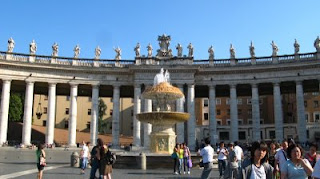
Again, the best place for links is probably this site: http://www.sacred-destinations.com/italy/rome. And my photos are here: http://www.flickr.com/photos/taking5/sets/72157619689628758/ . But let's end off with a picture of Bernini's famous colonnade; there are four rows of columns but when you stand on this particular spot you only see the front row:

Tuesday, June 02, 2009

Pilgrimage 2009 - Rome, Rotondo, Lourdes

(Note: These posts were largely written on the road, but edited and posted upon return to Singapore. I'm backdating them so that they describe the events of the day.)

I had been meaning to take my mother on a pilgrimage for a few years – so this year we finally got round to signing up for a 13 day Rome-Rotondo-Lourdes pilgrimage.


Our group is some 27 people, excluding our tour leader and our spiritual director. Mostly retirees, but about 6 younger people (including me). In true Singapore style, I find one ex-colleague, one colleague of a cousin and the parents and aunts of my primary school classmate. As we always say, Singapore is a small place.


Our first day was meant to be an “easy” day, but I must admit I was truly exhausted at the end. Probably because I didn't sleep on the plane, beyond dozing off for a few minutes here and there.

We started off at the Basilica of St Paul outside the Walls, or Basilica di San Paolo fuori le Mura (there is another St Paul within the walls of Rome but it is an Episcopalian aka Anglican church), which was erected over St Paul's grave. Here, we met our guide, Roberta, who displays a truly impressive knowledge of church history, the popes, and Roman history. I am amazed that she can remember whether a building was built under Pious V or Pious VI or Sixtus V or Sixtus VI. Roberta herself is an elegant Italian woman – unlike the stereotypical fast-talking Italian, she pronounces each word deliberately, accompanied by graceful hand gestures. She has to speak softly in a little radio transmitter; we get headsets to listen to her. With the large number of tourist groups around each church or site, I can imagine the cacophony which would have resulted if all the guides attempted to communicate to their groups over each others' noise. So each day we wait for the aptly named “Whisper” man to arrive to bring our headsets in.

St Paul's is one of the four papal basilicas in Rome, where the high altar can be used only by the Pope or his nominee saying a mass in his place. It is full on columns on each side, with a glorious ceiling and the portraits of the popes lining the walls.


We then went to Tre Fontana – where Paul was decapitated by the sword. The place is so called because tradition has it that when Paul was beheaded, his head bounced on the ground three times and where his head hit the ground, a fountain emerged, according to church tradition. Today the springs seemed a little sluggish with the water moving only slightly. I thought of Paul at the end of his life, proclaiming “I have fought the good fight; I have won the race.”


After lunch, we went to Santa Croce – the church of the Holy Cross, which had within the relics of the True Cross, brought back to Rome by St Helen, the mother of the Roman Emperor Constantine, sometime around the 3rd Century AD. Apparently the church was built or originally converted from the house of Helen, after her death. Sorry no photos, the relics were in a very low light environment and they just didn't come out well.


Along the way, we passed the Circus Maximus, where many of the early Christians were killed by the Romans. It was next to the Palatine, the home of the Emperors (so they didn't need to go far for the executions). Today it is a green grassy plain with a raised hump in the centre. Rome is drenched in the blood of the martyrs; apparently half a million Christians were executed by the Romans, principally by the Emperor Nero.


Thereafter, we went to Sancta Scala (the Holy Stairs) and the Basilica of St John Lateran, just next to each other. At Sancta Scala, it was incredible to see all the pilgrims going up the stairs on their knees. Don't know whether it is truly the steps leading to Pontius Pilate's rooms but the deeper beauty and truth of this place is the faith and contrition displayed by all the pilgrims who are taking this painful journey to repent of their sins. Alas, where I was concerned, the spirit was willing (well sort of willing) but my knees are weak. I would be prepared to give it a go on the last day but wasn't willing to hobble for the rest of the pilgrimage.

Our next stop was the basilica of St John Lateran, or more accurately, the Archbasilica of the Most Holy Saviour, St. John the Baptist and the Evangelist at the Lateran. The name came about because the hill the Basilica was built on and surrounding lands were originally owned by the powerful Lateran family of ancient Rome. Constantine took over the lands to build the church, the first official church in Rome. Thus Christianity was institutionalised within the Roman Empire. This is why the church of St John Lateran has also the title of "ecumenical mother church" (mother church of the whole inhabited world). It is also the cathedral of the Pope as Bishop of Rome. So from the blood of the martyrs, rose the early church.

The popes stayed here at the Lateran basilica until 1309 when the papal court moved to Avignon; it would only return 68 years later in 1377 (see my post on the Pope's Palace here). But it was felt that the palace was in too poor condition and not fit for habitation (especially if one compares it to the papal palace at Avignon ). So they moved over to St Peter's where the pope has stayed every since.

St John Lateran has been re-built a few times over the years. It has an imposing nave with gigantic statues of the apostles on each side, each with their iconic symbol (eg two keys for St Peter; coins for Matthew). The floor is beautiful with multi-coloured marble in geometric patterns. Here, we had our first mass together as a group. Father looked at the sorry, exhausted state of his flock and kept his sermon short.


We went for dinner, checked in at the hotel and went to bed quickly.

I've not put in the links for many of these references, but more information on many of these places can be found here. My photos can be found here.

Thursday, May 29, 2008

Sur la Pont, d'Avignon

Today, we set off at last to view the sights of Avignon. Although we had been here since Monday (three days ago now) we had been occupied elsewhere, visiting Orange, Chateauneuf-de-Pape and the pretty little Provencal villages on Tuesday, then Arles yesterday.

So it was only today that we had the opportunity to take in the sights of Avignon. We went first to the biggie, the Palais des Papes in Avignon. The Palace of the Popes has indeed a special place in Catholic history. The uncertainties of the times in the 1300's drove the papacy out of Rome. The popes Clement V and John XXII then decided to settle in Avignon, creating the Avignon Papacy. Altogether, 7 Popes and 2 Antipopes resided in Avignon. The building is stark and severe, a fortress rather than a palace. Again, I suppose this reflects the uncertain times.


Whilst the Papacy returned to Rome in 1378, the Vatican retained Avignon in its possession as a Papal State, until the French Revolution. The Palace was then turned into a barracks for many years. As such, today, the Palace retains very little of the former grandeur it must have had in the days of the Popes. No furniture or hangings, or paintings. What does remain are some frescoes in some chapels and also in the Pope's bedroom. Well, the Pope may have stayed there over 600 years ago but that is still the nearest I will ever get to his bedroom. We were not allowed to take any photos, though.


We went then to the nice little church near our B&B, Eglise St Pierre. It is apparently one of the older churches in Avignon, after the cathdral Notre Dame-des-Doms. It has beautiful wooden doors, and is really ornately decorated inside.


We had lunch thereafter, at one of those little restaurants on the Place d'Horloge - definitely a tourist trap. It was a set meal with soup, a main course and dessert and I really would not recommend it to anyone. It was quite pleasant, however, watching the people in the square - particularly a little boy who was running around the place, shadowed by his anxious mother.

After lunch, we headed back to St Benezet's bridge. The bridge is only a half-bridge, with half of it destroyed by floods many years ago. Yet its fame has spread far and wide thanks to a simple little song:

"Sur le Pont d'Avignon,
on y danse,on y danse,
sur le pont d'Avignon,
on y danse tous en rond..."


St Benezet was a shepherd boy who heard voices telling him to build a bridge - he managed to convince people that he was divinely inspired when he was able to lift a huge stone that no one else could move. However, no one ever danced on the bridge because it was deemed too narrow. Rather, the people danced on the river islands on which the bridge had been built. Such is the power of song....


We wandered around the shops to buy some souvenirs after our visit to the bridge. Unfortunately, it had started to rain - an unpleasant, incessant drizzle which made it very irritating to shop. Avignon has a high street with many shops, no shopping centres per se. So in the end we made our way back to our B&B where I had some time to clear emails before going out for dinner. Dinner was at the Hotel de Palais - we ate at the restaurant hotel. It was a pleasant enough meal, but what I really liked was the fireplace in the middle of the room. It was one of those which looks like a log fire, until you notice that the logs aren't being consumed by the flames...

Looking back, it is indeed a pity that we did not have more time in Avignon. I'd have liked to have the opportunity to cross the river to visit Villeneuf le Avignon. Well, we had wanted to get to Avignon much earlier on the Monday but the trains did not allow. Likewise, we would be taking an extremely early train back to Paris the next day. So, our time in Avignon was curtailed a little more than we had initially hoped.


Here's photo link.

Friday, May 23, 2008

Of Cathedrals and Saints

Today, we took the train down to Rouen. We went down to Gare St-Lazare and found out that the train we were planning to take, was only scheduled for one day a year ! and as such had to take a later train, due to leave one hour later. That's what comes of not reading footnotes. Might be slightly difficult if they are in French, but at least there would have been some sort of warning. Anyway, we walked out for a short stroll about the place and did some window shopping before returning to catch our train.


We eventually arrived in Rouen just before 12 noon and found our way into the old city. Apparently Rouen suffered considerable damage during World War II but even so, there were many old, half-timbered houses which survived from the time. And certainly, the narrow, cobblestonee streets appear to be in good order. We walked down to Hotel de Ville and the neighbouring Eglise St-Ouen. Unfortunately the church was closed and we could not get in. But behind the church, we found a quiet park. It was lunch hour (maybe the reason why the church was closed) and many people were lying on the grass, enjoying the sun. This gentleman was definitely having a nap.


Rouen, we found, was a more leisurely place than Paris. People greeted each other with the traditional pecks on the cheeks, which we did not see in Paris. Drivers stop for people at the zebra crossings on the road. And lunch hour was definitely sacred. The church, various shops, and the tourist office were all closed. So we did as the people of Rouen did and lunched on baguettes in a square beside the cathedral.


Rouen is also full of Japanese tourists. The only spot open in the tourist office was the service point for Japanese tour groups. We also saw them in the streets, taking photos of the cathedral, and even at the next table to ours, sipping a cup of coffee. They were in the cathedral, too. I suppose it is because Rouen is such a convenient day out from Paris, and makes a nice accompaniment to a visit to Giverny. A "Monet day"!


Of course, the cathedral is the main attraction of any trip to Rouen. Its tall towers, intricate facade and delicate stonework are indeed very beautiful. But its main attraction had to be that it was painted so many times by Monet. Going inside, what I found interesting was the many little placards in the side chapels which described the chapel's contents and showed pictures of how the cathedral had been damaged in WWII. One placard in one particular chapel noted that this was the only chapel which had survived the bombs on that side of the cathedral and if it had been destroyed, likely the whole nave would have fallen in, and the whole cathedral destroyed. Here it is, with its wood-panelled walls and paintings still intact...


We were also lucky that the cathedral had been recently restored. In places like France and Italy, restoration is indeed a never-ending task, because of the number of such beautiful old buildings. No sooner is restoration completed on all the buildings, that it is time to start again. But it is well worth the effort as beautiful stone emerges from beneath centuries of grime.


We walked from the cathedral to this little street of shops, Rue de Gros Horloge to the Gros Horloge, or this big clock and the tall tower beside it. This was the shopping street in Rouen and as lunch time was past, it had come back to life. We made a little detour to the Palais du Justice, the old Normam Parliament Building and then found our way to the little church of St Joan of Arc, or Eglise Ste-Jeanne d'Arc.


St Joan of Arc is a French national heroine. Her feast day is celebrated throughout France, and the church is just part of a larger national monument to her. It is a small modern church, built besides the ruins of an older building (destroyed during WWII?). The church is roughly fan-shaped in area and has a whole wall of large, stained glass panels across the diameter of the hall. A flower bed outside marks the spot where Joan was burnt at the stake. On the other side of the church, is the marketplace. It seems a little incongruous but on the other hand, who knows? It could have stood there for many years before being rebuilt in a more modern manner...


We got back from Rouen that evening, in time for dinner at the restaurant in Nicholas Flamel's old house. It was a pretty restaurant, a charming place to have a meal. And service was pretty good. The food however, missed that special something. The appetisers were fine. I really enjoyed my foie gras with the baked gala apples on it. But my 7-hour lamb was a teensy bit dry. I also swapped dessert with my friend and her ginger creme brulee was not really very exciting.

After dinner, we went back to the apartment - to finish washing our clothes. Because we had no drier, the apartment was covered with clothes after that.


Photos here!

Friday, November 17, 2006

Dominicans and Constable

I managed to have mass with the Washington D.C. Dominican community on my last day in the US. I just wanted to go for a nice, quiet Saturday morning mass (considering that I would be missing Sunday mass due to time lags and such). So I went to St Dominic's down the road from our hotel where there was supposed to be an 8am daily mass. However, the church was locked and this lady I bumped into told me mass would be at 8.15am in the chapel. When I got there, it was completely empty except for one robed figure in a corner who I took to be the priest and so I sat half-way down the chapel. Then, these elderly white-robed men started entering the chapel. No other lay people in sight. I started feeling quite uneasy. Was I in the right place? I contemplated making a run for it. Then I decided that what the heck, I had every right as a Catholic to be present. Never mind that in a group of white-robed Dominican priests, I was clearly the odd woman out.

Anyway we started mass with the psalmody. I had no idea where to find this and the Dominican across the aisle had to assist. Mass proceeded as per normal after that. It was the feast day of St Martin of Tours so the sermon referred to the story of how he gave half his cloak to a beggar, etc and what "we as Dominicans" can learn from St Martin. Apparently the Dominicans don't take a vow of poverty and Martin of Tours was famous for his hermitlike existence. The liturgy of the Eucharist took place next and all the priests started moving up towards the altar and took turns saying their lines. At some points (eg the consecration of the bread and wine) it was a chorus. I stayed put. I do know my place. At communion, of course there was only one (lay) recipient. Was not sure whether to go but the main celebrant gave me a little nod and up I went. I can't say I enjoyed mass, but I did appreciate the experience.

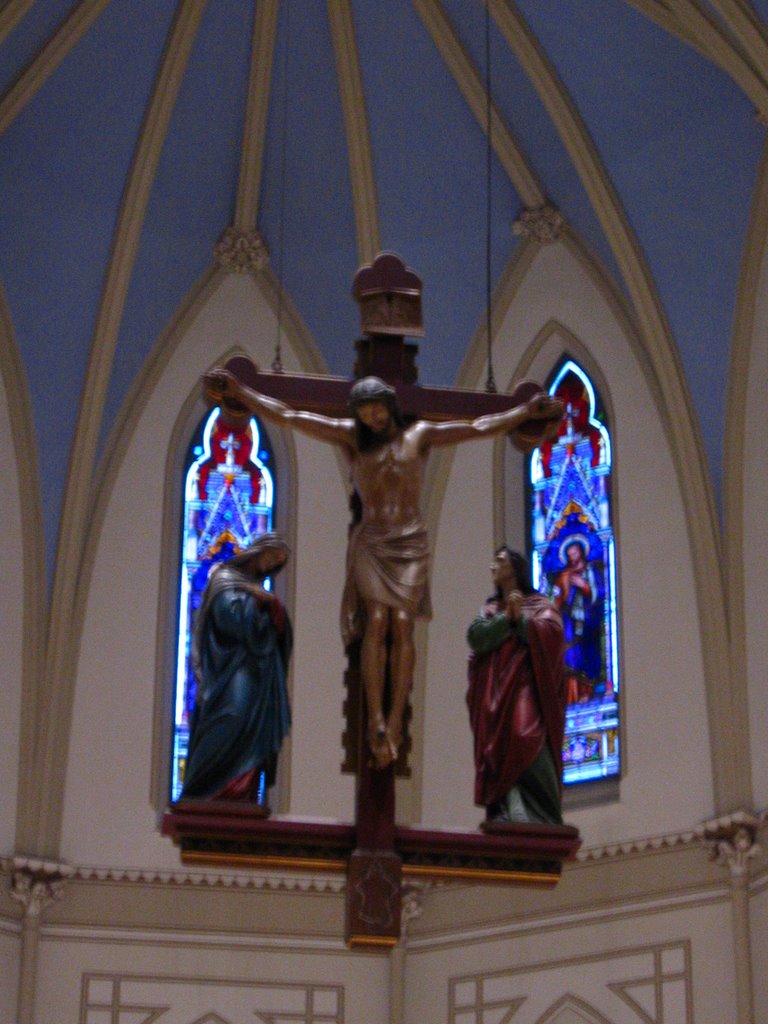
I didn't take any photos of the little priory chapel but here is the crucifix in the main church of St Dominic's. (I'd gone there for All Saints' Day when this photo was taken. What I did not expect was that I would be taking the wine up at Offertory. Someone asked me to do so at Offertory itself! I was not quite prepared for this and forgot to wait for the bread to be passed to the priest before returning to my seat. Ah well, it seems that I am not destined to have "ordinary" masses at St Dominic's.)

The previous day, we'd gone to the National Gallery of Art and since I'd spent time looking at American artists in Mexico, I went to see the special exhibition of John Constable's Six-Foot Paintings in the US! Constable started painting six-footers to attract attention at exhibitions and such. (Artists must always know what's commercial.) Constable started off by painting full-scale sketches of his work and then doing a polished version after that. It thus provides an idea of his thinking as he worked. The Six-Footers were done throughout Constable's career and therefore also show how his style progressed over time. One point which struck me was how the style in the final product began to look more and more like the more fluid and less polished style of his sketches, over time.

The National Gallery of Art is actually quite amazing. It was started off as a donation by Andrew Mellon to the nation in the hope that others would follow his example. And they did. Today, Bill Gates and Warren Buffet don't build museums/galleries. They look to improve public health around the world, and raise educational standards. Apparently the Gates Foundation is now one of the largest donors in the world, in the area of health, surpassing many countries' contributions. But they apply a private sector perspective on looking at effectiveness of aid, which perhaps state donors are less able to do. So income inequality in the US may be pretty stark but it is very difficult for anyone to resent Bill Gates' billions if he is helping to eradicate polio or whatever.

Starting the Day Right...

Related Posts Plugin for WordPress, Blogger...