Showing posts with label Bucket List. Show all posts

Sunday, November 03, 2019

Papa Francesco and St Peter's Square at Night

I'm this close to Pope Francis!
This is a short post; mainly to keep track of the key events in my life which took place in 2019. I was privileged to be a participant in the Caritas Internationalis General Assembly held in May this year.  The GA opened with a Papal Mass celebrated by Pope Francis.  Definitely one of my Bucket List items! 

It was a wonderful experience, sitting there in the Basilica with Catholics from all over the world around me.  The Universal Church!

After mass, there was a reception and dinner.  We had the pleasure of walking back to our bus through St Peter's Square.  What a serene atmosphere it was, in the still and peace of the night.

A few days later, we had the additional honour of a Papal Audience.  Truly a moment to remember.


St Peter's Square at Night

Saturday, December 15, 2018

A Jewel of Cathedrals - Chartres

Chartres Cathedral
Chartres Cathedral, or more properly called Notre Dame de Chartres, is a jewel of Gothic architecture.  The first church on the site was built as early as the 4th Century, but was destroyed a few times and rebuilt each time.  Charles the Bald, the grandson of the great Charlemagne, donated the "Sancta Camisia", or the shift of the Virgin Mary, to the church and it became a place of pilgrimage.  (The shift is still to be found in the cathedral today).   Eventually, after yet another fire, Bishop Fulbert built a vast cathedral which was completed in 1037.  Whilst some part of this building was destroyed by fire, the bell tower and part of the front face remained.  The church was rebuilt and extended further (including the addition of another tower), and finally consecrated in 1260 in the presence of King Louis.  Today, the cathedral is renowned for its spectacular stained glass windows dating from the 12th and 13th centuries, its medieval crypt and the mysterious labyrinth embedded in the centre of its nave.  It is no wonder that this famous cathedral is a UNESCO World Heritage Site.

The North Rose Window
To say that the cathedral is beautiful is an understatement.  It is magnificent!  The tall vault above the nave, the majestic pillars, lead the eye up to the heavens.  The statues in the screen around the choir are so intricate and expressive.   The stained glass windows, with their vibrant colours and beautifully detailed panes - I could spend hours just trying to work out what scenes they depict.

We managed to get to the cathedral  in time for the tour by THE authority on Chartres Cathedral, Malcolm Miller.  Miller has been giving his tours since 1958!  He doesn't have a fixed tour per se, but brings visitors to different parts of the cathedral each time.  Apparently he is not really affiliated with the cathedral per se but they support his tours and he is listed on their website.  But you need to get in touch directly with him to check whether he is holding the tour on a particular day.  We were lucky enough to go on a day when he was conducting his tour. (There is another English language tour available so you can go on that if you miss Miller's tour).

Indeed his knowledge of the cathedral was truly encyclopaedic.  He pointed out the various biblical stories told in the stained glass windows, similar to how perhaps the illiterate peasants would have learnt the bible stories way back in the Middle Ages.

Detail - Adam and Eve
He also revealed the deeper theological references within the windows - for example, that whilst the tale of Adam and Eve described the Fall of Man, the Parable of the Good Samaritan spoke of God's Salvation through Jesus Christ.  In the parable, the traveller represents Adam, cast out from paradise; the priest and the Levite walk past him; but Christ is the Good Samaritan who brings him to safety and promises to return for him.  On a more prosaic note he also showed us the details in the windows which showed who had donated the cost of their production - be they tradesmen, or nobles etc.   More on the cathedral's stained glass windows can be found here.

Miller also took us outside the church, to take a look at the statues adorning the doors and entrances to the church.  He showed us the Last Judgement, found at the South Porch of the church.  Christ sits above the doorway, with Mary and John the Evangelist on either side, the angels above and around him.

We decided to go on a second tour, around the crypt.  The tour was in French but since you can't go to the crypt on your own and that was the only tour available... we went on it.   (Most of the people in the tour didn't speak French so we were all in the same boat).  The crypt is the largest in France and it is here that the early origins of the cathedral are most obvious, as being underground, it survived all the fires above.  The cathedral was rebuilt on the foundations of the crypt, and you can still see the ancient pillars on which the building above rests.  Old, faded murals on the walls also reflect the antiquity of this place.

The Labyrinth
The other well-known feature of Chartres cathedral is its labyrinth.  In the old days, pilgrims would walk the labyrinth (some on their knees).  It was symbolic of the twists and turns of life, the trials and false turns made along the way.  But eventually, the pilgrim could reach the centre where the way out was straight towards the altar, i.e. to God's saving presence.

When we were there, labyrinth was partly covered by chairs. It is revealed fully some days (I believe Friday afternoons).  I did not realise it was such a large labyrinth - reaching out to almost the entire width of the nave.

Around the altar, are the little chapels and shrines.  We saw the Lady of the Pillar (a local devotion to the Blessed Virgin), the Sancta Camisa as mentioned earlier.

In addition, there was a small little side shrine devoted to St Therese of Lisieux.  Beside it, preparations were being made to add one more - for St Therese’s parents, the newly canonised St Louis and Zelie Martin!  The first couple to be canonised as saints for their unique role in creating an exemplary Catholic family environment for their children.

We ended up spending the entire day in the Cathedral, without even going anywhere else in Chartres!  But it was indeed a day well spent, absorbing the beauty of the surroundings and praying in this sacred place.

More photos will be put up here.

Chartres Cathedral - Interior


Sunday, October 28, 2018

Monet's Garden at Giverny

A perfect garden, a perfect day.

The Water Lily Pond at Les Jardins de Claude Monet at Giverny

I have always wanted to visit the incredible gardens of Claude Monet at Giverny. And this time, with my garden-loving mother around, it seemed like the perfect opportunity! Especially since my brother-in-law kindly took leave to drive us there.  So off we went in our little rental car to Giverny.

Monet established his family at Giverny in 1883 when he was 43 years old.  It was not a conventional family.  His first wife had died some time after the birth of her second child, following which Monet became "romantically involved" with the wife of a friend.  She and her children, stayed with Monet and his children at Giverny.  Monet was already an established painter, and his home and gardens in Giverny provided the inspiration for some of his most famous and spectacular works.  More on Monet's life story is here.

Monet found inspiration in the Japanese aesthetic for his art, and I like to think that he was also inspired by the beautiful Japanese gardens for his Water Garden too.  We walked down a little pathway to emerge at the water lily pond.  The pond was like a mirror, reflecting the sky, the trees and plants surrounding it.  As we strolled around the pond, different aspects of the pond appeared - the willow, draping its branches over the bridge; the boat (and boatman) going across it; the multi-coloured flowering plants.  On the pond, the lily pads floated, and reeds peeked above the surface.  It was as though I had walked into a Monet painting.  Indeed, this was what Monet wanted to do when he created his huge images of his garden for the Orangerie museum (his gift to France, which I had visited on a previous trip), to create an entire world in itself, without horizon, of water, lilies and light.

We went next to the formal gardens beside his house.  It was full of beautiful spring flowers, a blend of colour and light - again, just like a painting!  I learnt however that they plant with the season in mind, so that the gardens are flowering all the time.

The formal gardens
Monet's first studio
From the gardens, we entered Monet's house.  The first room we went in contained Monet's collection of Japanese Ukiyo-e (woodcut) prints, including those by great masters such as Hokusai. But the highlight was visiting his first studio, a large room overlooking the garden, with big windows all along the side.  The walls were covered by his paintings (replaced since by reproductions) so visitors could admire his genius.  Monet subsequently moved into another studio and it would appear that this became the family living room.

Going upstairs, into the bedrooms, gave an even better view of the grounds and there were even more paintings.  In his bedroom - paintings by other Impressionists, including Renoir.  There was another bedroom, I believe the one used by his stepdaughter who was living in the house after his death.

The front entrance and the house
Going downstairs again, we saw the dining room and the most enviable kitchen, with its tiled walls, copper pots and gigantic kitchen table.

In short, this was truly a comfortable and welcoming family home for Monet and his family.

With this visit, as well as my earlier trip to Rouen, to see its famed cathedral, I have really had the oppportunity to see for myself how the artist reperceives his subjects - whether it is the lily pond, or the formal garden, or the ancient cathedral - and transforms it into a masterpiece.  What a privilege!

But this was not the end of our day.  My sister wanted to do a little more sightseeing before returning to Paris so we went next to the little town of "Le Petit Anderlys".

It's a charming little village, with its half timbered houses, ancient church and fortress on a hill,  Chateau Galliard built originally by Richard the Lionheart of England.

Half timbered houses, Le Petit Anderlys
 Indeed, visiting this little town reminds me just how much history this corner of France holds.  It was from Normandy, of course, that William the Conqueror hailed from.  His descendants linked Normandy and England for so many years, and it was here that so many battles between the French and the English were fought (and thereafter, the battles of WWI and II).

There is so much more to learn and see.  One day I must really do a proper visit to Normandy!

Many more photos here.


Saturday, January 06, 2018

Mount Fuji: The Icon of Japan


Fuji-San
If there was one thing on my bucket list I wanted to fulfil this year, it was to visit Mt Fuji.  Fuji-san, as it is commonly called, is a mythical, mystical mountain for the Japanese.  At 3,776m above sea level, this is Japan's highest mountain.  Its symmetrical cone, formed by volcano action, rises above the surrounding plains and dominates the landscape for miles around.  After coming to Japan every year for the past three years, it was about time to meet Fuji-San.

There are many spots from which you can view Mt Fuji, and many scenic places around the mountain itself to visit.  For our visit, we decided upon a day tour from Tokyo, since it seemed the most convenient (although I have to say that I would love to visit again, and spend a night or two at the Fuji Five Lakes area).  It is also nice to have someone taking care of things!  Unlike the previous tour to Nikko, we had an older Japanese lady who was clearly a more experienced guide than the other two as she could offer more information and background in general, eg on how the mountain was formed, and about Japanese lifestyles.  She was also quite firm and reminded us to be punctual at every point in the journey.  

Our very first stop on the tour was the 5th station of Mt Fuji!  It was truly quite exciting and exhilarating, as we were actually ON Mt Fuji itself and had a lovely clear view of the peak and the surrounding countryside.  The weather was beautiful - brilliant blue sky, almost glaring sunshine, and a refreshing wind blowing.  We were about 1,600 m above sea level, not even halfway up the mountain, but it was cold, with that crisp chill in the air which makes you feel energised and alert despite the cold.  At this point, the vegetation starts to fail so when you look up, you can see the volcanic rock of the mountain rising above you to the top of the peak, interrupted here and there with streaks of white - I assume these are springs off water falling down from the mountain.

Above all, I was so glad that we had such a great view of the peak.  We were checking when the best time was to get a clear view (find out more here)  and it was wonderful that it all went according to plan.  Or at least, almost to plan as I was hoping that the snow cap would be there.  I had read earlier that Mt Fuji had experienced its first snowfall of the year just one week before our arrival.  Sadly, because of the warm winds brought in by the tropical storm, the snow cap had melted by the time we got there.  Which means that another visit is definitely in order!

Wakuike Pond, Oshino Hakkai 
Kagamiike Pond - can u see Mt Fuji reflected?
After the stop at the 5th Station we went to visit a charming little village called “Oshino Hakkai”.  Mt Fuji had shaped the landscape in the area in many ways, including creating the 8 ponds in this area, spring fed from Mt Fuji.

The crystal clear waters reflect the blue of the sky, the trees, and in some of them... even a mountain.  After some trying, I managed to get a shot of Mt Fuji reflected in one of the ponds! (Tip: look hard!)

We went off to our next stop, eating our bento lunch along the way.  I have to say that I preferred the nice hot food on the previous tour.  We were also enlivened by the conversation of our fellow tour participants.   The thing about day tours is that you also meet lots of people - we met a fellow Singaporean (of course) and hooked up with her for photo taking etc.  There was a Malaysian family, a Chinese-Australian lady, and a few Americans - one of whom was quite chatty. It truly amazes me how some people can talk about themselves and their lives to chance-met strangers - sharing it theoretically with one person, but in practice at a volume which allows the entire bus to hear all the details!

The secret valley to the Shiraito Falls
Anyway, after a rather noisy interlude, we arrived at the Shiraito Falls, the next stop on our tour and one of the most beautiful waterfalls in Japan.  There is another waterfall just next to it as well, Otodome Falls, which is much smaller.

The Shiraito Falls are reached after a short walk along the side of a gorge.  We walked down the gorge, turned a corner and there, in this long deep valley was a shining waterfall right at the end.  But the waterfall was not just that single stream of plummeting water. As you walk along, you realise that there are a thousand silver streams of water flowing down the side of the valley, joining the little stream beneath.  

Our last stop of the day was the Fujisan Hongu Sengen Shrine - the shrine devoted to the “Goddess of Mt Fuji”, Konohana. Apparently, Konohana is the flower-princess and her older Sister, Iwa-naga, the rock princess.  Because Konohana’s Husband chose her over her older Sister, human life ended up being as fleeting as a cherry blossom and not eternal, like stone.  Our guide made an offering to the Goddess on our behalf and we proceeded to walk around the shrine compound.  Similar to the Oshino Hakkai area, there is another pond which is again fed by a mountain spring from Mt Fuji.  

 Fujisan Hongu Sengen Shrine
After our long day, our bus turned back to Tokyo and dropped us off at Shinjuku station.  We were given some discount vouchers for the Keiō department store - we went there really because we had some discount vouchers from the tour company which we didn’t use in the end. But, at the stationery section of the store, we found a calendar with a lovely woodcut pictures including the Great Wave by Hokusai!   So indeed, all our activities today were associated with Mt Fuji!  I can’t wait to make a second visit....

More photos of this day can be found on my Flickr page.


Sunday, December 11, 2016

Back to Kyoto: Autumn Foliage


Kiyomizu-dera Temple at Night

After two years, I am back in Kyoto!  During my first visit, it was for "Hanami" or to view spring flowers, particularly the delicate, transient cherry blossoms.   This visit, it was "Momiji" time! "Momiji" specifically refers to the red maple tree leaves but in reality there are others too, and the colour is not just red but also the golden yellow of the ginkgo tree and others.  

Here in Kyoto, we arrived as the maple trees were supposed to be at their peak.  But this is a fast season, and we realised that maybe we had arrived a day or two beyond the peak.  We also realised that just because the maples were at their best, it didn't mean that every tree was ablaze with red.  Some trees (eg the cherry) may have already lost their leaves, and others may be still as green as ever, resulting in a "patchwork" of colours.         

Kiyomizudera
Our first stop in Kyoto was the Kiyomizu-dera temple - one of the most well-known temples here in Kyoto, and the one nearest our little apartment!  We did not arrive early enough to visit the temple grounds properly (in daylight) but we managed to take a few photos in the fading light and then joined the throngs on the deck facing the main temple to get a chance to photograph the famous illuminations of the main hall.  
Indeed, the throngs waiting to take that one iconic shot were immense!  We stood five-deep along the deck facing the main temple.  People were pushing and shoving to get through and in the meantime, people were hogging the front of the deck taking their photos.  Well, we finally managed to get our shots and went on to meander around the gardens to admire the illuminated pagoda rising above the illuminated trees.

Next day, we went to two more temples, Nanzenji and Eikando-Zenrinji.  First, Nanzenji.  Nanzenji is famed for its aqueduct (quite easy to find) and also its sub-Temples.  We went to one, Nanzenin, famous for its little pond garden, and for the mausoleum to the Emperor Kameyama, who founded the Nanzenji temple in the first place.

The pond garden was a true delight!  First, being a sub temple, it was less popular with visitors (it had its own separate entrance fee, which could be one reason for the smaller crowds).  So we were able to admire the autumn foliage in the garden in relative peace and quiet.  The beautiful red leaves also formed a layer on top of the pond.... So the reflection of the red leaves was accentuated by the leaves already in the water.

The pond garden at Nanzenin

Rock Garden at the Hojo, Nanzenji
Nanzenji itself has a beautiful tranquil zen rock garden in its "Hojo", the dwellings of the chief priest.  Apparently, the rocks look like a tiger with her cubs.... I'm afraid that that one went right past me.  We sat there and contemplated the rocks and the patterns in the pebbly sand nonetheless.  Subsequently, walking through the Hojo, we did see rooms with wall paintings of various animals including tigers (and leopards, I think).  That, I can get.  

Our next stop was the Eikan-do Zenrin-ji temple.  Like Nanzenji, this temple is famed for its autumn foliage.  Indeed, we were not disappointed (and got to see the leaves in the blaze of sunset!).
Momiji lit by the setting sun

We walked all the way to the Pagoda, with its view of Kyoto, and then walked around the temple buildings, looking at the internal gardens before making our way down to Hojo pond.  Well, I can only say that a picture tells a thousand words so please do take a look at my Flickr site for more glorious photos of Eikando temple and the other two.  (Please note that the photos are being put up progressively).

Pagoda at Eikando 
Technically, this was the day we were supposed to walk up the Philosopher's Path and end our day at Ginkaku-Ji (yes, yet another temple).  But the thing about short days and our relatively slow progress is that we don't cover all that much each day.  Of course we could have gone there for the illuminations but somehow after the first night's experience, it didn't appeal.  

Maybe another time, another visit to Kyoto!


Saturday, April 12, 2014

Hanami time: Viewing flowers in Kyoto

Day 2 in Japan.  It was a good day for viewing blossoms!
Cherry Blossoms at the Imperial Palace

Kyoto was the Imperial capital of Japan for many years, until the capital shifted to Kyoto.  But as a result, Kyoto has many historical buildings, mystical gardens and peaceful temples. We visited only a small fraction of the many beautiful buildings but the Imperial Palace was a must-see on our list.

Serenity of a Japanese Garden
Access to the Imperial Palace is normally restricted - visitors to the Palace must sign up for a guided tour.  But twice a year, the Palace is open to the public - one week in spring, and the other in the fall.  We were lucky enough that our visit coincided with the spring "Open House" for the palace.  So there we went, ourselves and thousands of other visitors, Japanese and tourists alike.  There were special performances scheduled for the morning in the palace grounds.  So we went to watch, us and probably half the visitors in the palace.  We lined up around the performance dais and found that we still could not see the performers with ease.  After a while, we gave up and decided to explore the beauties palace and its grounds instead.

 The Palace is a collection of sprawling buildings, including an imposing Imperial throne hall in a gigantic
The Imperial Throne Hall
courtyard surrounded by brightly coloured orange pillars.  Smaller halls surround this main hall, and there is a small, exquisite little garden alongside - the Emperor's private garden.There were mannikins arramged in one of the halls, to illustrate how the members of the Imperial court would have lived. The bustle in the Palace was probably quite similar to what the place must have been like when Kyoto was the capital city of Japan. But I would like to come back, another time, when there are fewer people and the Palace is restored to its normal state of peace and tranquility.

We wandered outside, through the park surrounding the Palace, to the small little food fair which was set up just beside the exit. It was selling mainly snacks - sweets, pickles, cakes, nuts and many other things including sake.  Bought a green tea ice cream :-)

Artists and the Cherry Tree
But what was really pleasant to see were the people enjoying the beautiful weather, and the holiday atmosphere of the park - small groups of friends and family were sitting in the park, on benches and the ground. People were playing with their children, or walking their dogs - and a small colony of artists were painting the cherry trees! 

We finally found a magical little dell with weeping cherry blossom trees shedding petals on the ground below.  Our little hanami viewing party of two settled beneath our own cherry tree. Unfortunately we had no food but we sat and watched the petals fall on our mat, our bags and ourselves.  Around us, people were sitting and chatting, and having a good time catching up.  It was a delightful time.

Tulips in the Kyoto Botanical Gardens
After the Palace, we went to the Kyoto Botanical Gardens, a few tube stops away.  We had a pleasant surprise - brilliant, brightly coloured tulips were on show.  But of course we were there for one thing - and we were not disappointed as we discovered the enchanted grove of weeping cherry trees (fast becoming my favourite cherry tree variety). The trees were burdened with the most beautiful pale pink flowers, with the deeper pink buds alongside, the branches falling down like a gentle little curtain around us.

Going through the cherry tree groves, it is indeed very clear why the Japanese so love the cherry blossom.  Indeed, even after a whole day looking at and photographing these fragile blooms, I too must admit to becoming a very big fan.   So, here is a little video taken in the Imperial Palace park which I think captures perfectly the atmosphere in the grounds.  And one last photo taken in the Kyoto Botanical Gardens.  More photos can also be seen on my Flickr page, as I slowly update it.  Enjoy!  


Kyoto Botanical Gardens

Wednesday, June 10, 2009

Lourdes – a place of pilgrimage for the universal church


Lourdes, Lourdes. Whoever thought that there would be so much to see and do? Our time there was so packed that it is difficult to make sense and describe the many different experiences and impressions. After some reflection I thought I could describe it from three different perspectives.
First, as a place of pilgrimage, it is a meeting point for the universal church. Second, where individuals can intensely experience the Lord.
Lastly, it is where the pilgrimage industry can be observed. Not such a spiritual experience but certainly quite interesting to observe.

But first, a little context setting. Lourdes is essentially a pilgrimage town, with hotels, shops and restaurants serving the pilgrims there. We are staying in a hotel just a 5 minute walk away from the Sanctuary, and overlooking the River Gave which Bernadette was supposed to cross when she first saw the apparition of Our Lady. The Sanctuary itself is sprawling – it comprises the Grotto, with a statue on the spot where the apparition appeared and the spring flowing vigorously from the ground. By the Grotto, are the taps from which we can fill our bottles with the water of Lourdes. Then there are the churches – the original Basilica of the Immaculate Conception built directly above the Grotto, and then in front of it the Rosary Basilica, which contains a mosaic for each of the original 15 Joyful, Sorrowful and Glorious Mysteries of the Rosary and in front of it, the latest 5 Luminous Mysteries. Below our feet – the Underground Basilica of Pius X. Across the River, the Church of St Bernadette. There is also a chapel of reconciliation, for confessions. All this just to accommodate the multitudes of pilgrims who throng Lourdes! For more details on Lourdes, St Bernadette, here is the link to the official Lourdes site (check out the little interactive site at the bottom of the screen for a virtual tour of Lourdes!)
Now for the rest of my post.
My first impression was that Lourdes is indeed a meeting point for the universal church. Never have I felt so much the sense that I am in a true community of believers, from all over the world. Since it was Wednesday, we started the day off going for the International Mass, held in the cavernous underground basilica. Mass is said in 6 languages – French, Italian, Spanish, English, German and Dutch. So here we were, with people from all over the world, coming here together and praying in so many languages but yet everyone knew what was going on and able to follow the same mass together. At the beginning of the mass, a priest would “introduce” the various groups of pilgrims, by language group – so a French priest introduced the pilgrims from various French-speaking countries (cheers erupt when each group is announced), followed by the Italian-speaking pilgrims, the Spanish, the English (including a group from Singapore and Malaysia, ie us!!), the German and finally the Dutch-speaking pilgrims. The main celebrant was a French bishop; the readings said in three languages with the reading in the other three languages flashed overhead on the large screens around the basilica; the languages are alternated for the gospel reading. No sermon, but a song about Bernadette ends the mass.
But this is only one of the “mass activities” here in Lourdes. Lourdes is a place where the sick take pride of place. They have special reserved areas during the mass, and in the evening there is a special Blessing for the sick, where the sick move in procession to the Underground Basilica where we together adore the Blessed Sacrament.
But the culmination of any visit to Lourdes has to be the candlelight procession. Our Lady said to Bernadette, that she wanted people to come in procession here. The candlelight procession is long, very long. And this is not even the peak of the pilgrimage season! We assemble about half an hour before the procession and find a place to stand. We have our own banner (Malaysia/Singapore) and arranged ourselves behind it. Behind us, there is an Irish group behind us from Waterford and also a German group. The rosary is said in the same six languages, with the leaders from the different language groups taking turns to lead the “Hail Marys”. We take one hour to say the rosary, as songs are sung after each decade. As we recite the rosary, we walk in procession slowly, behind the statue of Our Lady, around the great field in front of the two Basilicas until we get to the square right in front of the basilica. Even by the time the statue reaches the front of the basilica again, there are still pilgrims starting to make their way around the square.

Carrying our candles high, we move in a snaking “S” shape pattern (see video below) till we reached the front of the Basilica. We end off with “Salve Regina”, which we have been learning over the past few days but I must admit I still wasn't very good (and I am not able to sing it now either). Finally, we offer the sign of peace to all those around us. The crowd disperses, back to our hotels, and then to our own homes. But we bring a little of the peace of Lourdes with us.


More photos of Lourdes here.

Wednesday, June 03, 2009

Upon this Rock

This morning, we went to visit the catacombs of Rome – Santa Domitillla's. I was fascinated by the whole prospect of visiting the catacombs. The guide however dashed some of my illusions/ preconceptions about the catacombs. I thought it was this early Christian hideaway but he told us that no, the early Christians certainly did not live there.

First, the Romans knew exactly where the catacombs were so it could not be regarded as a sanctuary. Second, the catacombs themselves did not support life – smell of rotting bodies would have been a real turn-off. There was not enough oxygen, they were very dark (and apparently an oil lamp only lasts 20 minutes due to the lack of oxygen). They were left strictly for the burial of the dead and some prayers would be said there but not a proper mass.
On the walls, though, were the signs of the early Christians – the fish (the greek word for “fish” is an acronym for Jesus Christ Son of God and Saviour), the good shepherd, fish and anchor, the chi-rho and the alpha and omega on the walls of the catacombs. We could not take pictures inside so this photo was taken outside.

The guide also took us around a small portion of the catacombs. The corridors were narrow and ceilings were low, and there were little niches in the walls where the bodies were put. The individual chambers were also decorated depending on the wealth of the family concerned.

We had our mass in the catacombs, in a small chamber. It was a little crowded for our group but it added to the atmosphere of the mass, that just like the early Christians, we were just together in a small room to pray and worship our Lord. Here in Rome, what I find most moving is that we reconnect to the beginning of the church, to the early Christian fathers and the early days of our Faith, creating a true sense of continuity within the church.
After lunch (another Chinese restaurant) we went off to the Vatican City. We started first with the Vatican museum but sadly we did not have the time to go through it in detail. We walked through a few beautiful rooms but the highlight was the spectacular Sistine Chapel, featuring the frescos of Michelangelo. I had seen them many years ago, prior to their being cleaned and frankly it was hard to retain an impression of this dark and dingy wall and ceiling. But cleaned of the grime and smoke of centuries, the fresh and powerful colours of Michelangelo's original painting shone brightly again. We were not allowed to take photos, but I saw quite a few people sneaking shots.

Leaving the museum, we came across this water fountain. Rome has a number of water fountains, and the water is all drinkable. I seem to remember this from my earlier visit here. There are a number of such fountains around Rome, our guide also showed us one little one which looks like just some drainpipe on the street.

Our next stop was the crypt, including the shrine above St Peter's grave, which was also near the grave of Pope John Paul II (JPII). For many the highlight was being near JPII's grave but I thought of Peter, leaving Rome to flee to safety, only to meet a stranger on the way who, in response to the question, “Quo Vadis”, indicated that he was going to Rome to die again (or Eo Romam iterum crucifigi). Peter, realising it was Jesus, turned back to Rome to face his martyrdom. No photos allowed in the crypt and we were not allowed to linger by JPII's grave.
We then spent some time in the great Basilica of St Peter's. The church is magnificent and I was immediately struck by the rays of light coming in through the windows in the dome (by Michelangelo), as shown in the photo here. We saw the beautiful Pieta, also by Michelangelo - my mother whispered critically in my ear, “the proportions are all wrong”. Well, yes. There is no way a small little woman (the way I envisage Our Lady) could carry the body of the Christ over her knees in that way. But hey, Michelangelo gets to break the rules. We walked around the huge church, found the statue of Peter with his shiny and worn foot, and then admired the huge dome. I had wanted to climb up the dome of the church but there was insufficient time. That's the problem with tours -sometimes you can't do the things you would like to do. We did however spend some time in quiet prayer, in a corner of the largest Catholic church in the world before leaving for dinner.

Again, the best place for links is probably this site: http://www.sacred-destinations.com/italy/rome. And my photos are here: http://www.flickr.com/photos/taking5/sets/72157619689628758/ . But let's end off with a picture of Bernini's famous colonnade; there are four rows of columns but when you stand on this particular spot you only see the front row:

Saturday, November 24, 2007

My Visit to Angkor


I have just returned from a short (essentially 3 day) trip to Siem Reap, Cambodia, to view the ancient temples of the Khmer Empire and the fabled towers of Angkor Wat. In recalling this visit, three main images spring to mind:
  • the spanking new airport building
  • the Apsara dancer
  • the face of Buddha
These images tell a lot of the story of the Khmer monuments at Angkor. The story of how these buildings came about, the different religious beliefs of the Kings who built them, the times they lived through. Also, the story of how these historical monuments were re-discovered and restored for the world to become major tourist attraction for Cambodia, and the impact of the tourist industry on Siem Reap. But all this is against the backdrop of the history of modern Cambodia, in particular, of the human tragedies which took place during the Pol Pot regime.

The story I want to tell is just of my own short visit here. Over the past few days, we have visited towering temples and smaller shrines. We have sailed on the Tonle Sap lake, driven around the Cambodian countryside and bargained in its old market. I knew that there was more to see in Siem Reap than just Angkor Wat. But it was a real revelation to find out just how many temples there actually were! It was also amazing to find out that they had been preserved for so long (for some, more than 1000 years) and in such (relatively speaking) good condition. To start off, here is the list of temples seen/visited (in order of visit) (and remember this is just a subset of all the temples there are):

Day 1
Banteay Srei (built around 967 - 1000)
Pre Rup (944-968)
Banteay Kdei
Prasat Kravan

Day 2
Angkor Thom (1181-1243 - same time as Bayon)

Bayon (1181-1243)
Bapuon (1050-1080)
The Royal Palace (968-1010)
Elephant Terrace (1181-1243 - same time as Bayon)
Terrace of the Leper King (1243-onwards)
Khleangs (968-1010)
Ta Prohm (1181-1243 - same time as Bayon)
Angkor Wat (1080-1175)
Phnom Bhakeng (889-923)

I should explain that we were on a guided tour from the second day, so we spent the first afternoon in Angkor seeing the less "popular" temples. It was a good way to see how temple architecture changed over time. The older temples we saw (Phnom Bhakeng, Banteay Srei, up to Angkor Wat) were influenced by Hindu beliefs. They displayed Hindu gods and goddesses, and told the stories of the Ramayana and the Mahabharata. Then, in the days of King Jayavarman VII, Mahayana Buddhism became the official religion of the kingdom. Whilst the structure of the temples (tiered towers upon towers) remained the same, the images on the temple walls changed and reflected instead the face of Buddha. After his reign, the country turned Hindu again and much of the Buddhist imagery was destroyed. Today, the country is again Buddhist (Theravada Buddhism) and Buddhist statues have re-emerged in the temples and are venerated by the locals to this day.
The Khmer empire which built these great monuments of stone has long since passed away. The reasons appear to be a little obscure. But these magnificent structures certainly testify to their advanced engineering knowledge, which they amply combined with artistry and imagination.

Friday, November 10, 2006

The Place where the Gods Began - Mexico, Day 2 Part 2

We visited two pre-Hispanic sites during our one-day tour.

Our first stop, Tlatelolco ruins or what they now call the Plaza of the Three Cultures. There are the ruins of Tlatelolco, the Spanish church of Santiago Tlatelolco which stands next to it and finally the buildings of modern Mexico around the place. As mentioned before, Tlatelolco was a twin city to Tenochtitlan and was the commercial centre of the Aztec empire. Traders from all over would come to Tlatelolco bearing products from the Oaxaca area, the Mayan area and so on. However, much of it is probably covered up by modern Mexico today. The ruins we saw were again temple ruins, very similar to those of Templo Mayor in Mexico City. I guess the biggest buildings around were the temples themselves, and it was hard to get rid of them completely whilst the stone from smaller buildings could be easily carted away. We again saw how the pyramid builders operated - building a larger pyramid over a smaller one in order to enlarge the size of their temple. Our guide showed us one altar and told us that when it was excavated, there were about 170 skulls found with a hole punched through the cranium. They were probably strung together at that point for display. The last battles between the Aztec and the Spanish were fought at Tlatelolco, and it was here the Spanish empire came to an end. The plaza was also the place where a massacre of students took place in 1968. They were protesting (Mexicans love protests, I find) against the conditions of the day (whatever they were). The government did not want disturbances just before the Olympic Games took place and so they shot the students! Bizarre logic.
After Tlatelolco we went to the Guadalupe shrine (see last post) and then to a handicraft factory outlet. This was quite fun because we got to try the local tequila and try out corn bread with cactus (sans the spikes) and cheese topping. Aztec food?

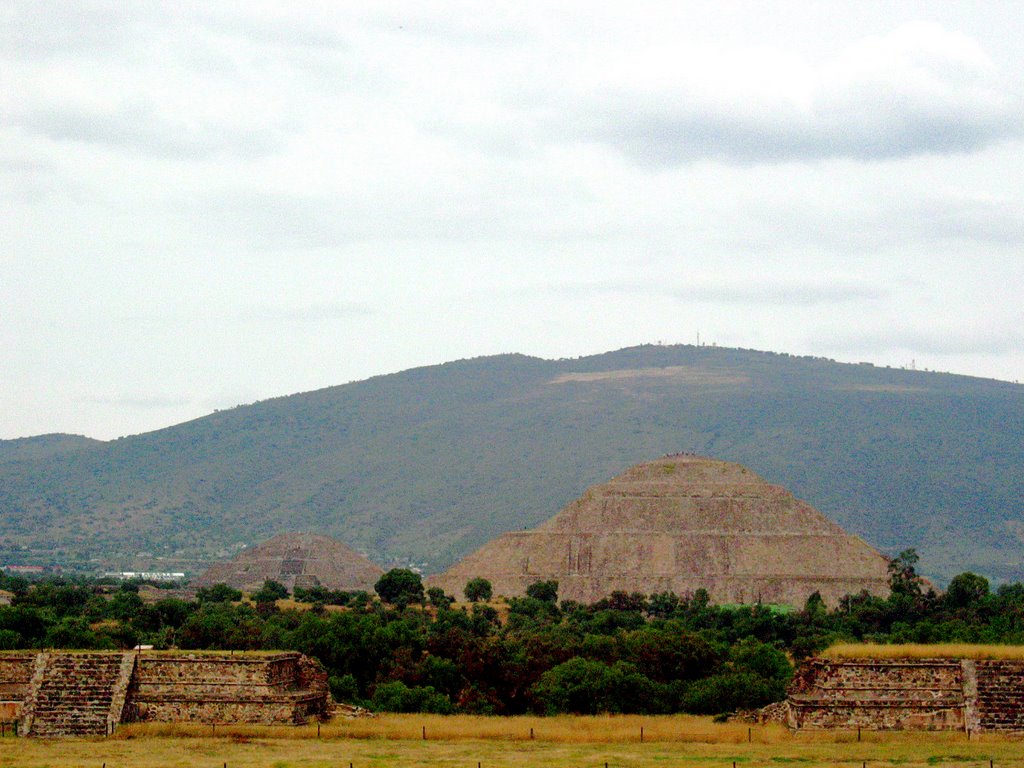
We then went on for our pyramid climbing expedition. Now, the Aztecs did not actually build the Teotihuacan complex. It had been built many many years earlier by a people now unknown. The Aztecs found the complex and found it so impressive, that they thought it must have been made by the Gods. So they called it “Teotihuacan”, or “the Place of the Gods”. It is a huge complex, with three pyramid structures and several temples all linked by this long “Avenue of the Dead” (apparently the Aztecs thought the buildings alongside were tombs). Just as was the case for Templo Mayor and Tlatelco, the pyramids were built in layers one on top of the other. And this meant that they covered up a lot of other things as well. So the starting point for the tour is a small museum displaying what archaeologists dug up out of interior of the Pyramid of the Moon. Other artefacts are displayed at the National Museum of Anthropology (where we went on Day 3). We visited the museum and after that started pyramid climbing.

The first pyramid was the pyramid of Quetzalcoatl and Tlaloc. Quetzalcoatl is the feathered serpent, thus symbolising the union between earth and sky. In the Aztec mythology, he taught the Aztecs about growing corn, about pottery and astronomy (their calendar). Tlaloc is the rain God, i.e. symbolising water. Apparently they are paired together in many representations. Aztecs believe in the duality of all things - fire and water, rain and earth, sun and moon. See video here for approach to the pyramid.

We then walked down the Avenue of the Dead to the Pyramids of the Sun and Moon. Now, in case anyone is labouring under any illusion that this is a nice, pleasant stroll, the Avenue of the Dead is not a straight road per se. There are a series of raised quadrangles which we have to climb up and down. I tried walking around one side only to see our guide lead us to the other side where she showed us some Jaguar heads.

The Sun pyramid is the highest of the 3 and it had rather steep stairs to clamber up. Anyway, I am pleased to say I did it! Panted a lot but that was probably the altitude, yah? The Pyramid of the Sun is shorter than the pyramid of Cheops in Egypt but has the same base and is apparently the third highest in the world. The view from the top is great except that it takes a lot to get there. I didn't climb up the Pyramid of the Moon. Felt that I had proved myself :-) And you don't get the best view of the pyramid on the pyramid itself, right? Not all in our group climbed up either - there were these Brit girls who happily sat at the bottom of the pyramid admiring the view too.

Also, spent some time wandering around the Temple of Quetzalpapalotl, or the temple of the plumed butterfly. It is a well preserved (at least I hope it is well preserved) little temple with beautifully carved columns. It was quiet and peaceful especially with the sun slanting in. Also visited this Palace of the Jaguars, where there are some beautifully preserved murals.

There are also many, many souvenir sellers around the Teotihuacan complex hawking little obsidian statues, silver jewellery, handwoven cloth etc etc - essentially the same stuff as at the handicraft museum but at a fraction of the price. Hmmmm...... I did buy something so as to average down my costs but when I compared it to the stuff in the little shops near the exit to the site, it seemed fairly comparable. Guess I didn't get a great bargain but at least I didn't get ripped off.

All in all, I find the story of Teotihuacan fascinating - how this people came so long ago to build these pyramids that lasted so long that those who came after them marvelled at their splendour. Sometimes the works of men do persist, after all.

See my Multiply page (link on left) for more panoramic views of Teotihuacan. The link to Flickr photos is here.

Saturday, October 07, 2006

NIAGARA FALLS!

The next day (1 Oct) we went off to the Cave of the Winds (where we got into touching distance of the falls) and rode on the Maid of the Mist to the Horseshoe Falls.

There are three falls altogether: two in the US - the American Falls and the Bride Veil Falls and one in Canada - the Canadian or Horseshoe Falls. The Horseshoe Falls are the most spectacular of the three. Apparently a greater volume of water is flowing over the Horseshoe Falls than over the other two, hence a more rapid erosion of the falls there.

We went first to the Cave of the Winds, where we were given little beach slippers and also a raincoat. We then walked down to the bottom of the Bride Veil Falls to see the Falls at pretty close range. This was quite exciting as the falls sort of spray you as you walk around the area. What I didn't dare do, however, was climb out to a platform about a third of the way up the falls. I did start up the stairs and then there was a sudden gust of wind which hit my face and my legs (including the bottom of my rolled up pants) so I beat a hasty retreat.

But, what was truly exhilerating was our ride on the Maid of the Mist to the Horseshoe Falls.

Frankly, it is difficult to see much of the Horseshoe Falls. The most active area is shrouded in mist and so you only see one of the ends more clearly. Nonetheless, it is spectacular - the water falling all around us, the roar of the water as it falls, the cold of the spray and mist around us. I must admit however I carefully tied my blue martian raincoat around my face and turned my face away from the mist and the spray of water when the wind inconsiderately blew it towards us.
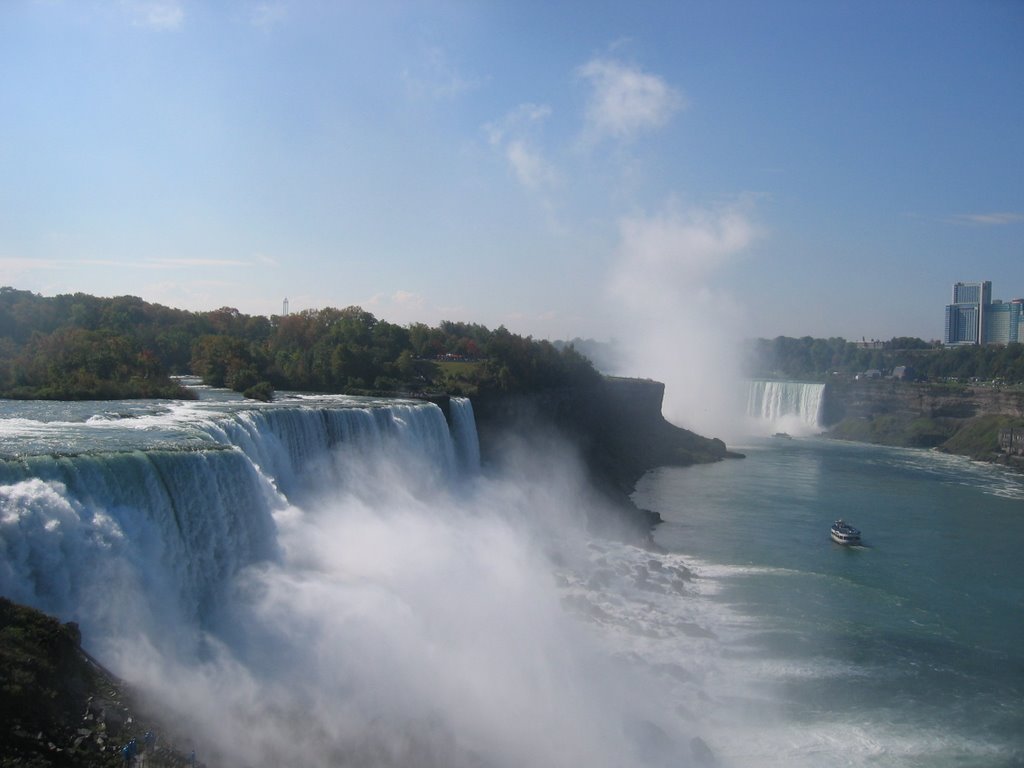

After the MotM, we went up to the observation deck for a good view of the falls. The bridge between US and Canada was on our right and I could see why it was called the "Rainbow Bridge" because there was one just in front of us.

Oh yes, I forgot to add. We met one chap from the Masters in Public Policy (MPP) Prog in the School at Niagara Falls! He was doing a term in Columbia (this is part of the School's exchange programme with Columbia) and he chose to visit Niagara that weekend too. Talk about coincidence.

We left the Falls soon after and went back to Boston. But this trip has truly been the highlight of my US trip thus far. It really brought me face to face with what must be one of the wonders of the natural world. A moment to remember indeed.

See here for more Niagara (and Thousand Island) photos, the Multiply link on the left will bring you to my videos of Niagara (and other videos too).

Monday, October 02, 2006

Niagara Falls


Just came back from Niagara Falls. This has to be the highlight of my US stay thus far. I will write a more detailed post later on, but this is to introduce my new Multiply website, where I have posted some videos of the visit. The website has also been added to my links on the left.

Starting the Day Right...

Related Posts Plugin for WordPress, Blogger...