
Showing posts with label shrine. Show all posts

Sunday, November 18, 2018

Saints Extraordinaire


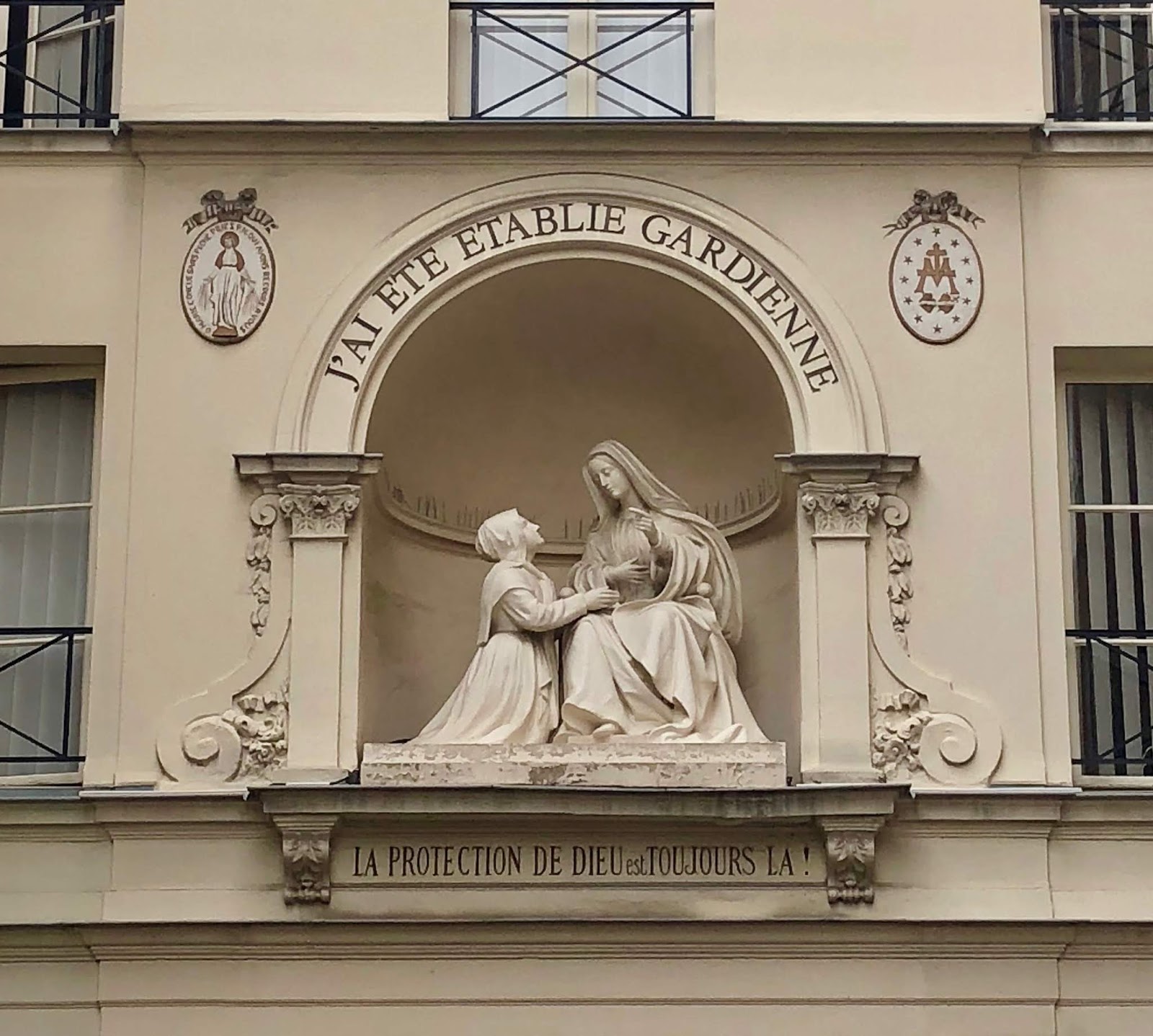
St Catherine praying at the feet of Mary
In a little corner of the left bank of Paris, just behind the trendy St Germain area, is "Religious Orders HQ".  We came here to visit the Chapel of the Miraculous Medal, but found also the motherhouse of the Mission Etrangers de Paris (MEP), and the Espace Nicholas Barre of the "Souers de L'Enfant Jesus"!  Without them, my life would indeed not have been the same!

The visit to the Chapel was one of the more significant stops on our mini-pilgrimage.  Hidden behind an insignificant little entrance way on the Rue du Bac, this is the original quarters of the Sisters of Charity (also called the Daughters of Charity), co-founded by St Vincent de Paul and St Louise Marillac.  It was here that the Virgin Mary appeared to St Catherine Laboure, then merely a novice of the order.  A detailed account of Catherine's story is here, but I shall give a short summary: Catherine had a vision of Mary, seated on a chair.  Mary asked her to have a medal made, with the image of Mary with beams of lights emitting from her hands on one side, and with the Sacred Hearts of Mary and Jesus on the other.  Around the person of Mary, the words, "O Mary, conceived without sin, pray for us who have recourse to thee". Thus, the medal is more properly known as the "Medal of the Immaculate Conception", and confers graces and blessings on the wearer.  Catherine had the medal made but her identity and role in its making was kept secret for most of her life.  She was subsequently canonised as a saint.

The Chapel at Rue de Bac
The Chapel of the Miraculous Medal itself is a shrine containing the perfectly preserved bodies of St Catherine Laboure and St Louise Marillac.  It also holds a reliquary containing the undecayed heart of St Vincent de Paul, which had been removed earlier from his then undecayed body.  Unfortunately, the body of this great saint subsequently decayed after being affected by a flood.   We visited his shrine later on, just around the corner.

Anyway, we had timed our visit to the chapel in good time to attend the morning mass, but it was quite crowded what with all the groups of pilgrims coming from all over and seats were in short supply.  So we had to split up. But we were fortunate, for others could not even get a seat! I took some time to admire the chapel - it is truly a little jewel, with lovely mosaics covering the arch above the altar, and on the side chapels.  On the left of the altar is St Joseph, bearing the Christ child, and on the right, Mary holds a globe in her hands.

It was a powerful experience being there for mass and even after, as the pilgrims stayed back for quite some time after mass ended, to venerate the saints and to pray at the foot of the altar.  Thereafter, we went to the little shop and bought lots of medals and got them blessed by one of the priests who said mass.

We went next to the Shrine of St Vincent de Paul, just around the corner. It was behind yet another nondescript door but what splendour awaited us on the other side!
.
Magnificent shrine of St Vincent de Paul
The shrine is richly decorated, with an ornate ceiling and pillars along the sides.  The bones of St Vincent, covered in wax to create a wax model, are in a transparent case above the altar, and apparently you can get nearer if you go up a staircase behind the altar.  Well, we did not know it at the time and so did not go up...

Two other, lesser known saints lie along the side aisles of the church - St Jean-Gabriel Perboyre and St Francois-Regis Clet, both martyred in China.  More of their background is told in this article.  These two martyrs are priests of the order of the Congregation of the Mission (CM), which is a missionary order set up by St Vincent de Paul (again).  They are also called Vincentians, or Lazarists.  The main church is this shrine of St Vincent de Paul and hence this is where the other two saints were laid to rest.  Interestingly, the one society St Vincent did not found is the Society of St Vincent de Paul!  It was in fact set up as a lay society by a French lawyer, Blessed Frederic Ozanam, who was inspired by St Vincent to do this work for the poor.

After the visit to the shrine, we went back to Rue du Bac to have lunch at La Grande Epicerie de Paris, the food section of Le Bon Marche, Paris' oldest department store.  We had a simple sandwich there and thereafter made some purchases (mostly goodies for the office) before making our way onward.

The "Meridian Line"
After lunch, we went on to our next stop, the Church of St Sulpice. St Sulpice was born in 570AD (!) and died in 647.  He was the Bishop of Bourges and was greatly concerned with the poor and the sick.  The current church replaced an older one on the same site and was built by the then Parish Priest, Jean-Jacques Olier (1608-1657).  It is the second largest church in Paris, smaller only than the Notre Dame and includes a seminary as well.  There are a number of interesting features about this church, such as its impressive pipe organ, and more unusually, its "gnomon", which is an astronomical device meant to help determine the dates of important church feasts.  The gnomon was featured in the Dan Brown book, "The Da Vinci Code", and called a "Meridian Line".  It was meant to act as a red herring to confuse those who sought the grail... ... but the use, and description of the line in the book were in fact erroneous.  Even so, due to the book's popularity, the number of visitors to the church increased, all looking for this device.  So much so that there was apparently a small notice indicating that a lot of the details about the gnomon in the book were in fact wrong.  I didn't see the notice, but then again I never even realised that the obelisk had anything to do with the Da Vinci code ...

After this visit, we had certainly seen enough churches for the day, so we went to the Cafe de Flores for hot chocolat and tarte au citron.  Then back home to rest.

More photos of the Miraculous Medal here, of the Shrine of St Vincent here and of St Sulpice (from both this and a previous trip) here.

Tuesday, December 20, 2016

Scenic Route: Kibune and Arashiyama

There is so much to see in Kyoto, but a lot of it seems to be temples.... so, in an attempt to insert some variety in our autumn leaves viewing experience, we decided to take in the maple leaves by train, especially after we read about a "maple tree tunnel" on the way to the little village of Kibune which was illuminated at night.  

So we decided to take the train there by day, visit the famous Kibune shrine, and take the train back by night.  Maple tunnel by day AND by night, sounds good right?  Unfortunately, things didn't quite turn out that way.  The train journey was easy enough (check here for the e-guide by the rail company)

But very sadly, our day time journey revealed that many of the autumn leaves had fallen already, so there was not much to see.  And the train zipped by so fast, we could not take many photos.  The night journey back? Well, suffice to say that there was a moment of suspense and excitement when the lights on the train went out, for us to better view the illuminations.  But there was also a collective sigh of disappointment when the leafless (but illuminated) trees appeared.  So much for that!

Up to the shrine
Fortunately, we did have a good visit to Kibune.  Confusingly, the village is called "Kibune" and the shrine sometimes called "Kibune" or "Kifune".  The shrine itself marks the ending point of a journey; a goddess in a yellow boat travelled up the river and stopped here.

River flowing over rocks and leaves
It is quite popular during this period, with many people lining up to pay their respects to the deity, and to pen down their prayers, wet them in the shrine's spring waters (it is dedicated to the water god), and tie them to the nearby stand.  At night, the lanterns lining the stairs leading to the shrine are lit, adding to its mystique.

The rest of the village is tiny - apparently there are expensive restaurants and ryokans here, serving busy city dwellers who want to come away for a lazy and quiet weekend.  In summer, the restaurants serve meals on platforms over the river flowing past the village as it goes down the hill.  At this time of year, there are no more platforms but the river continues to be lit up by charming little lanterns.  We hoped to see autumn leaves but we were just slightly past the peak so most of the leaves had fallen - but they still looked pretty floating in the river, trapped by the rocks!

We had a more successful train ride the next day, on the Sagano Romantic Train from Arashiyama to Kameoka.  The train itself is an old fashioned steam train, with old wooden carriages etc.  The ride took us on the banks of the Hozugawa river gorge, and the autumn colours were beautifully displayed along this scenic route.  Whilst it was perhaps slightly past the peak season, it was still quite a sight to see - when the train first emerged out of the hill side to a view of the river gorge there was another of those collective sighs - but of wonder and excitement this time, not disappointment, as the train hurtled through a gorgeous patchwork hillside, and by a rushing river in the gorge below.  Check out my video:


In theory, we were supposed to take a boat ride back to Arashiyama.  It would be a two-hour ride, back along the same river gorge, in an open boat.  Exposed to the elements.  On a sunny day that would have been fine.  But it was raining, a miserable, incessant and cold drizzle.  We decided that two hours in the rain was not for us.  So we went for lunch at Kameoka (more of this in a subsequent post) and took the normal JR train back to Arashiyama.

The last time I was here in Arashiyama was in spring time, looking at the cherry blossoms, and it was indeed quite a different experience seeing the autumn colours.  And the low lying clouds created a totally different atmosphere, compared to the crisp clear skies of spring.  Autumn is "a season of mists", after all.

The river at Arashiyama
Having been to the sights in Arashiyama the last time (bamboo forest, garden, two Temples) it was quite liberating to decide that we had enough rain for the day and find a nice place for tea.  

And so that's the way our train journeys went.  Neither really turned out as the "perfect" day out from Kyoto, but they each had their own pleasant and memorable moments, and that's all you can really ask from a holiday.

See more photos on Flickr!

Starting the Day Right...

Related Posts Plugin for WordPress, Blogger...