Showing posts with label Chiang Mai. Show all posts

Saturday, May 12, 2012

Doi Inthanon, the tallest mountain in Thailand


I’ve always enjoyed mountain tops and mountain walks. The sense of exhilaration that comes from being “on top of the world”, the clear mountain air, the view of valleys below and distant hills, always thrills and inspires me. This visit to Chiang Mai, we went to the top of the tallest mountain in Thailand, Doi Inthanon, which is to the south of Chiang Mai.


It was about a 2 hour drive to the mountain, and we took the opportunity to chit-chat with our guide, Ata. He told us that he is of the Akha people (one of the hilltribes), near Chiang Rai.  He was sent to the monastery when he was a child, and spent nine years there as a novice monk. Thereafter, he was given a scholarship to study in Bangkok for six years. He’s now back in Chiang Mai, working as a tourist guide to support his family. (He has three younger brothers to help put through school). Ata speaks 5 hilltribe languages, English and (obviously) Thai.  Our driver, Ban, also speaks a little English but was busily focusing on the road.

As we drove along, we passed several fields, and villages, including several rows of plants covered by what looked like a plastic covering.  Ata explained that a number of these were  "Royal Projects", set up by the King of Thailand to help the hill tribes – by giving them access to new agricultural techniques, and introducing new crops.  These included new fruits, such as strawberries and physalis berries, amongst others (I bought some berries at the hill tribe market on the way back to Chiang Mai). Quite clearly, the need to help the tribes people improve their lives is an important cause for Ata.  He told us also about his friend who has set up a coffee business, roasting and preparing coffee for sale. Proceeds go to a foundation to help support the hill tribes.

Ata told us also that the King and Queen of Thailand typically come each year to Chiang Mai and spend some part of the "winter" months in their palace in the vicinity.  The hilltribes in turn respect and revere the Royal Couple.  We saw a few visiting the King’s and Queen’s stupas on the mountain to pay their respects on Songkran. We also met a park ranger during our trek, a Hmong man who was formerly from Yunan in China. He spoke Mandarin, though with a thick accent and apparently he is rusty  from lack of use.

We were happy to be driven right to the top of the mountain, which was not particularly exciting beyond the shrine to King Chulalongkorn’s father-in-law, the 7th King of Chiang Mai (those were the days prior to the unification of Siam and King Chulalongkorn married a princess of Chiang Mai). But then, we  took a walk on the mountain ridge – following the trail as it went up and down the various peaks.
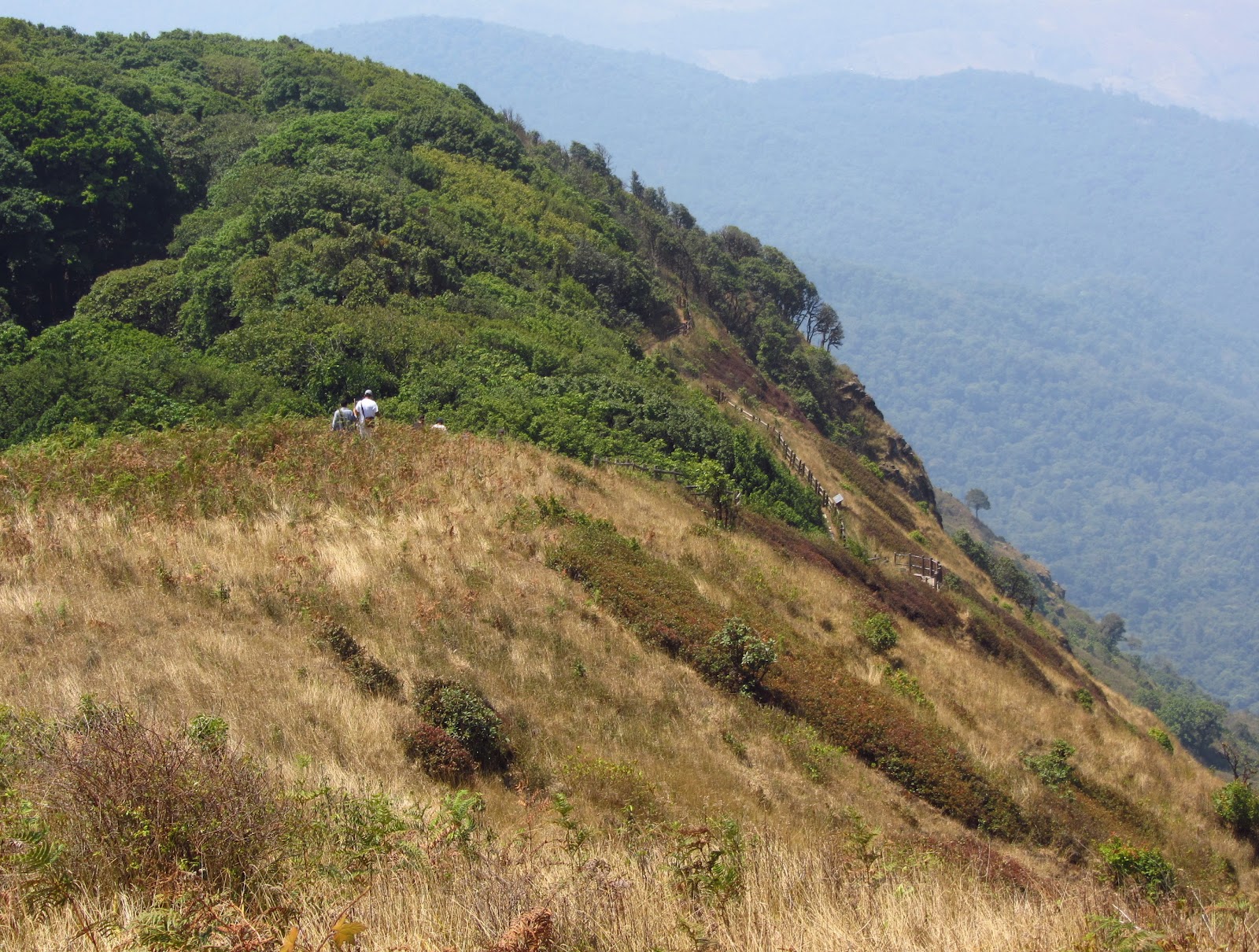

Guided by a park ranger, we  literally got to see two sides of the mountain. On one side, a lush cloud forest, with tall, majestic trees, ferns and flowers. Peaceful and intimate, but filled with the sound of birds and insects, of water falling.

On the other side, the stark savannah grasses of the sub-Alpine meadows, but allowing us to see magnificent views across the whole range of the mountains and down to the valleys below. Each had their own special magic, but both offered very different experiences.

Our guide also pointed out a goral, a mountain goat which lived on the slopes of the mountain range.  We could not see him at all and had to resort to taking photos of rocks, which, when we zoomed in to the photos later, revealed the elusive animal.  Its brown coat with a black stripe indeed camouflaged it from our eyes.  Photo is on my flickr page, if you want a look :-)


“The most beautiful things in the world cannot be seen or even touched. They must be felt with the heart” 
- Panoramic view sign on top of the ridge.

After the walk, we visited the King’s and Queen’s stupa, on the ridge. From there, our guide showed us how far we had walked. We couldn’t believe it! It was indeed pretty far. From the picture below, we started off roughly near the hand on the left of the screen and stopped just before the little house on the right.  Did we really do all that in a little more than 2 hours?


By this time, it was past 2pm and we were rather hungry.  Lunch was at a small restaurant on the side of the road - obviously a tourist lunch spot as we saw many other buses there.  It was one of those simple but tasty Thai meals, and we ate with relish.

We made our way back subsequently - visiting the Wachirathan Waterfall along the way (at least I think it is the Wachirathan based on comparing my photos with photos elsewhere on the web).  I forgot to check the name with Ata :-) There were people everywhere - taking advantage of the Songkran holiday season, making the most of the hot weather.

As ever, check here for more photos!


Saturday, April 28, 2012

Celebrating Songkran

I was in Chiang Mai from 11-15 April 2012, just at the period of the Songkran festival –or, the Thai New Year. This is the time of year when the Thais seek the blessings of Buddha, by pouring water over the Buddha statues. It is also the time of year when the streets of Chiang Mai turn into an all-out water fight!

We spent our first day in Chiang Mai quite  blamelessly, wandering around the night market and taking in the atmosphere in the cool of the evening. The next day, we started off (relatively) early, to visit some wats before the day got too hot. As we visited the wats, we saw the Thais coming to the temple, to seek blessings at this auspicious time. Some offered flowers to the Buddha, was others sought blessings (they put these “blessing flags” into big “stupas of sand” which were in auspicious places in the wat compound).

But as we walked from wat to wat, we noticed increasingly the presence of the water brigades on the streets. These fell largely into two categories: young children, generally stationed outside their homes; and tourists, who went prowling around looking for potential victims. We were carrying our umbrellas (against the sun, like typical Asians) but they did double duty to shield us from water attacks as well! And where they did not – well, it was pleasant to have some cool water on a hot day. And it evaporated really quickly, too. But to be fair,  my legs got sprayed at as the combatants tended to respect the "unarmed".

It did not take long, however, for the “Songkran spirit” to affect us more deeply, particularly my dear travelling companion (my cousin). In fact, she startled me considerably by deciding to buy her own Doraemon water gun from one of the street vendors, to join in the fun! Of course, anyone carrying a gun immediately became a major target (far more than people carrying umbrellas) and a guy with dreadlocks gave her a good drenching with his big water-bazooka.

The next day (13 April), however, was when the blessing of the Buddhas took place in earnest. We started the morning with a session at the hotel itself. The hotel’s Buddha statue was placed under their 200-year old Tamarind tree. Flowers and a small holder of the Songkran blessing flags surrounded it. Guests were invited to pour water over the Buddha. There were also a few special guests who sat in chairs by the tree and they too got water poured over their hands, as a blessing.

In the afternoon, the Buddha statues from various wats were then paraded through the city. We stood by the gate, waiting. But we were not alone. The hotel had put two largish tanks of water in front (topped up continuously with a hose). All the hotel guests were there too, really taking part in the water fights with gusto. No tuk-tuk, taxi nor motorbike passed without them letting loose to give the unfortunate driver and  passengers a good drenching. Sometimes, the people on the vehicles (or passers-by) fought back. Many came in trucks which huge tanks of water on board, with a crew of people armed with water guns, pails etc giving as good as they got. Our side had numbers, though, as it seemed that most of the hotel guests were there. There was a little boy amongst the group (don’t think he was a hotel guest just a kid who wanted a good source of water) and he was a particularly active participant. Again, my dear cousin could not resist. Toting her Doraemon gun, she walked behind the front lines. But she only retaliated or took revenge on people who gave her a splash.

Finally, the time arrived and the procession came down the road. The Thai people, including the shopkeepers started appearing on the streets. They too carried cups and little pails, but jasmine flowers had been added to the water, so that the Buddha statues would be bathed in this scented water. Most of the statues were preceded by pretty Thai girls in traditional dress, carrying signs, or men bearing fruit sculptures, or older ladies bearing the fruits of the field. I was at first a little shocked when I saw the Thais pouring water on the procession participants. Then I realised that this was indeed part of the event, as the water was not splashed in their faces (at least not that I saw) but ceremonially poured on their shoulders.

The first Buddha statue was that from Wat Pra Shing, and hence is known as the Pra Shing Buddha. Unlike most of the other Buddha statues, he was pulled along on a golden carriage - people on the roadside often joined in too, at least for a few steps -  and accompanied by two young men. As the statue was so high up, the bystanders had no choice but to fling the water up as high as they could. Typically a few men were standing around the statue, and they would also scoop out the water and ladle it back in the empty cups which were held up to them. Ah…. Indeed, the water would be more “precious” now that it had touched the statue! But the men around the statues were completely soaked through.

We did not time our visit to Chiang Mai with the Songkran period (it was a coincidence). But am indeed glad I did, for it allowed us the opportunity to witness the Thais celebrating one of their major festivals.

I was also glad that we had the opportunity to see more than the water fights, to recognise that this New Year was a period of renewal, of washing away the past year and starting the New Year afresh.

For more photos of Songkran and Chiang Mai, check out my Flickr set.

Postscript: On the morning of 13 April, we heard and saw helicopters in the air, circling overhead. We speculated as to what this could mean. The next day’s newspapers made all clear – Yingluck Shinawatra was back in her hometown of Chiang Mai to celebrate Songkran, giving alms to monks in the morning and taking part in the blessing of the procession in the afternoon (the newspaper reports that she got splashed too!).

Post-postscript: Got really drenched on the way back from church on our last day in Chiang Mai. Of course, this was just before we were going to the airport which meant that we had to have an entire change of clothes (good thing we bought t-shirts at the bazaar the night before).

Starting the Day Right...

Related Posts Plugin for WordPress, Blogger...