Sunday, September 02, 2018

Notre Dame, St Chapelle and Latin Quarter

St Chapelle by Candlelight
Four Seasons
Undoubtedly, the highlight of this second day in Paris was our concert at Sainte-Chapelle. Vivaldi's Four Seasons sung through the chapel.

Sainte Chapelle was built by King Louis IX (later St Louis) to house the Crown of Thorns (at least what was thought to be the crown of thorns).  Completed in 1248 (!), it is a beautiful medieval chapel with tall windows of magnificent stained glass. Whilst there has been some destruction over the years (for example during the French Revolution), apparently two-thirds of the stained glass is original, and the chapel underwent an extensive restoration fairly recently.   It is one of the most difficult attractions to get into in Paris, due to the small size and the length of the queues outside.  So I thought that the best way was to combine the visit with this classical music concert.

Indeed it was a very special experience.  The queues were long, it is true, but needed in any case to get through security and into the chapel.  As the sun was still shining (days are lengthening at the end of May) we still got to see the stained glass lit by the light of the evening sun outside.  The strains of "Air on a G String", followed by the "Four Seasons" filled the chapel as the light slowly faded outside.  But then the exquisite screen, just behind the musicians then took prominence.  It was really an unforgettable evening!
Chapel of the Crown of Thorns

After the concert, we were surprised when the rain started    pouring down when we left.  The day had been so bright and sunny that we were not expecting such strong, gusty winds nor the torrential rain.  It was as though we were experiencing Singapore's own two seasons (tropical heat and thunderstorms) in this one day!

But back to how we spent the day.  We started off at Cathedral of Notre Dame at the Ile de Cite, which I have been to twice during previous visits to Paris. But as always, you find new things to see.  This time, I particularly noticed the chapel devoted to the Crown of Thorns relic (moved over from Sainte-Chapelle during the French Revolution).  I am always rather sceptical as to the authenticity of these relics but one can and should remember the symbolism of the crown of thorns, and the suffering of Christ which he endured on our behalf.

Restored - the Visit of the Magi


The Cathedral itself is undergoing its own slow process of restoration.  The exterior has been largely completed and within, various areas have already been restored.  The screen around the high altar is in progress, so half of it looks a little grubby whilst in the other half, the expressions and features figures in the key biblical scenes have emerged from centuries of dust and grime.

Within Shakespeare & Co
After our visit to Notre Dame, we had lunch across the Seine in the Latin Quarter and from there we last visit to Paris.  This little bookshop is so popular with tourists that it has even managed to start up its own little eatery on the side.  But I like it for the quirky little upper room, with its beautiful view of the towers of Notre Dame, and the resident cat (I didn't spot the cat but I did see the cat bed!).

I bought a book (of course) - David Leibovitz's The Sweet Life in Paris which I had borrowed previously from the library.  I like his irreverent style, his self-deprecating humour, and the yummy recipes sprinkled throughout.  My sister read the book prior to moving to Paris and apparently can relate to the tussles with the French bureaucracy both within government and with the service standards and processes in even the commercial retail establishments.  My mother too ended up reading the book during the rest of our stay.

Christ child meets John the Baptist
We continued to stroll around the Latin Quarter, visiting the church of Saint Severin, famous for its gargoyles, stained glass, and magnificent architecture.  It has also got a majestic pipe organ, so the church is also famous for its sacred music performances.  We were lucky that someone was rehearsing whilst we were there  - click here for my video.  The stained glass is huge - so you can actually see every single detail clearly!  There were more small churches in close proximity to St Severin, but we didn't go visiting them (two in one day is quite enough).

We also walked on the banks of the Seine, itself a UNESCO World Heritage Site.   On Pont Neuf we took in the views over the Seine including the impressive  Conciergerie, a palace turned prison turned Department of Justice.  We ended the day with dinner, and of course the concert at Sainte-Chapelle.

A long but enjoyable day!  More photos here.

The classic view of the Conciergerie  with the tourist boat sailing past

Sunday, August 19, 2018

Living the Expat life in Paris

It has been about ten years since I last went to Paris on holiday!  Some people find it odd that I don't mind revisiting places that I've been to.  I don't find it odd at all!  Big cities have so many things to see and do that you can't see them all on one trip; places change and I and my interests change too.

Anyway, this time round it was very different as my mother and I were visiting my sister and her husband, who are currently working in Paris.  It was an opportunity to experience the life of the expat in Paris.

The Arc de La Defense, from Neuilly-sur-Seine
So first of all, we were not staying in the central Paris area; the Paris planned by Baron Haussman.  We were staying in the prosperous suburb of Neuilly-sur-Seine, in a small one bedroom apartment within 5 minutes' walk from my sister's apartment (rented off AirBnB).

It's also a straight metro ride to the centre of Paris, and to my sister's office in the La Defense area - Paris' business district.  We paid a visit to La Defense, sat beneath the arc, visited the local Decathlon and walked around the towering, modern office blocks in the area.  It's a totally different Paris! There's also residential blocks in this area, but we were glad that my sister had chosen to stay in the quieter, more traditional Neuilly area.

Trompe L'Oeil wall, Neuilly-sur-Seine
Here, the houses are the traditional 6 to 7 floors high.  What was once an old house has now been divided up into apartments (about two per floor) typically with a caretaker staying on the ground floor.  There are typically shops on the ground floor too - a florist, or baker, or butcher.  You enter through a large front door, big enough to drive a car through. As in the old days this would be a carriage, just beyond the entrance there is a smaller yard area where you can find another building which would be the stables.  My sister's apartment is on the sixth floor, with lovely views over the area.  Our apartment was over the stables, with a view of the yard.  But very quiet, with no traffic noises.

We spent our first day in Paris mostly walking around La Defense and here in Neuilly-sur-Seine.  Whilst there are quite a few restaurants in the vicinity, we typically had nice home cooked dinners most nights.  The local supermarkets are just nearby and there's also this frozen food paradise called Picard (the ultimate in quality and convenience).  We bought our bread from the bakery, our other breakfast items and fruit from the either the supermarket or the little shop at the corner, which was open all hours (run by migrants of course).

Eglise de St Pierre
There are also a number of churches in the area - St Peter's, St John the Baptist.  Handy to get to for Sunday mass.  But we didn't go to either!  Instead we went to the English language church in Paris, St Joseph's (apologies, I forgot to take photos here). It is a smaller, intimate and more modern little church with a very diverse and cosmopolitan congregation.  Including of course all the Singaporeans!  So it was that when we went over for Sunday mass, my mum met two people she knew from our parish back in Singapore.  They too had moved over to France...

For the rest of this trip, we would be visiting many, many more churches.  My mother had decided on a "DIY Pilgrimage" and so we had listed down all the major Catholic sites to see in Paris, plus a few others to visit on day trips.  I'll be slowly covering our visit in my next few posts.

In the meantime, check out this France album for all my shots this trip.


Saturday, March 10, 2018

Colours of Impressionism - National Gallery Special Exhibition

Palace of the Popes, by Paul Signac
The National Gallery held a special exhibition, Century of Light from 16 Nov 2017 to 11 March 2018.  It was actually features two exhibitions, Colours of Impressionism: Masterpieces from the Musée d'Orsay and Between Worlds: Raden Saleh and Juan Luna, who hail from Indonesia and Philippines respectively.

Impressionism is one of my favourite periods in art - the use of light, the freshness and the spontaneity of the paintings are what appeals to me most.  So I was indeed very happy to view the beautiful artworks from the Musee d'Orsay which had been specially brought over to Singapore, by artists such as Cezanne, Renoir, Manet, Pissaro, Monet and so on.

As always, it was a fascinating learning journey.  I did not know that actually Impressionism was not just a new approach towards art, but that it was also made possible through newly invented pigments and colours which made it possible to capture the colours of the world so much more vividly than before.  That's why as time went by, the artist's palette itself changed, from more dark colours (and black) to the bright, fresh greens and blues, rosy pinks and glowing yellow which we see in so many paintings of the era.  To further illustrate the point, the exhibition also featured a palette of one of the Impressionist painters (I think it was Renoir) with the little blobs of paint still on it.

I didn't take that many photos (there are so many good photos of the paintings on line, and in any case the photo is a pale shade of the actual artwork).  What I did do was to record paintings which had a special meaning for me.  For example, this painting by Paul Signac, because it is of the Palais des Papes at Avignon, which I had visited a few years back.  I had not really heard of Signac before but he was a painter of the Pointilism school (made famous by Georges Seurat) where each painting is composed of carefully placed dots, or points!  Indeed, the whole is more than the sum of its parts.  Just like the painting is so much nicer than any of the photos I took of the Palace.

Family of J.C. Baud by Raden Saleh
Whilst the d'Orsay paintings showcased the famous artists of the day, what I really appreciated about the National Gallery is that they also try to remind us visitors that we should be proud of our own painters from this part of the world.  Hence, the second exhibition on the works of two South East Asian painters who had in their own different ways also achieved international standing.

Detail from "House of the Resident of Banyuwangi, East Java"
by Antoine Auguste Joseph Payen
The first was Indonesian painter Raden Saleh. Born in 1811, Raden's talent was first nurtured by Belgian painter Antoine Auguste Joseph Renoir who was working for the Dutch colonial administration.  Thereafter, Raden went to Europe to further his training.  He painted quite a few portraits, including this charming family scene (J C Baud was a friend and mentor), but also was well known for his paintings of tigers and other wild animals (there was quite a disturbing painting of a tiger just waiting to pounce on two innocent travellers, and yet another one of a hunting scene with the poor tiger as the victim).  He returned to Indonesia in his later years. 

Besides paintings by Raden Saleh, this segment of the exhibition also featured some paintings by his teacher, Antoine Payen.  I find it amusing that this picture of an Indonesian scene was done by a European whilst the picture of the European family was done by an Indonesian!  I suppose however both were done through a European lens.

La Mestiza, by Juan Luna
The other artist featured, Juan Luna was a Filipino painter and activist.  He too would travel to Europe to study painting and in fact, ended up winning an award at a Spanish art exposition, the National Demonstration of Fine Arts, for his painting, "The Death of Cleopatra".  However, tragedy struck in later life when he murdered his wife and mother-in-law in a fit of jealousy.  He was arrested but eventually was acquitted of murder on grounds of temporary insanity.  

All in all, it was an engrossing weekday afternoon, spent "Between Two Worlds" of European and South East Asian painters and subjects.  For a much better review, read the Straits Times article here.  More of my photos of the paintings here.

Saturday, February 10, 2018

Tokyo Neighbourhoods: Meiji Shrine and Yoyogi Park

For almost three centuries, the Tokugawa shogunate founded by Ieyasu Tokugawa ruled Japan whilst the Emperor was marginalised.  This changed in the mid-19th Century when the last Shogun lost the support of the feudal lords and resigned.  The Emperor took charge again.  Recognising that Japan had slipped behind the western powers, he opened up Japan to foreign trade, technology and know-how.  It was he who presided over the industrialisation of Japan, and the renaming of "Edo" as "Tokyo".  The Meiji shrine was erected in memory of the Emperor and his Empress and is meant to "enshrine" their spirits.

Bonsai
Today, the shrine remains very much a key centre of Japanese religious life.  Indeed, when we were there we saw no less than four separate activities taking place at the shrine!


First, there was a chrysanthemum exhibition, featuring also bonsai bonsai plants.  The Chrysanthemum is always associated with the Imperial Family - a specific variety is the Imperial flower, and the Emperor sits upon the Chrysanthemum throne.  So it was most appropriate that there was yet another chrysanthemum exhibition to visit here.  In addition, there was also a selection of bonsai plants to be admired.  Personally I much preferred the bonsai exhibitions as the miniature landscapes displayed far more Creative flair and imagination compared to just viewing gigantic chrysanthemum flowers.

Sake from distilleries throughout Japan
Second, to commemorate the Meiji Emperor’s birthday on 3 Nov,  every year, major producers send a special gift of their best produce to his shrine, in hopes of continuing future prosperity. This is displayed in a small corner of the shrine area (I presume there are more but they select only a portion to display).  I was quite impressed by the number of sake bottles on show!  Of course there were other products exhibited but none of them made such a convincing display.

Dressed in her best kimono
Third, we saw lots of little boys and girls dressed up in their traditional clothing, looking ever so sweet and cute.  I was wondering what it was - on checking up it is a "shichi-go-san" or "3-5-7" festival, so named because children of these ages are meant to visit the shrine as part of their "growing up" rituals.  Accompanied by their parents and sometimes their grandparents, the children
walk into the shrine, to get a blessing - a candy representing longevity and health.  The families don't need to go to the Meiji shrine in particular - any shrine will do.  Technically the festival is on Nov 15 (3+5+7) but families do go to the shrine even a few weeks beforehand, presumably to beat the crowds.  All dressed up in their best clothing, the children looked as they were having a good time, getting their photos taken, playing with their balloons etc etc.  I'm afraid to say that we did go around "stalking" the especially cute ones, to take their photo!

Fourth, we saw a wedding procession!  Not entirely unexpected, as I had read earlier that the shrine is a preferred location for couples to solemnise their weddings.  So we came to the shrine hoping to see a wedding.  This, to be honest, was my highlight of the day.  Earlier on,  I had seen the Shinto priests just outside the main courtyard of the shrine talking to two women who must have been the mothers of the bride and groom.  Then, as I was busily trying to catch a photo of a cute kimono-clad kiddie, the bridal procession marched in.  Dressed in traditional clothing, the bride and groom walk in behind the priests, accompanied by their entourage.  Everyone looks quite stern and serious.  They walk into the shrine, ignoring the gaping tourists around them.  After a few minutes (presumably after the appropriate rituals are completed) they return to the courtyard.  Just before the exit, the Shinto priests stop, exchange bows with the couple before making their way out.

To me, the Meiji shrine visit really gave me an insight into the spiritual heartbeat of Japan.  It is a "working shrine", one where the spirit of the great Emperor Meiji continues to be venerated and thanked for helping to bring about modern Japan.

We went for lunch thereafter (at Heiroku Sushi) but made our way back to walk around Yoyogi Park. It's one of the restful green lungs of this busy city - where Tokyo residents spend time with family and friends in the peaceful environment of the park.  An elderly bunch of Elvis imitators were gyrating near the entrance, and we walked past a group of men playing frisbee, girls chatting under a tree, a poodle club (and owners) meeting and so on.  We reached a little lake in the middle of the park where the trees around were just beginning to show their autumn colours.  It was a lovely end to the day.
Autumn colours in Yoyogi Park

I've been visiting Japan every year from 2014 to 2017 and with each visit here, I am slowly learning more about the rich and distinct Japanese culture, history and society.  This is a society which appreciates beauty and nature, believes in the pursuit of perfection, and filled with an ancient pride and spirituality which makes it distinct from all others.  Can't wait to see what my 2018 visit has in store!

In the meantime, all photos from this Tokyo trip here.

Saturday, February 03, 2018

Tokyo Neighbourhoods: Ginza and Tsukiji Market


Tsukiji Market
 If you have not visited Tsukiji market, you have not visited Tokyo.  Due to the problems found on the site of the “new” Tsukiji market, this famous fish wholesale mart had not yet shifted at the time of our visit, so we decided to take a trip and see the old market before it was torn down. The other reason is of course that we went to find the freshest, yummiest sashimi to tuck into.

Now if you read all the websites, they give you lots of advice on how to get there - the need to get there at the truly unearthly hour of 3am in the morning, bring warm clothing because it is pretty cold in the market etc etc.

Within the inner market
None of this was relevant to us as we were not so fanatical as to make the 3am trip to the market.  Insteadwe went there after the wholesale market is opened to visitors, after 10am.  The area itself is a cavernous place, and at this point in time it had mostly emptied out, with the remaining stallholders mostly just cleaning the place up.  But I could see why there was a need to redevelop - shops cramped together; the floor was uneven and the lighting dim.   Big styrofoam boxes line the narrow lanes between the stalls and every now and then we have to get out of the way as a little electric vehicle transports yet another load of boxes out of the market.

We walked around the stalls but quickly returned to the outer market.  It was still in operation - here is where tourists can buy themselves some yummy seafood, which is what we did.  But it was a bit late so we did not have much to choose from.  I have to admit that I had a much better food experience my previous visit to Tsukiji, with my Japanese-speaking colleague.  We had our fill then of Uni, grilled shellfish, prawn sashimi, all washed down with some crab soup.

Outer market - selling tuna
Nonetheless, it was still quite interesting to walk around the small buildings and shops.  One stall was selling freshly cut tuna, from a gigantic fish - half of it had already been cut and sold.  I wondered how long this gigantic fish had been swimming around in the ocean, until some fishing boat had hauled it in and brought it here for sale.  I don't think I am going to stop eating tuna but somehow the sight of the fish reminded me that we should also not eat to excess, and neither should we waste.  Anyway, I bought my lunchtime sushi from another stall.

Famous Wako building
After eating our sushi, we walked over to Ginza.  Technically this should have been in the “shopping neighbourhoods” post but then it would have been a really long post.  Ginza is the most exclusive shopping district in Japan.  You can read all about what to see and do in Ginza here.

The famous 4-chome intersection in Ginza is in fact where all the famous stores are - Wako, Mitsukoshi, Ginza Place (where the Nissan car gallery is) etc.  We went to Mitsukoshi, where we were delighted to find a quiet and restful oasis  - Mitsukoshi has a whole floor worth of space to rest, have a meal or cup of tea whilst looking at the roof tops of the surrounding buildings.

From here, we could see Mikimoto pearls - where Melania Trump had visited just two days earlier.  Ah yes, we visited Tokyo the same time as Donald Trump..... probably that also accounted for the helicopters flying around overhead too.

Ginza Place - opposite Wako
We didn't buy anything from Mitsukoshi, although we did wander around the store and visited its Food Hall in the basement (great temptation, but I did not succumb).

But we did manage some purchases at Uniqlo!  The Ginza Uniqlo is Uniqlo's flagship store - it is the largest in Japan with its 12 floors.  However, much of the merchandise was repeated across floors so I was not as bowled over by the selection as I had hoped to be.  Also, because it was selling more wintry clothing, my choices were further limited.  But, since there were some quite sweet baby clothes, I got some for my cousins who just gave birth.

I would not say that I’m a Ginza shopper - I immensely preferred the buzz around Shibuya, for example and the more affordable range and variety around Shinjuku station.  But I’m happy to come here just for a short visit, to complete my Tokyo shopping experience.


Sunday, January 28, 2018

Tokyo Neighbourhoods: Shibuya, Harajuku and Ometesando

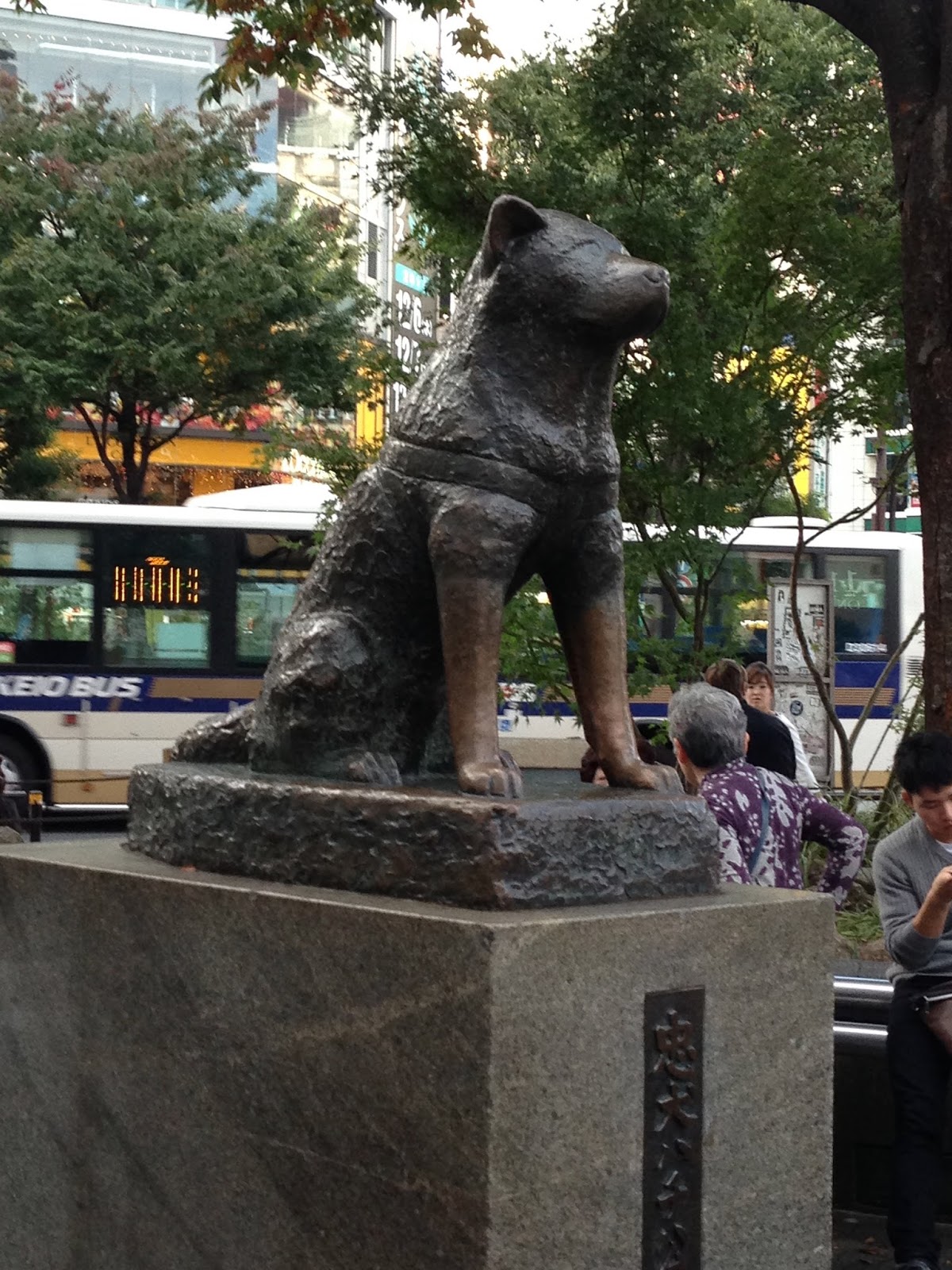
Hachiko the Faithful Dog
It is said that each Japanese shopping district has its own distinct clientele and its own vibe.  Where Shinjuku is the province of the salaryman, or the government official going to the staid Isetan and Takashimaya departmental stores, Shibuya is where the fashionable youth congregate and Harajuku the quirky kawaii side of Japan.  Then there is upmarket Ometesando, with its expensive boutiques (and Apple store).

Well, I am pleased to say that we spent an appreciable time in all.  I wrote about Shinjuku in this earlier post so I’ll talk about the rest here.  Shibuya is of course known for the most famous traffic junction in Tokyo, Shibuya Crossing.  This is a “scramble crossing”, in other words, the traffic stops completely and pedestrians take over, crossing to the exact side of the road which they want to go to. It is apparently one of the busiest traffic junctions in the world!  We emerged at the “Hachiko” exit of Shibuya station - as everyone knows, Hachiko is the loyal dog who waited for its owner to come back at the station exit every day before they walked home together.  Alas, one day, his owner had a heart attack and died before coming home.  But the loyal pooch continued to wait for him, just the same until he too passed away.  His statue now stands in the spot where he used to wait.

Incidentally, another famous icon of Japan is just by the Hachiko statue - Hello Kitty is the decor theme of the Tokyo Tourist Info Bus!

Scramble Crossing, from the L'Occitane Cafe
Many guidebooks mention also the Starbucks at one junction, as the place to watch people scrambling across the road.  But of course we didn’t go there - we went instead to L’Occitane which was on another corner and has a rather nice cafe on the second floor, with a good view of the crossing too.  (Of course the main L’Occitane store with all its products is on the first floor.). Unfortunately the tables by the window were taken but we still managed to get quite a good view of the crossing.  The cafe itself is a little pricy but I think I would rather have sat here and eaten our dessert medley with a taster of four desserts altogether and a cup of tea each, than gone and queued up at the Starbucks for a pricey cup of coffee.

After tea, we went shopping - there’s a lot of shops catering to a younger crowd here, but we didn’t go to them.  Instead, we went to Tokyu Hands and Loft.  My favourite stationery shops in Japan and maybe the whole world!!!  Topped up my collection of washi tape, and bought some accessories for my handphone.  I still have not used up all the post-its I bought the last time.

Our beef on a grill
We ended the day with dinner at Aburi Shibuya Honten, a little grill restaurant on the fourth floor of one of the little buildings, just near Tokyu Hands.  Not easy to spot, but we were glad we did!  The restaurant has maybe six tables, and we got the second last one (the last one was filled up whilst we were there).  Service is fast, the meat is very tender, succulent and flavourful.  Just goes to show that in Japan you don't need to go to the much reviewed places - just try something a little unexpected and you'll find that it's pretty good!

On Takeshita-Dori
The next day being Sunday, we went to church at Roppongi (St Francis, English masses!) and then went down to Harajuku.  We were looking for kawaii gals and punk guys, but we just got loads and loads of tourists :-(  Tokyo Cheap gives a great list of things to do in Harajuku and indeed I did make it to places like the Meiji Shrine, and Yoyogi Park (which I will talk about in a future post).  But for the youth scene, the place to go to is apparently Takeshita-Dori, so that's where we went.  Indeed, the shops are most interesting - check out the exciting costumes sold at Takenoko - you also get shops selling high platform shoes, lingerie, fairy clothing etc.  But not that many people actually going the whole hog.  But maybe it's all just gotten too cliched to go down the street dressed Harajuku-style.  There is also a big Daiso - and that's where we spent a little time.  100 Yen is less than S$2 after all!  And of course, lots of sweet things - cotton candy, and crepes galore!  We went to Marion Crepes where we had savoury crepes (it was lunch time, after all).

From Takeshita Dori, we walked to the Ometesando area.  Just before that, we found Laforet, the departmental store for Lolita wannabes... we went in trying to find some Lolitas but again, not much luck. But it is still worth paying a visit, just to look at all the merchandise.

The Ometesando area is where all the more high-end shops are - again we didn’t really go to these.  But there are also children’s shops, and small quaint little boutiques of all shapes and sizes. Just off the main road is Cat Street, which I initially had high expectations of but sadly, it was really just the street name.  It is a small pedestrianised road which (again) has lots of charming, quaint little boutiques selling Knick-knacks and the like.  Expensive ones, of course.

What with all this walking, it was time for a cup of tea.  We had read on-line about  Q-Pot, which actually makes jewellery items (pendants, rings, earrings etc) which look like chocolates, biscuits and sweet things generally.  So Q-Pot cafe is where they serve the desserts looking like jewellery.  If you want a kawaii cafe, look no further! The table decor comprises towers of macaroons and where the lamps are jugs hanging upside down from the ceiling. The "necklace" plates display a lady wearing a Victorian/Edwardian era dress and the piece of cake is displayed like a necklace hanging around her neck.

Food itself was generally ok - I liked my "Russian Apricot Tea", served with apricot jam instead of sugar.  I had the BisQuit Tiramisu on my necklace plate which was enjoyable, but not exceptional.  You go for the experience, if you want to see the kawaii side of Tokyo.

I have to confess that after taking tea we were a little tired with all the walking and went back to the apartment.  But the next day, we did come back to this area because we wanted to try out the sushi at Heiroku Sushi, which we had walked past on our search for Q-pot Cafe.  Heiroku is supposed to be one of those well-known sushi bars where all the tourists go to, etc.  And yes, we did have to queue, but fortunately it was not peak period so the wait was relatively short (and in any case it was good to take a little rest from all our walking).  I have to say that it did not “wow” me as much as I would have expected and the plates coming out were all the high-end, expensive stuff.  So you have to order the cheaper items! (I thought that it should be a better mix).  But I suppose if you come to this area to shop, you would go for more high-end stuff :-)


More photos of everything on Flickr, here.  In brief, if you want to go shopping, these shopping districts of Tokyo can satisfy all your needs and then some.  But even for non-shoppers, these are interesting places to visit to do a bit of people-watching and just feel the vibe of this modern, exciting metropolis. 

Saturday, January 06, 2018

Mount Fuji: The Icon of Japan


Fuji-San
If there was one thing on my bucket list I wanted to fulfil this year, it was to visit Mt Fuji.  Fuji-san, as it is commonly called, is a mythical, mystical mountain for the Japanese.  At 3,776m above sea level, this is Japan's highest mountain.  Its symmetrical cone, formed by volcano action, rises above the surrounding plains and dominates the landscape for miles around.  After coming to Japan every year for the past three years, it was about time to meet Fuji-San.

There are many spots from which you can view Mt Fuji, and many scenic places around the mountain itself to visit.  For our visit, we decided upon a day tour from Tokyo, since it seemed the most convenient (although I have to say that I would love to visit again, and spend a night or two at the Fuji Five Lakes area).  It is also nice to have someone taking care of things!  Unlike the previous tour to Nikko, we had an older Japanese lady who was clearly a more experienced guide than the other two as she could offer more information and background in general, eg on how the mountain was formed, and about Japanese lifestyles.  She was also quite firm and reminded us to be punctual at every point in the journey.  

Our very first stop on the tour was the 5th station of Mt Fuji!  It was truly quite exciting and exhilarating, as we were actually ON Mt Fuji itself and had a lovely clear view of the peak and the surrounding countryside.  The weather was beautiful - brilliant blue sky, almost glaring sunshine, and a refreshing wind blowing.  We were about 1,600 m above sea level, not even halfway up the mountain, but it was cold, with that crisp chill in the air which makes you feel energised and alert despite the cold.  At this point, the vegetation starts to fail so when you look up, you can see the volcanic rock of the mountain rising above you to the top of the peak, interrupted here and there with streaks of white - I assume these are springs off water falling down from the mountain.

Above all, I was so glad that we had such a great view of the peak.  We were checking when the best time was to get a clear view (find out more here)  and it was wonderful that it all went according to plan.  Or at least, almost to plan as I was hoping that the snow cap would be there.  I had read earlier that Mt Fuji had experienced its first snowfall of the year just one week before our arrival.  Sadly, because of the warm winds brought in by the tropical storm, the snow cap had melted by the time we got there.  Which means that another visit is definitely in order!

Wakuike Pond, Oshino Hakkai 
Kagamiike Pond - can u see Mt Fuji reflected?
After the stop at the 5th Station we went to visit a charming little village called “Oshino Hakkai”.  Mt Fuji had shaped the landscape in the area in many ways, including creating the 8 ponds in this area, spring fed from Mt Fuji.

The crystal clear waters reflect the blue of the sky, the trees, and in some of them... even a mountain.  After some trying, I managed to get a shot of Mt Fuji reflected in one of the ponds! (Tip: look hard!)

We went off to our next stop, eating our bento lunch along the way.  I have to say that I preferred the nice hot food on the previous tour.  We were also enlivened by the conversation of our fellow tour participants.   The thing about day tours is that you also meet lots of people - we met a fellow Singaporean (of course) and hooked up with her for photo taking etc.  There was a Malaysian family, a Chinese-Australian lady, and a few Americans - one of whom was quite chatty. It truly amazes me how some people can talk about themselves and their lives to chance-met strangers - sharing it theoretically with one person, but in practice at a volume which allows the entire bus to hear all the details!

The secret valley to the Shiraito Falls
Anyway, after a rather noisy interlude, we arrived at the Shiraito Falls, the next stop on our tour and one of the most beautiful waterfalls in Japan.  There is another waterfall just next to it as well, Otodome Falls, which is much smaller.

The Shiraito Falls are reached after a short walk along the side of a gorge.  We walked down the gorge, turned a corner and there, in this long deep valley was a shining waterfall right at the end.  But the waterfall was not just that single stream of plummeting water. As you walk along, you realise that there are a thousand silver streams of water flowing down the side of the valley, joining the little stream beneath.  

Our last stop of the day was the Fujisan Hongu Sengen Shrine - the shrine devoted to the “Goddess of Mt Fuji”, Konohana. Apparently, Konohana is the flower-princess and her older Sister, Iwa-naga, the rock princess.  Because Konohana’s Husband chose her over her older Sister, human life ended up being as fleeting as a cherry blossom and not eternal, like stone.  Our guide made an offering to the Goddess on our behalf and we proceeded to walk around the shrine compound.  Similar to the Oshino Hakkai area, there is another pond which is again fed by a mountain spring from Mt Fuji.  

 Fujisan Hongu Sengen Shrine
After our long day, our bus turned back to Tokyo and dropped us off at Shinjuku station.  We were given some discount vouchers for the Keiō department store - we went there really because we had some discount vouchers from the tour company which we didn’t use in the end. But, at the stationery section of the store, we found a calendar with a lovely woodcut pictures including the Great Wave by Hokusai!   So indeed, all our activities today were associated with Mt Fuji!  I can’t wait to make a second visit....

More photos of this day can be found on my Flickr page.


Starting the Day Right...

Related Posts Plugin for WordPress, Blogger...